


How To Enlarge Holiday Snapshots. Part 2
Description
This section is from "Every Woman's Encyclopaedia". Also available from Amazon: Every Woman's Encyclopaedia.
How To Enlarge Holiday Snapshots. Part 2
Place the table about a yard back from the window, with the easel standing upon it, just opposite the camera-lens, and stand a sheet of cardboard upon it at just such a slant as will equalise the tilt given to the camera back by the cotton-reels. If no easel is obtainable the cardboard may be tilted up against a strong wooden box or pile of heavy books arranged on the table as a support.
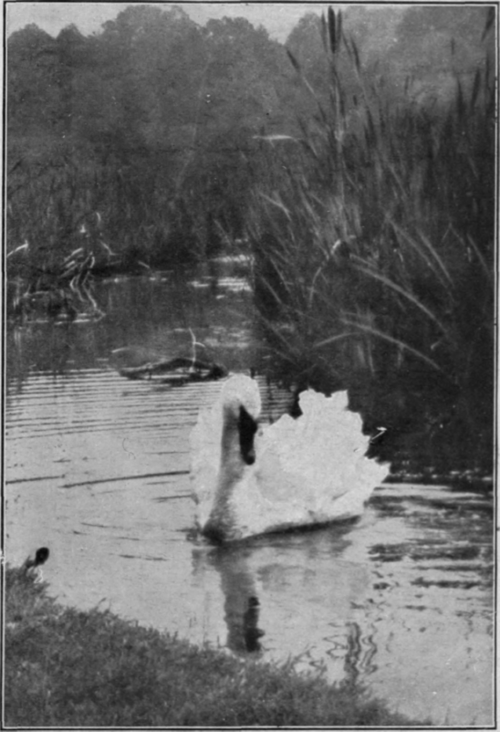
The swan from the preceding photograph enlarged to form a complete picture
If the brown paper corner is fastened up, and the ruby lantern turned to the wall, and the lens uncapped, an enlarged image of the negative will be thrown on the sheet of cardboard. Get it to the size you require by moving the easel nearer or farther away, and then focus it carefully to get the detail as sharp as possible, and put in a medium-sized stop.
It seldom happens that a negative is good enough to enlarge in its entirety. More often it is desired to enlarge a part only, and in order to do this as economically as possible mark the part to be enlarged with a pencil upon the cardboard, and, having re-capped the lens and brought forward the lantern, choose a sheet of bromide paper to fit the part marked on the cardboard as nearly as possible, and, without moving the cardboard or easel, carefully pin the sheet of sensitised paper to the print in the required spot with the help of four or five drawing-pins. Uncap the lens and make the exposure, replace the cap, and the enlargement is made.
In order to decide what exposure to give it is a good plan to have several strips of bromide paper at hand, and pinning them successively over the most important feature of the enlargement, give each strip a different exposure - the first strip five seconds, the second strip ten, the third fifteen, and the fourth twenty seconds' exposure, for instance. Number each one in pencil, and then develop them; it is easy to see which exposure is correct, and this important point determined, a set of a dozen enlargements may be made one after another,
Some Suggestions
It is a good plan to lay several different sized packets of bromide paper in stock to choose from, according to the size of the enlargement which is to be made. It is best, as a rule, to keep enlargements on the small side - a child's head covering a square inch on the negative, if enlarged up to three or. four times the original size and mounted on to a rather large mount, will give a charmingly soft artistic result, but the same head enlarged to eight or nine times its original size will probably make a very dull picture.
In order to make a successful enlargement a negative must be absolutely in focus, for the slightest blur is emphasised tenfold in the larger picture.
Avoid enlarging very fiat, thin negatives, for the results are sure to be disappointing, All under-exposed negatives with violently contrasted light and shade are also unsatisfactory, the enlargement serving to emphasise the over-strong contrasts and lack of detail.
The ideal negative for enlarging purposes is one which has been developed with pyro soda, with a pleasant contrast of light and shade, and good detail in the shadows. A somewhat over-exposed negative which has been slightly intensified often gives very artistic results when enlarged.
The success of an enlargement may sometimes be still farther enhanced by a little skilful retouching.
For this, grated French charcoal and a few finely pointed stumps will be required. A touch or two given to the eyelashes and hair of a portrait head, or to the rigging of a ship in a seascape, will often be a great improvement, but care must be taken not to overdo it, especially in a picture intended for exhibition purposes, for retouching is by no means popular with the majority of judges.
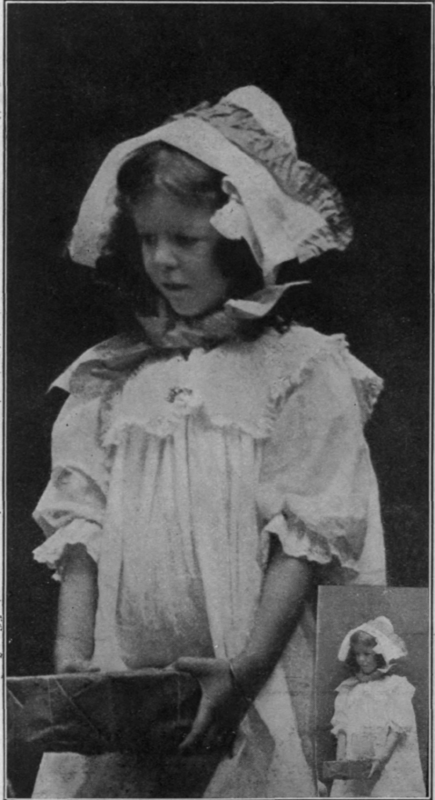
A child study, showing the value of successful enlargement
A practical use can be made of enlarged photographs by anyone who will take the trouble to acquire the art with a high degree of skill. Those who are ever on the look-out for some means of adding to an income which barely suffices for the many calls made upon it, will find a remunerative hobby in enlarging pictures of their own taking, or the results of their friends' cameras.
Many a modest nest-egg has been made by photography amongst a circle of acquaintances. It is merely necessary to do the work as well as a professional, charge a moderate fee for the same, and be sure to keep to time in the matter of delivery. This last point is a frequent fault of amateurs and often loses good custom, because it is impossible to obtain the goods when promised, and people shirk the disagreeable task of finding fault with or harassing a friend, or the friend of a friend.

By Joseph Coyne
Men have attained fame in many and diverse fashions. To Mr. Joseph Coyne, so far as the British public is concerned, the pinnacle of dramatic success has been gained by dancing. For over two years this American actor, as Prince Danilo, in "The Merry Widow," entranced countless audiences, not merely by his finished acting, but also by his wonderful dancing in the far-famed waltz of the play. Of dancing, in its many aspects and forms, there-fore, Mr. Coyne can indeed speak with authority. He knows all there is about it. And in this most interesting and characteristically expressed article, specially written for "Every Woman's Encyclopaedia," other devotees of the art can find arguments with which to confront those who are not as yet true lovers of dancing.
Continue to:


My Books

