


How To Enlarge Holiday Snapshots. Part 3
Description
This section is from "Every Woman's Encyclopaedia". Also available from Amazon: Every Woman's Encyclopaedia.
How To Enlarge Holiday Snapshots. Part 3
Do I like dancing? Well - yes. It seems to me one of the best things in this best of good worlds. There's nothing like it for the nerves, the temper, and the liver. It keeps you fit; it keeps you healthy; and it keeps you happy.
Look at the ripe ages most celebrated dancers have attained. And look at the tremendous joie de vivre - excuse my French - which carries dancers through life at a whirlwind pace that exhilarates themselves, and every soul with whom they come in contact.
A Joyous Art
Happiness is the greatest thing in life; and dancing assuredly brings happiness. That's why I love it. The mere joy of flipping one's toes around, waving one's arms, and nodding one's head drives melancholy straight out of the nearest window. It is not possible to dance and be unhappy. I defy the biggest misanthrope and pessimist on earth to whirl through a step dance or Scotch reel and not emerge with a smile on his face. It simply can't be done.
Personally, I can't remember a time when I did not dance; all day, and every day, for choice. I've done a great many things in the course of my career, but I think dancing comes first, because it began earliest, and is going strong to this very hour, so far as I am concerned. When I was a small boy with elongated legs, way back in that city of skyscrapers and icecream soda, New York, I was the leader of a chosen gang of kindred enthusiasts, terp-sichorean experts all!
Those were glorious days. I can see myself now, with a select following of my choicest adherents in crime, dancing our feet into huge blisters to the wheezy melodies yielded up by an antiquated barrel-organ. I was always at it in those days - dance, dance, dance, from early morn till dewy eve. I would rather dance than eat in those days, and I'm not sure that I don't feel the same way now. When cents were as scarce as strawberries in January, in those New York days, I often spent my money on a gallery seat to watch some good dancing, in preference to buying candies or "pie."
Our greatest delight was to go to some big hall or theatre, see a good dance, and then - hey presto! - off we'd rush to a backyard; and there, among dustbins, clotheslines, cats, empty tins, and other impedimenta, we would dance the things we had just seen, step by step, dance by dance. And I don't think we were often wrong. That was the way I learned dancing - for have never had a dancing lesson in my life, except the ones I gave myself with the aid of my eyes and a pair of feet. By watching the best dancing in America and other countries, I have learned all I know, perfecting it with much practice. So, if I am considered anything of a good dancer, I am a living example of what can be done by watching and copying in this delightful art. My Early Lessons
"Step" dancing has always delighted me, and I picked up real sand dancing and buck dancing by watching niggers on plantations down in Virginia. The Southern States are the places to see good dancing. What we get over here on the stage is a very pallid imitation, as a rule. For hours on end I have watched niggers doing their characteristic "buck" dancing - shuffle, shuffle backwards and forwards, with queer, flat-footed movements. In Colorado the Indians do fascinating dances, too; the steps are insignificant, but the weird sounds they make and their original positions are intensely interesting.
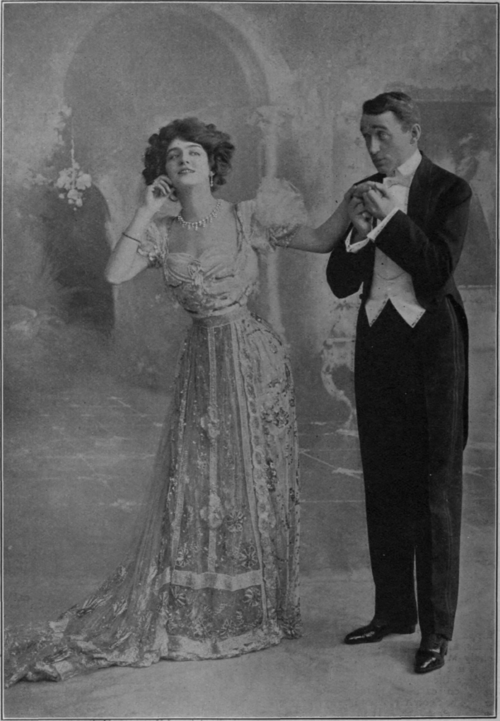
Miss Lily Elsie and Mr. Joseph Coyne, who danced the world-famous waltz of "The Merry Widow." Mr. Coyne, in addition to being a versatile actor, is one of the most renowned dancers of the day, and in this article he gives unique hints to those who desire to excel in the art
Foulsham & Banfield
Mexicans, too - half-bred Spaniards most of them, a lazy, sun-loving people, who dawdle through the day and dance through the night - are experts at a peculiar, sinuous type of dancing that is highly popular in ballrooms to-day - the Argentine tango, for example, which is more than half Spanish.
But I was really going to talk about waltzing. In England I am associated more closely with waltzing than any other type of dancing, because of the "Merry Widow" waltz. And I love waltzing, too, though I am not prepared to admit that it is absolutely first favourite with me, because "step" dancing runs it very close. But waltzing is certainly adorable; and I should like to say, here and now, that I can't help feeling sorry that real good waltzing is being driven out of ballrooms in this country by a lot of "freak" dances which really belong to the stage, and are not particularly desirable even there. Still, there is one consolation in the fact that these ugly measures are so "extreme" in every way that they will bring about their own ruin; and once they go out of fashion we may get back to the original beauty of the waltz.
In Praise Of Waltzing
There is nothing to beat a real waltz - either from the point of view of audience or performer. The sight of two people waltzing in perfect time and sympathy is a really lovely thing, and I think that is why the "Merry Widow" waltz was so immensely popular. For it was a genuine waltz. Though we started in a novel way, and ended in a position still more novel, during the bulk of the waltz we were doing the genuine step at a reasonable tempo. It was languid, and full of swaying grace; but it quickened towards the end as the position changed, and ended in a perfect whirl. The story of the famous waltz, and how it came to be danced, as done by Miss Lily Elsie and myself at Daly's is rather interesting. Very few people know that the "Merry Widow" waltz, when danced in Germany and Vienna, was nothing like the version we did at Daly's. The Continental edition had nothing remarkable about it except the music; but in England we added, by sheer chance, some remarkable positions, which practically "made" the waltz - and us.
It happened like this. We rehearsed very hard and very long for this waltz, practising the neck and waist clasp most diligently. One day, after a long and tiring rehearsal, we were all feeling thoroughly weary and longing to knock off and get some dinner. Everything had been going contrary, as it sometimes does at rehearsal; and when the producer said, "Now, we'll just do the waltz again, please," Miss Elsie and I stood up, feeling perfectly furious.
A Lucky Moment
We went through the scene which precedes the waltz, in which, as you may remember, I, as Prince Danilo, had a slight disagreement with Miss Elsie as Sonia. We reached the point where we stood glaring at each other, ready to begin the waltz. 1 was cross, and so was she; and in a sudden moment of madness I seized her hand savagely, holding it as in a vice, and, clutching her round the waist, piloted her across the stage while we glared and stared at each other with murder in our eyes.
"Splendid!" shouted the producer from the stalls. "Great! Keep it like that!" We did, and the "clutch" and "gaze" became the most remarkable and popular features of that waltz which drew all London to Daly's for over two years. And it was all the result of an accident. Which proves that unpremeditated effects are often the best.
Some Strange Dances
In the "Quaker Girl" there is a certain amount of waltzing in the "Dancing Lesson" duet between Miss Gertie Millar and myself, but it is nothing like the other waltz, and has no specially remarkable features. Of course, there are crowds of so-called "new" waltzes; but I must confess that I don't dance them, and know very little about them. The old one is good enough for me. There is a strange thing called the "Butterfly" waltz, in which the dancers move along back to back, or face to face, with their arms extended, a la butterfly's wings. There is also the "No-clasp" waltz, in which the dancers solemnly revolve, gazing at each other but not touching with their hands. I should think this dance would be an easy way of mislaying an undesirable partner.
Of alb waltzes give me the old kind, danced with knowledge and pleasure, to a perfectly played tune - not a galop. It seems cool for me to hold myself up as an authority on waltzing when I've never learned it; and I can only say, as I do every night in the "Quaker Girl," when in doubt just "Take a step!"
Continue to:


My Books

