


Novelty Finishes For Art Wares
Description
This section is from the book "Things To Make In Your Home Workshop", by Arthur Wakeling. Also available from Amazon: Things to Make in Your Home Workshop.
Novelty Finishes For Art Wares
The vogue for home painting and decorating offers many opportunities for making smart gifts at a cost far less than their actual worth and market value. Because of their individuality, such gifts are far more appreciated than ones that are bought. Boxes, book racks, book ends, and novelties finished in the. modernistic fashion and in colorings to correspond with the decoration and furnishings in the home of the recipient, are gifts of real personality.
New treatments and fashions are being constantly brought into popularity. At this time the trend is toward the modernistic - angles, triangles, rectangles, and geometrical forms. The use of pure color in the decoration of furniture, accessories, and art wares is a prevailing characteristic, as is the use of rich gold and silver for edgings.
After objects have been finished in the usual manner with enamel, lacquer, or other painting materials, we can decorate them in any of the following ways.
First, with art transfer patterns (de-calcomanias). Modernistic designs have been developed by transfer manufacturers, and many decorative requirements, therefore, can be easily met from patterns available at up-to-date paint stores. The method of applying transfers will be described in detail in a following section. Usually the manufacturer supplies brief instructions with the transfers.
Stencils are also obtainable in nearly every locality. Since the advent of sprayers, stenciling has been used extensively for the decoration of furniture novelties and accessories. The stencils should be held very tightly against the surface to guard against blurred or ragged edges.
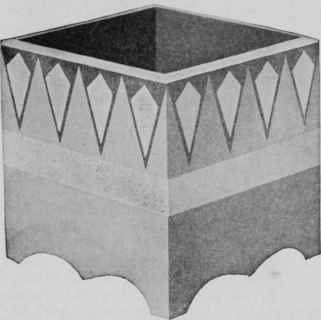
Fig. 5. - Modernistic design applied to a potted plant holder by the new and very simple method of using masking tape, as illustrated in Fig. 7.
Pins or tacks cannot be put into fine art wares and furniture, but a stencil usually can be held down with weights around the edges, or holes can be made in the stencil at intervals around the edges and gummed paper or pieces of tape placed over the holes and pressed through onto the surface being decorated. Ordinarily this will not leave any mark on the surface, but in case it does, the remaining adhesive can be readily removed with a cloth moistened with water or a mild mixture of half gasoline and half water.
When stenciling is done with a sprayer, any type of material may be used-enamel, lacquer, or paint. The surface surrounding the stencil design must, of course, be protected from the spray. Cut a hole a little Larger than the design part of the stencil in wrapping paper or newspaper and place the mask on the surface you are decorating. Then fasten the stencil in position over the hole, letting its edges overlap the mask.
When stenciling is done by pouncing with a brush, lacquer has a tendency to pick up the undercoatings; if carefully done, however, it can be put on through the stencil openings with a soft camel's-hair brush.
Oil colors reduced with turpentine are ideal for stenciling, but, of course, give a flat finish. The design can be brightened up, however, with a coat of clear varnish or lacquer applied with a small brush over the design part only, or as a protective coating over the entire surface.
Another method of obtaining modernistic designs, and one which permits more individual treatment, is to take a suitable design in the new dress goods or draperies or from a magazine illustration, trace it on a sheet of oiled paper, and cut a stencil with a sharp knife or razor blade, leaving the necessary "ties" at frequent intervals to prevent portions of the design from dropping out.
Those with a talent for free-hand drawing can make original designs for stencils or paint directly on the piece being decorated. In modern art, the expression of one's personality is unhampered by precedent or traditions; and motifs, while taken lamely from nature, are rendered in cubist style, or geometrically, or in other novel ways.
The use of "masking tape" often helps in painting modernistic angular ornamentation (Figs. 5, 6. and 7). The tape temporarily covers portions of the surface to keep them from being coated with the colors you are applying.
Regular masking tape is sold by dealers in the large cities who Bell supplies to automobile paint shops. However, gummed craft paper tape used for wrapping packages makes one of the best kinds of masking tape. It has a straight edge, is tough and durable, and comes off easily without disfiguring the surface. Craft tape can be obtained in cities from large commercial stationers and wholesale paper houses. It comes in various widths and costs little. In smaller towns it usually can be had at some factory or store that uses tape for wrapping.
Angular designs of various forms can be produced by pasting strips of tape on the surface so tightly that there will be no opportunity for the paint to run under the edges. When the paint has dried, the paper will generally peel off readily, but in case it does stick, it can be soaked off with water.
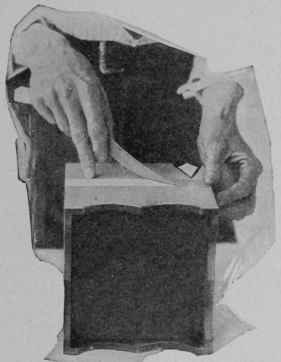
Fig. 6. - After it has protected one part while another is being painted, the masking tape is peeled off.
Masking tape also will be found useful for striping borders. Along the edge of the table top or whatever is being decorated, coat a strip about an inch wide with the color desired for the border stripe. Then cut a piece of tape the width of the stripe and of the necessary length. Cut it with a knife and straightedge to be sure the edges are absolutely straight. Paste this down and then coat the entire surface with the body color. When the color is dry, peel off the tape to expose the straight, even stripe of border color.
Continue to:


My Books

