


Novelty Finishes For Art Wares. Continued
Description
This section is from the book "Things To Make In Your Home Workshop", by Arthur Wakeling. Also available from Amazon: Things to Make in Your Home Workshop.
Novelty Finishes For Art Wares. Continued
The use of gold and silver for edging and otherwise ornamenting furniture and art objects is effective with any type of decoration. While the most widely used method of gilding is to brush on a mixture of gold bronze powder and a bronzing liquid ("banana oil" or some other type), a much stronger, brighter color with greater depth and richness is obtained by coating the surface with japan gold size, and, as soon as it gets tacky, pouncing on the gold or silver bronze with a chamois or soft cloth (Fig. 8). Surplus particles should be blown off. The very finest gilding, of course, is done with pure gold leaf. This may be applied by the home decorator if done with extreme care, although it is really a job for the skilled craftsman.

Fig. 7. - Gummed tape is used to make masks for shielding certain parts of the design before painting.
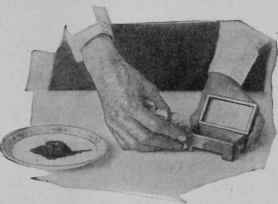
Fig. 8. - Dusting gold bronzing powder on a jewel box previously coated with japan gold size.
Metal leaf, gold and silver, and substitutes for them come in small sheets with thin paper between. The surface to be gilded is coated with japan gold size put on evenly and only where the leaf is to adhere. Necessarily, the size must be applied over a well scaled surface so that it will not soak into the wood.
As soon as the size becomes sticky or tacky to the proper degree, a sheet of the leaf is removed from the box, lifted gently by a corner, and laid on the tacky size. It is then smoothed out with cotton batting and patted down.
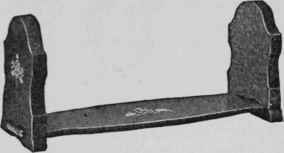
Fig. 9. - Chinese red bookrack. sponge stippled with gold and bright green and decorated with transfers.
Where small or narrow surfaces are being gilded, the leaf may be cut to the desired size with a razor blade. Wherever one piece of leaf overlaps another, the laps are allowed to remain until the size has dried hard, when all surplus portions of the leaf are wiped off.
The gilded surfaces, if not to be subjected to much handling or wear, may be left without a protective coating, but if they are to receive any amount of hard wear, they should be coated over with a thin, pale varnish, which may be rubbed with fine pumice stone powder and oil if it is not desired to leave them in a gloss finish.
Among other new finishes are the stippling lacquers recently brought out under various names. Artistic work can be done by stippling them on with a sponge after the piece has been lacquered with a suitable foundation color (Fig. 9). Stipple effects are especially suitable for use in panels and surfaces inside of a molding or a border, or for a finish around a panel of ornamental design.
Stippling lacquers usually are furnished in the form of a colored bronze powder and a special liquid preparation in two separate tin compartments. The bronze powder and liquid are mixed together immediately before use, and only as much should be mixed as will be needed for the particular work, because the material does not keep well after being combined.
For stippling, use a close-grained sponge. Soften it in water and wring it out practically dry; then dip it, flat side down, into the stippling mixture, which can be poured out on a plate, saucer, or even a piece of paper folded to several thicknesses. Tap the sponge a few times on a sheet of paper to remove the excess; then tap it lightly on the surface to be decorated.
It is often desirable to go over the surface two or more times to even up the effect. A second or third stipple color may be applied by cleaning out the sponge with lacquer thinner or using another sponge, and going over the surface again in the same way.

Fig. 10. - Candlestick with marbled finish obtained by drawing it through a film of floating colors.
Another type of treatment particularly suited for gift wares is what is generally termed "spatter" finishing. Small spatters of color are flecked onto a plaincolor background by dipping a brush into the spatter color, wiping it off on the edge of the container until only scant full, and then striking it against a stick or the back of the hand to jar off countless tiny specks of color onto the surface being decorated.
Two or more spatter colors may be applied, one following the other. A fine or coarse brush may be used, according to the effect desired, and a little practice will soon develop uniform workmanship. Either one or two strokes should always be made against a sheet of paper or other trial surface to make sure the brush is not too heavily loaded with paint or enamel.
An enamel finish is generally used for the background and enamel of a harmonizing or contrasting color for the spatter work. The spatter color should be thinned a little. If applied while the foundation coat is still wet, the spatters will sink level with the surface, but if the ground coat has become dry, they will lie on top of the surface in a raised or pebbled effect.
Another novelty treatment that produces a remarkable blending of colors is as follows: Fill a deep dish with water and drop a little of each of three or four colors of enamel on the surface of the water. Run them together somewhat with a spoon or small paddle to form a pattern like marble.
The object to be decorated, as for instance the candlestick in Fig. 10, is then let down into the water by means of a wire loop, and pulled up slowly through the film of enamel floating on top of the water. This coats the surface with a finish of unusual beauty.
With a few practice dippings, anyone can get the knack of the operation. Unsatisfactory attempts can be wiped off with gasoline. After being dipped, the object should be allowed to drip and dry. Suspend it over a newspaper by means of a hook formed on the other end of the loop of wire.
Now that we have covered various methods of home painting and decorating, we shall take up the art of preparing gifts at low cost.
Continue to:


My Books

