


Horology. Part 9
Description
This section is from the book "The Engineer's And Mechanic's Encyclopaedia", by Luke Hebert. Also available from Amazon: Engineer's And Mechanic's Encyclopaedia.
Horology. Part 9
What has been already advanced, will, we trust, be sufficient to convey a clear idea of the nature and general construction of horological machines; but great diversities in their form and a variety of curious movements have been introduced by the taste and ingenuity of artists in this branch: some of these excite admiration by the number and intricacy of the component parts, and the admirable precision with which they act, whilst others evince equal ingenuity by the simplicity of the means adopted to obtain the end proposed. Of this last description of clocks, none have as yet exceeded that invented by the celebrated Dr. Franklin; it shows the hours, minutes, and seconds, and yet contains but three wheels and two pinions in the whole movement. The lowest wheel contains 160 teeth, and goes round once in four hours; it carries the hand on its axle, which points out both the hours and the minutes, as will be described, and it turns a pallet above it of 10 leaves, on the same axis with which is a wheel of 120 teeth, that gives motion to a pallet of 8 leaves: the second-hand is annexed to the same axis with this latter pallet, as also the swing-wheel, which carries 30 teeth, that gives motion to the pallets of an anchor escapement, and to its pendulum that vibrates seconds.
The dial of this clock is of singular formation; the external circle on it contains 240 divisions, numbered from 1 to 60, in four successive notations; this circle shows the minutes; within it the hours are arranged in three concentric circles, or in a volute of three revolutions along four radii, which form right angles with each other. By this arrangement, while the point of the hand shows the minute, its side exhibits the hour; or, more strictly speaking, shows that the hour is one of three; but so that it will hardly ever happen that any doubt will remain of winch it may be, as there are four hours difference between the figures next to each other on the same radial line. A small circle is placed above the great one, and divided into 60 parts for the seconds. This clock was wound up by a line going over a pulley and ratchet, on the axis of the great wheel, by which the weight was drawn up in the same manner as in the common wooden clocks. Many of these clocks have been made which are found to measure time exceedingly well.
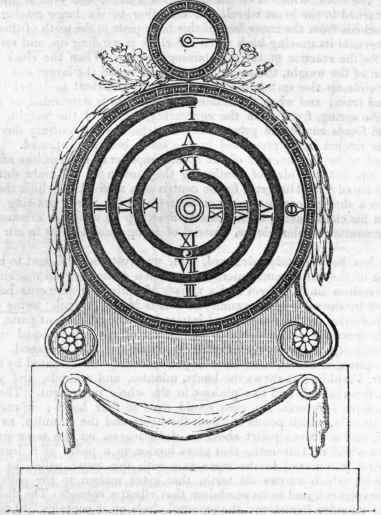
The small imperfection in this clock, of its leaving the uncertainty mentioned as to which of three hours it denotes, though so easily corrected by the judgment, has given rise to some ingenious contrivances to obviate it Of these the most curious is that which forms the subject of the engraving on page 698. To the great wheel of this clock two concentric plates are annexed, the external one of which has a groove cut through it along the line of a volute of three revolutions. This groove forms a trough, in which a metal hall is placed, part of which is seen through the excavation beneath the hour 11 in the figure; as the plate and groove turn round, the ball rolls along the volute, still approaching nearer the centre as it proceeds; and when it at last arrives at the centre, it falls into another trough, by which it is again conveyed to the external part of the volute. The hours are engraved between the revolutions of the volute, and the minutes are marked in four divisions of 60 each, upon an external fixed circle, to which an index annexed to the volute plate points.
Several of these clocks were to be seen in the watchmaker's shops in London some years ago, but we believe the author of this ingenious contrivance is unknown.
In addition to the parts which measure and register time, and therefore alone constitute a watch or clock, various appendages are at times connected with them for pleasure or convenience, as chimes and puppets to clocks, musical and repeating movements, etc. to watches; but as these are not strictly comprised under the head of horology, we shall merely notice one or two inventions of this class, our limits not allowing us to do more.
One very useful addition which is frequently made to clocks and watches, is the alarum, or contrivance for calling attention at any fixed period of time. An excellent arrangement of this kind is the patent detached alarum watch, invented by Mr. Berollas, of the City Road, which is an improvement upon a former invention of the same gentleman called the warning watch. In the present invention all the useful parts of the watch are retained, while those that were inconvenient or had a tendency to disturb its regular movements are here in a detached state. The advantages that result from this arrangement are, first, the applicability or adaptation of the invention to all kinds of watches, whatever may be the principles of their construction; second, the alarum being detached from the watch, it can be made to produce a noise sufficiently loud for a house alarum; third, alarum watches as before constructed were inconvenient, from their bulk, to wear - by this contrivance they may be made as flat and thin as may be desired; and, lastly, the expense is much less than any watches hitherto made of similar performance.
Fig. 1 represents the mechanism attached to the watch, by which the alarum is locked and unlocked, as it appears when the dial-plate is removed.
The index by which the alarum is set to the proper time of going off, is attached to a hollow axle fitted upon the arbor of the ordinary hour-wheel. This index may be set by hand; but a preferable method is to attach a toothed wheel 4, which works into an intermediate wheel 7, which works into the wheel 6, and this latter works into a wheel 3, fixed at right angles to it upon the square end of the steel arbor 1, which runs through the pendant, and has at its other extremity a milled nut 2, by turning which nut it is obvious that motion will be conveyed to the alarum wheel and index to set it at any particular hour. To prevent the train being turned the wrong way, and to retain the index in its place, a small ratchet wheel is fixed upon the square part of the steel arbor 1, into which ratchet a spring-pall 5 falls. The hollow axis of the alarum index is made of steel, and on its underside is formed into a flat circular plate, as at 44, which represents the reverse side of the wheel 4; and in this plate a notch is cut straight down on one side, and sloping on the other, as shown at 45, which is a section of the wheel and hollow axle, the straight side of the notch lies in the direction of a radius of the flat plate in 44.
Continue to:


My Books

