


Boiler. Part 7
Description
This section is from the book "The Engineer's And Mechanic's Encyclopaedia", by Luke Hebert. Also available from Amazon: Engineer's And Mechanic's Encyclopaedia.
Boiler. Part 7
The object of the inventor in introducing such great masses of metal into his apparatus is not very apparent, unless it be the prevention of sudden and great variations of temperature in the tubes, which perhaps could not otherwise be effected, as the body of water they contain is too small to maintain much uniformity of heat, and Mr. Perkins must be well aware that the perfect safety of such generators is not increased by forming them of a square figure instead of circular.
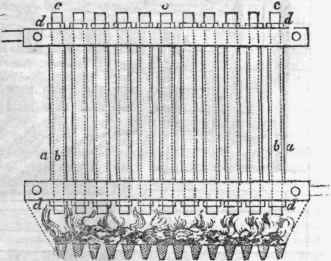
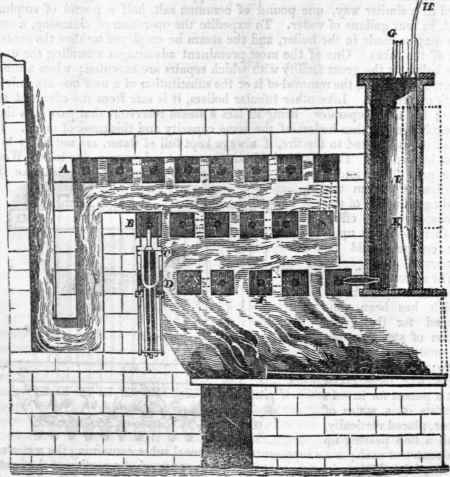
To obviate the destructive effects of the direct action of the fire upon the substance of which a boiler is constructed, and by which action the liability to rupture is increased, a great variety of plans have been projected. Three of these plans, which appear to be deserving the attention of the reader, we shall subjoin.
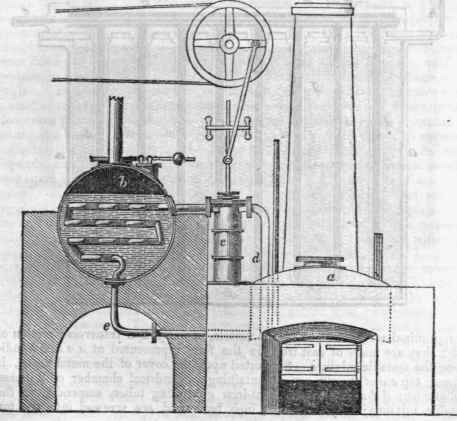
The first is the invention of Mr. Aaron Manby, of Horsely, near Tipton, in Staffordshire, for which he had a patent in the year 1821. It is well known that oil and other fatty matters are capable of being raised in temperature far above that of boiling water, without undergoing decomposition; this property in oil having never before been applied to the working of a steam engine, formed the groundwork of Mr. Manby's patent. The construction of his apparatus is explained by the annexed diagram; where a represents an oblong boiler, supposed to be set in brickwork, over a fire-place of the usual construction. This vessel is to contain the oil, which is to be heated to about 300° Fahrenheit. The vessel above b is a strong cylinder, containing the water to be converted into steam, inside of which is fixed a system of pipes, connected into one continuous line; through these pipes the oil is made to flow by the action of a pump at c, (worked by the engine, or other first mover,) which raises it by the pipe d, and discharges again into the boiler by the pipe e.
The heated oil in its passage through the pipes elevates the temperature of the surrounding water, and converts it into steam of several atmospheres' pressure.
The patentee states, that by this apparatus steam of very high pressure may be generated without the possibility of danger, and that a smaller quantity of fuel is consumed than when the fire operates in immediate contact with the water vessel. In what manner, however, this economy is effected is not very apparent; and although the danger of explosion in the steam vessel is considerably lessened, the liability to accidental conflagration is so far increased by the contiguity of the furnace to such an inflammable substance as oil, (which was liable also to become thick and glutinous) as to render it imprudent to use the apparatus in buildings that are not fire-proof.
The second invention we have to notice is that of Dr. Ernst Alban, a physician of Rostock, in Germany, a patent for which was obtained in this country in 1825. The heating medium is, in this case, such a mixture of tin and lead as will remain in a fused state at the temperature required for the steam, which is generated in small vertical tubes suspended in the bath of liquid metal. The subjoined diagrams exhibit two baths of this kind connected together, in each of which are deposited eight generating tubes. Fig. 1 shows a longitudinal section of one of the vessels, and Fig. 2 a transverse section of both; they are made of cast iron, in the form represented at a a a, b b indicating the metallic mixture. Supported upon the cover of the metal vessel, is a strong top c c of the generator, containing a cylindrical chamber of 2 inches in diameter; d d d, are the wrought-iron generating tubes, suspended in the metallic mixture; they are of 11/8 inch bore and are screwed into the top c c, so that they may be taken out whenever they require cleaning; e is the injection pipe, through which the water is conducted into the generating tubes through a small perforation made over each.
The double vessel, as best seen in Fig. 2, is suspended in the furnace, so as to expose all its four sides and ends to the action of the fire; so that although it is but 4 feet long, 3 feet 6 inches high, and 9 inches wide, it exposes a surface of 64 feet to the fire. The two injection tubes are connected externally, and communicate in one pipe with the forcing pump. This pump is of the usual construction, furnished with a lever and weight, which are raised by the engine.
If the production of steam in the generators be too great for the wants of the engine, the pressure in the steam chamber will act against the injection, and the weight will be insufficient to force down the piston of the pump, which will thus remain inactive, until the pressure is diminished by the ceasing of production and the expenditure of the engine. To prevent the metallic fusion from being overheated, in cases where a smaller supply of steam is required, or where a suspension of steam generation takes place, by the stoppage of the engine or otherwise, the inventor has arranged a heat regulator, which governs the intensity of the fire. The apparatus indicates the temperature of the fused metal, upon which solely its action depends, and the generation of steam in the generators has no influence whatever upon it, the regulator continuing to act when the generation of steam has ceased, on which account it appears to be essentially different from any heat regulator previously used. Its application to this apparatus is indispensable, to prevent such a heating of the generating tubes as might occasion a decomposition of the water injected therein.
It consists of two pipes filled with atmospheric air, one of each being inserted into each vessel, (Fig. 1, g) and surrounded by the metallic medium. To both pipes, very narrow tubes are fixed, shown at h, Fig. 1, and i, Fig. 3; these are joined externally into one tube, which opens inside the mercurial cistern a, Fig. 3. Within the mercury therein contained is immersed a vertical tube b, with a float c swimming on the top of the mercury. This float is connected, by means of the rod d, with the rod e, and acts by the rod /, upon the damper g, which regulates the draught of the fire in the ash-hole. When the air in the pipes, Fig. 1, g g, becomes heated by the fusion, it expands progressively as this becomes hotter, presses on the mercury in a, Fig. 3, and causes it to ascend in the tube b. By the rising of the mercury, the float c is made to ascend likewise, and acts by the rod d on the lever e, and thereby on the damper g, so that should the temperature of the fusion be greater than is required, it gradually closes the air-hole h, by which the supply of air to the fire is prevented, and the heat consequently diminished.
Continue to:


My Books

