


Boiler. Part 8
Description
This section is from the book "The Engineer's And Mechanic's Encyclopaedia", by Luke Hebert. Also available from Amazon: Engineer's And Mechanic's Encyclopaedia.
Boiler. Part 8
Although the intelligent inventor of this apparatus was, as we are informed, unsuccessful in the introduction of it, yet it has strong claims upon the attention of engineers for the originality and ingenuity of many of its arrangements. The employment of a fluid metal, possessing a high conducting power, for the heating medium, instead of an inflammable substance like oil, possessing but feeble conducting power, promised much better results, while it rendered the use of the apparatus perfectly safe.

Fig. 1.
Fig. 2.
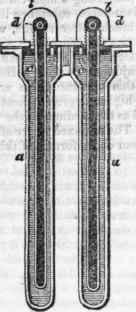
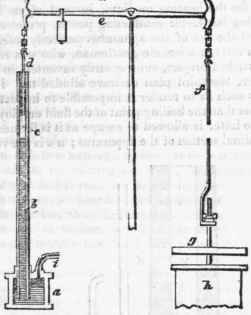
Fig. 3.
Mr. Porter, a scientific gentleman, who was connected with Dr. Alban in the last described project, subsequently invented, in conjunction with Mr. Beale, an engineer, the third plan we have alluded to. In this apparatus, the arrangement is such as to render it impossible to impart a higher degree of heat to the generator than the boiling point of the fluid employed as the medium, as the vapour from the latter is allowed to escape as it is formed. The annexed figure affords a longitudinal section of the apparatus; a a is the vapour chest, formed of thin plate iron; b the generator, which this drawing may be considered as representing by an edge view of a system or coil of wrought iron tubes; the dotted line c marks the height of the fluid medium; d the "breathing-pipe," which in the event of injudicious firing, serves as an outlet and condenser, for such portion of the vapour as may not otherwise be condensed by the lower temperature of the boiler; e an ordinary furnace and flue; f, the ash-pit; g the chimney; A the supply pipe to the generator, through which water is injected by means of a forcing pump, worked by the engine; i is the steam pipe communicating with the engine.
The water injected through the supply pipe h being exposed, during its progress through the generator, to the heat of the vapour furnished by the boiling fluid underneath, is thereby converted into steam, with a temperature and elastic force answering to the temperature of the vapour, which, losing a portion of its heat, resumes the liquid form, and falls to the bottom of the chest a, while the partial vacuum formed by its condensation causes a fresh portion of vapour to supply the void, and thus keep up a constant action. It is manifest that the temperature of the steam must be uniform, and that no greater degree can be communicated than the boiling point of the fluid medium chosen, and all injury to the machinery is therefore avoided, while, from the same cause, all those sudden accessions of elastic force, which have frequently proved so disastrous, are rendered impossible. This mode of heating has, we are informed, been very successfully employed in the preparation of vegetable extracts, and in other chemical operations where regulated degrees of heat are essential. As respects its application to the generation of steam for engines, we are not aware of its having been so used by any other persons besides the patentees.
Objections have probably been raised to the combustible media employed in the vapour chest, and the expense attending the supplying the loss of it occasioned by evaporation. These media were chiefly the spirit of turpentine, naphtha, naphthaline, and other products of coal tar, forming a variety of mixtures, whose boiling points vary from 200° to 700° Fahrenheit.

In the former part of this article, we have had occasion to notice the inconvenience arising from the deposit in boilers, and to mention some of the modes adopted for cleansing them. Occasionally these deposits are several inches in thickness, and as hard as the artificial stone pottery, caused by the baking they receive while in contact with the metal of the boiler, which receives the direct action of the fire. To remove these incrustations is a work of considerable labour; it being a general practice for workmen to get inside the boilers, and break up the stony matter, by means of heavy hammers and cold chisels. These deposits are also the cause of other serious inconveniences; they form a non-conducting shield between the fire and the water, rendering the boiler liable to become red-hot, by which its destruction or premature wearing out is effected, and a considerable waste of fuel is made. To obviate these injurious tendencies, a variety of plans have been proposed. Some engineers throw into the boiler a quantity of some fibrous and mucilaginous vegetable matter, such as bran or husks, to which the earthy matter in the water adheres, and is thereby prevented from becoming concrete and hard, and consequently more easy to be removed.
In the year 1828, Mr. Anthony Scott, of the Southwark Pottery, Durham, took a patent for a very obvious and effective contrivance to abate this evil. His plan is to place a number of slabs or trays of metal stone or wood near to the bottom of the boiler, which it is said so reduces the agitation of the water during the ebullition, that nearly the whole of the sediment descends by its own gravity, and deposits itself in the trays, instead of on the bottom of the boiler. The transmission of the heat is not intercepted by this arrangement, while the trays are removable at pleasure, for clearing them of the sediment deposited upon them.
More recently, (in 1830,) Mr. William Taylor, of Wednesbury, took out a patent, having for one of its leading objects the prevention of the incrustation and removal of the sediment, without stopping the operation of the boiler. It consists of a sediment trough or vessel, extending the whole length of the boiler, immediately under it, with a valve opening at one end, through which a portion of water is occasionally permitted to escape with great velocity, arising from the pressure of the steam, that it may carry with it whatever deposit may have settled in the bottom. This arrangement is represented in the annexed sketch; a a is a cylindrical boiler, having a fire place b, and a flue within it; c is the deposit vessel below the fire. When this invention is applied to boilers which have the fire under, instead of inside them, the patentee applies a deposit trough on each side, and these must be shielded from the action of the fire. The claim to invention under this patent is limited to the particular modifications described; as deposit vessels have, before the date of Mr. Taylor's patent, been applied to boilers; and they are undoubtedly appendages of great utility.
Continue to:


My Books

