


Plinking With Your .22
Description
This section is from the book "Boy's Fun Book Of Things To Make And Do", by Grosset & Dunlap Publishers. Also see: The Pocket Dangerous Book for Boys: Things to Do.
Plinking With Your .22
It is often said that America's No. 1 game animal is the cottontail rabbit. Instead, it's the tin can-and after that the bottle. Both are fine targets, far better for the ordinary man than mere black-and-white circles. Why? Because something happens when they're hit-and most of us want action when we shoot. We can learn a lesson from the carnival shooting gallery. It abounds with clay pipes, floating ducks, moving squirrels, running moose, ringing bells. Everything falls, breaks, or makes a noise when it's hit-and the public loves it!
Want to learn that you must swing with moving game? That parade of nice little metal squirrels will teach you. Want to break yourself of the habit of dragging out your aim for each shot? Try knocking off every one of those squirrels as it slides by -or ringing that swinging gong.
We can't take shooting galleries with us on our informal jaunts into the country. But we can make our plinking a lot of fun as well as excellent practice for game shooting. Line up some bottles, shoot at them, watch them break; then, as your skill grows, move farther back. Put a tin can on the ground and start it rolling with bullets. You might even make a game out of it. The contestant who can roll it farthest in a given number of shots wins. If he misses, or if the can stops moving between shots, he's disqualified. Silly? Not at all! Your expert can-roller will come a lot closer to stopping that big white-tail buck as he bounds over a windfall, and is in sight only a couple of seconds, than will the man who does nothing but make small groups in a target.
Almost as good as the shooting-gallery duck is the swinging tin can. Tie a string to one, suspend it from a tree, and set it swinging. That target is one from which even the most skillful rifleman can learn something. Or put a can into a swift little stream and shoot at it as it dances along the riffles. You'll do a lot of missing, but also a
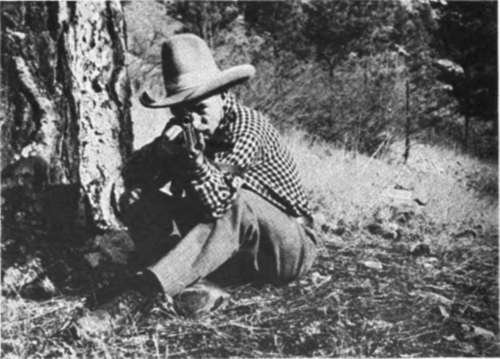
Cross-legged sitting shot-for lean boys only lot of learning.
For maximum action and results, buy hollow-point high-speeds, and shoot at tin cans filled with water. These cans will jump into the air, split wide open, and spray water over the countryside. Try aerial work with that .22. Hitting objects in the air looks frightfully hard, but it isn't. The trick is to hold just below your target when it's at the top of its flight-then pull the trigger!
It is best to start with a medium-size tin can. Stick with it until you can hit it almost every time, then work down to smaller cans, stones, empty cartridge cases, then finally coins.
Another way to dramatize plinking-and to get good practice-is to take out into the country some fair-size pieces of cardboard with game animals drawn on them in natural colors. Hava someone set one up in the grass at an unknown range. Then shoot at it, putting in five shots as fast as possible. Such shooting can be scored-a chest, head, or neck shot counting 5, other body shots 4, and leg shots 3 or 2. It's a fine picnic game and also excellent informal practice.
But now for just a word of caution. To many, the .22 seems like a toy. It makes little noise, it doesn't kick, it sounds anything but deadly. Yet heed that warning which the loading companies print on the flaps of .22 cartridge boxes-Dangerous within 1 mile. Many a domestic animal and many a human being has been wounded by those tiny bullets, from half a mile to a mile from the muzzle.
The plinker should always know where his bullet will land. He should shoot against a hillside or stream bank, so that his bullets won't go sailing into the next township. Even ricochets often travel several hundred yards. As a matter of fact, the little .22 is more dangerous to shoot in level country than many high-power rifles, for the .22 bullet almost always ricochets, while bullets driven at high velocities tend to go to pieces on impact with the soil.
Dollar for dollar, there's more fun in a .22 than in any other sort of firearm. You can buy a marvelously precise little instrument for as little as $5, and the ammunition is very inexpensive too.
For short-range plinking and indoor work on a basement range a .22 short is satisfactory. No .22 should be used on game larger than the jack rabbit, or vermin larger than the coyote.
Wire clinches the rubber into grooves around top and bottom. The intake valve is a rubber flap held by a single screw
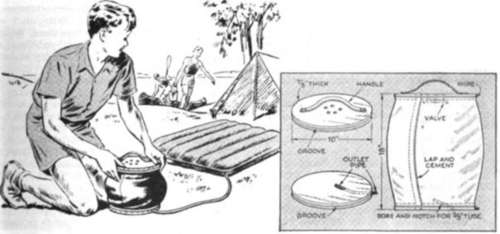
Simple Bellows Pumps Up Pneumatic Camp Beds Quickly.
Filling several air beds with a tire pump took so much time and work, one man made the bellows illustrated from two wooden disks and rubber from an old inner tube, which was split along the inside and cut to lap over about an inch. To operate, the top disk is pulled up and pushed down slowly. About ten strokes will fill a bed, whereas it takes 200 or more strokes of a tire pump for a similar accomplishment.
Continue to:


My Books

