


Fishing With Worms
Description
This section is from the book "Boy's Fun Book Of Things To Make And Do", by Grosset & Dunlap Publishers. Also see: The Pocket Dangerous Book for Boys: Things to Do.
Fishing With Worms
WORMS are perhaps the best-known and most widely used of all live baits. They are easy to obtain and are consistently good bait for most game fish, as well as for the more humble varieties. While there are a number of kinds of worms, for our purpose they may be divided into two types -large and small. The really large ones are those commonly known as night crawlers. These are to be obtained by searching the surface of wet lawns and gardens at night. If the ground is soaked, not much searching is required. They will be found sprawled all over the place. To catch them requires some knack as well as experience. Your flashlight should not be too bright and you must not walk heavily. When you make a try for a worm your action must be sure and firm, but also gentle. If you do anything wrong, you will be amazed at the speed with which these crawlers can snap back into their holes.
Once you get hold of one, don't pinch him. If bruised, he'll die. Also, don't pull too vigorously, for he may break. Have some dirt on the ends of your fingers; it helps you to hold the worm without exerting too much pressure. If you injure or break a worm, don't put it in with the good ones. Either put it into a separate container or throw it aside. Dead worms in your box contaminate the rest, and soon the good ones become mushy and die. Even if you feel sure your worms are in good condition, they should be sorted at least every two days. Also, the material you are keeping them in should be replaced frequently.
There are many ways of carrying worms on a trip. Some like burlap and dirt, others like moss. If you use moss, the long moss, packed fairly tight, is best. The worms should be placed on top and allowed to dig their way down into it. If they fail to do this, either use them quickly or discard them. Some good soil, such as you find in the moss when gathered, is good to have if it isn't too gritty. There is a kind of long, bushy moss, which you'll find in spring meadows in the deep forest, which is good for scouring purposes and acts as a cushion against injury.
Heat is the greatest obstacle to keeping worms alive. For this reason, after placing the worms in the container, be sure to put the box in a shady place. Your cellar is good, as it is cool in the heat of summer. If the cellar is damp, it will aid in keeping the worms healthy. Worms are often kept as long as four weeks by weeding out the sluggish ones and completely changing the moss whenever a sickly worm is discovered. When it is possible to put the container in a location where the cool air of moss-covered springs circulates around it, the worms will keep for two weeks without a change of moss.
Other kinds of worms may be kept in the same way as the night crawlers. Earthworms don't crawl along the top of the ground at night, but may be dug from any suitable soil. A fork is best for this work; you won't cut up so many as you would with a spade. Don't take mutilated worms unless you expect to use them at once. One of the best of these small varieties is the light-colored kind so often found along stream banks.
Fishing with worms is too common to require much description, but perhaps some of these suggestions will be helpful. First, always fish a worm as if it were unattached to your line. That is, let it drift and sink naturally. Of course, sometimes bizarre methods produce sensational catches, but that is not the way to consistently successful results.
For lake and still-water fishing one method is to cast out from a stationary position and let the worm sink to the bottom, there to squirm at will. This is excellent for snagless, weedless bottoms; but if the bottom is not like that, then when you cast out without a float, you must see to it that the hook doesn't get caught on something as it sinks. For some fishing in such locations a weedless hook will help, but worms are tender and can't be forced through weeds without breaking. Where the water is so deep that you can't see bottom it is best to drop the worm close to the boat; when you find the bottom or the top of weeds, adjust your line length so that the bait is just high enough to escape being fouled or hidden. A little practice will make you adept in avoiding bottom trouble.
Next, you can use a float, or dobber, and so control the depth to which the worm will sink. Many fishermen think that a foot above bottom is the most effective. Another way is to adjust the float so that the bait just about touches the submerged weeds, snags, and rocks. The more the worm looks like a free, squirming one-not an unnatural thing suspended by a line in space-the more effective it will be. Not that a dangling worm won't catch fish. It will, but if you fix it so that the worm seems to crawl to bottom, yet doesn't get snagged or under cover, then you have an ideal set-up.
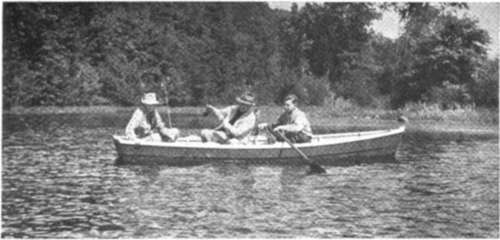
Take time out from the pursuit of bass or trout and enjoy the leisurely art of angling for panfish.
Many worms are taken as they descend to bottom. Often that is the only way fish will take them, particularly in waters heavily fished. For this reason it is a good plan to make a fresh cast every few minutes.
Continue to:


My Books

