


Fishing With Worms. Continued
Description
This section is from the book "Boy's Fun Book Of Things To Make And Do", by Grosset & Dunlap Publishers. Also see: The Pocket Dangerous Book for Boys: Things to Do.
Fishing With Worms. Continued
All this applies to fishing from a stationary position. But you can take more and better fish by moving about, so long as you use judgment in doing so. You should know bottoms and depths. Then concentrate on those places where the fish should be, always fishing at the proper depth to get the best results.
A dobber on your line is excellent for this drift style of fishing, if you have a sufficient area of the same water depth to float over. Using this method, first start the boat drifting with the wind so that it will pass over the productive water. Then, as the boat drifts along, keep casting directly ahead of it. In an ordinary wind these casts should go out at least 50 feet. If the boat drifts fast, the casts should cover even longer distances, to allow the bait to sink properly. Keep watching the dobber, and also take in line as it slackens from the drift of the boat. If you get a bite, keep taking in slack until the boat almost reaches the dobber; then- but not before-bring the line taut and set the hook. Never attempt to set the hook until your line makes a direct line from you to the fish. Should the line curve, you may lose the fish.
Another Drifting Method Is To Be Used wherever-without too much interference from weeds, snags, and rocks--you can drag a worm near or directly across the bottom. Keep the speed of the boat at or under a quarter of a mile an hour. If you feel the bait touch every little while, it will be just about right for ordinary conditions. Not all bottoms are adapted to this method, but it's deadly wherever it's possible to use it.
When stream fishing, the more naturally you can drift the worm with the current the more it should produce. Cast across stream into a current which you feel sure contains fish. Then, as the bait starts drifting and sinking, follow its progress with the rod tip. "The instant it touches bottom, start it on its way again win a slight upward movement of the rod. Keep it progressing this way until you get a strike or else get caught on bottom. If caught, make a roll cast to release it. To do that, let out slack and raise your rod until it extends slightly backward over your shoulder. Then make a firm, quick, forward movement of the forearm so that the line rolls out beyond the place where the bait is caught. You may get a strike when you do this. Of course, many times you get snagged so badly that it is necessary to break the leader to get loose. Don't let that bother you too much-worms drifting near the surface will rarely catch fish, and when they do it's time to change to flies. After all, bait is needed only when the fish are bottom feeding, or when the water is high and discolored. Trout and bass can smell a worm even if they can't see it, but they can't smell an artificial fly. Or, if they can, it won't smell right.
Another method of worm-fishing streams is first to look over the current tongues and, after selecting one above you that leads into good water below you, to cast your worm up-stream into that current which leads to the spot you wish to reach. This gives you a perfect drift. The line goes slack the moment the bait touches the water, and this allows the bait to drift and sink naturally. Thus, by the time the bait reaches the desired water it is at the proper depth to get results. Of course you must figure out the correct distance to cast, allowing for the speed of the current and the sinking of the worm. But that isn't hard. Just use your head and eyes and forget about your rod and casting. If you know what you must do, you can usually find a way to do it.
Shot and other types of lead sinkers may be used to get the bait down. Sometimes this works better than any other way, particularly when you're fishing swirling pockets while standing a rod's length away and letting the worm work along the bottom wherever the undertow takes it. But never use a sinker unless it is positively needed, and you can't handle bait any other way.
One difficulty of fishing the natural drift without a sinker is to know when you get a strike. Watch the line carefully as the bait drifts along. If it makes the slightest pause, or seems to move contrary to the drift, immediately raise the rod to see if you can feel anything. Usually the evidence of a bite is so slight that you think you just imagine it. Don't be misled by that. Often these faint impressions will yield a fish if you strike.
As with every other method of fishing, the use of a worm requires skill and knowledge for good results. Fish like to eat worms; but to catch the fish you have to do something more than merely drop a baited hook into the water.
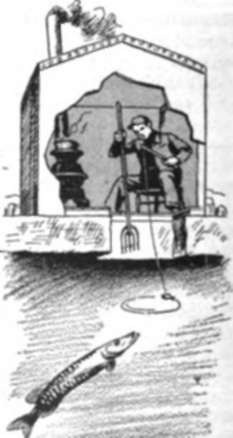
Helpful Hint for the Ice Fisherman: Metal Decoys Aid in Spearing Fish Through Ice
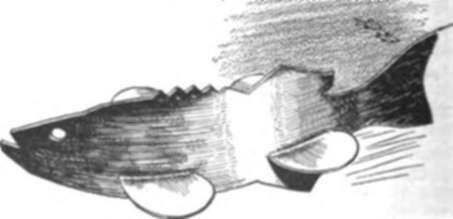
Decoys to use in the sport of spearing fish through the ice from a fish house-a sport that is popular in many of the colder sections of the country-can be made as shown from sheet metal or heavy tin. The decoys may be from 3" to 8" long and patterned after any desired kind of fish.
Cut the metal to shape with tin snips or cold chisel, hammer it flat, cut slots for inserting the fins, and solder the fins in place. Add extra solder under the frontal fins so that the decoy will glide downward when the control string is slack. Drill a few small holes along the top edge for inserting a small hook and swivel.
For running the decoy, a stick about 18" long with a 6' or 8' fishline is used. The hook and swivel are tied to the end of the line. See that the fins of the decoy are horizontal except the back edges of the frontal fins, which are bent up slightly. Bend the body of the decoy to form an arc so that it will travel in a circle of from 12" to 18". Insert the hook of the control line in whichever hole permits the decoy to balance properly. The decoy may be left in its natural finish or colored, as preferred. A red head with a white body is a good color combination.
The fisherman usually sits by the edge of the ice hole and gives the control line slow jerks with one hand so the decoy will travel in circles. He holds the spear in the other hand and rests the tines at the edge of the hole until a fish is seen. The spear is ordinarily 4' or 5' long.
Decoys of this type can also be used as summer bait by drilling a small hole at the nose and tail. Fasten a gang hook at the tail and a small swivel at the nose. Bend the decoy so it will travel through the water like a crippled minnow.
Continue to:


My Books

