


Learning To Shoot. Part 3
Description
This section is from the book "Boy's Fun Book Of Things To Make And Do", by Grosset & Dunlap Publishers. Also see: The Pocket Dangerous Book for Boys: Things to Do.
Learning To Shoot. Part 3
Regulate the height of the knees by drawing them inward or stretching the legs outward until the correct position is obtained. Place the elbows well forward over both knees, not directly on the kneecaps. Lean forward, bringing the body and knees close together.
Glance through the sights. If the rifle is not pointing naturally at the target, shift your whole position, so you won't have to hold over in order to aim.
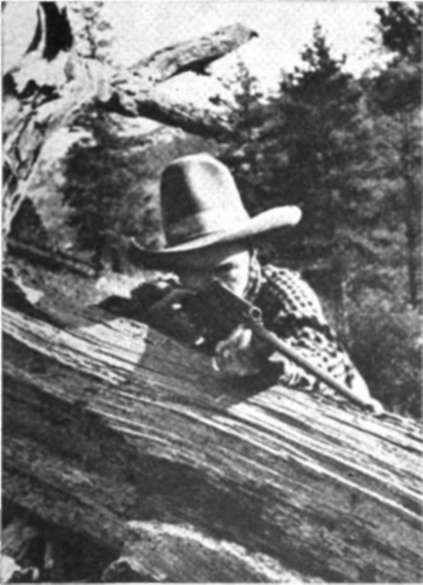
Down timber not only provides cover for stalking but often makes a steady rest for the hunter.
Many good shots cross the legs or place the heels together. If you do not find the position which has been described comfortable, after giving it a real try, experiment with the others. If you are comfortable and can produce good scores, the exact position is immaterial.
You will find the kneeling position difficult at first, mainly because it's an entirely new position for you to assume. Everybody lies prone frequently, or sits on level ground, but the kneeling your mother taught you is nothing like what you will learn now.
Take your sling up still another hole. Now kneel on the right knee, sitting on the side or heel of your right foot, with the left foot drawn up toward the body. Place the left arm well over the knee. Now lean forward until you feel the weight of your upper body definitely on your left knee.
To test the correctness of your sling and position, lower the right hand and release your hold on the rifle with the left hand. The rifle should remain in the aiming position, pointed directly at the bull's-eye. If the rifle does not remain in place, adjust your sling and position until it does.
For the offhand or standing position, the sling is not needed. Stand with your left shoulder toward the target, the body and knee absolutely relaxed, the weight balanced equally on both feet, which should not be uncomfortably far apart.
Grip the rifle in the right hand, with the thumb across the stock, while resting the butt on the waistline. Close the fingers of the left hand into the palm, clasping the rifle without gripping. Now raise the butt to the shoulder. The left upper arm should be close to the body, and the wrist and fist stiffly erect, without touching the rifle with the palm.
The left elbow should be directly under the rifle. The right elbow should be held in the most natural position.
Do not strain the head toward the sights; instead, move the butt up or down until the head can be held naturally in sighting.
The rifle cannot be held steadily in this position for more than a few seconds; practice raising it and getting off the shot correctly in one motion, without loss of time. Be ready to fire the instant the sights are aligned on the target. If you are unable to fire at once, lower the butt of the rifle and rest a moment.
These latter positions should be mastered in order, one at a time. Use your regular practice periods, take as much time as you need in one position before going to the next, and you will have a good start.
Continue to:


My Books

