


Reinforced Combs
Description
This section is from the book "History Of American Beekeeping", by Frank Chapman Pellett. Also available from Amazon: History Of American Beekeeping.
Reinforced Combs
During the time that all this development was taking place, numerous attempts were made to find some artificial comb which would replace the natural article. Although these attempts have never resulted in anything of much value, there is some interest in a review of the various efforts. In 1876 announcement was made that Moses Quinby had applied for a patent for an artificial comb with cells of full depth made of metal. Such combs would be nearly moth proof, but the effect of temperature changes, especially extremes of heat and cold, were to be reckoned with and little was heard of the Quinby attempt.
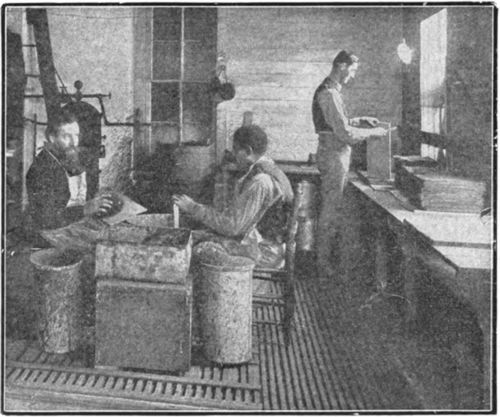
In the early days sheets of wax were obtained by dipping boards in tubs of melted wax.
The metal comb idea then slumbered for many years until 1918 when The Aluminum Honeycomb Company was launched in California to push the manufacture and sale of a metal comb developed by a man named McDonald. This was made of very thin metal and had the advantage of being light in weight and occupying very little more space in the cell walls than the natural comb. For a time great enthusiasm was manifested for these combs. Dipped in beeswax the bees occupied them in moderate weather without much delay, and some felt that the problem of artificial combs had finally been solved. A few beekeepers invested in large numbers of these combs.
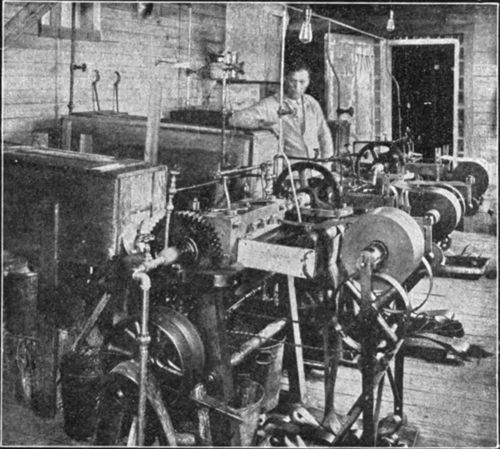
Weed sheeters forced the wax through a narrow slot after which it was wound on spools like a ribbon.
In practice they were very easily damaged and could not be repaired as could a natural comb. Being sensitive to temperature changes, they proved unsatisfactory in either unusually hot or cold periods, and everybody who invested in them lost as a result.
In the seventies Charles Nash Abbot, editor of the British Bee Journal, offered a wood foundation made of a very thin sheet of wood dipped in melted beeswax. When these sheets were hung in the hive the bees raised their cells on the wood base. The resulting cells were flat bottomed and although much attention was given the product in the British Bee Journal for a time, it was soon forgotten.
In 1920 the Roots began experimenting with a similar base and in their 1922 catalog offered a wood base foundation. In their announcement they told of having tried foundation with a wirecloth base, as well as thin sheet metal, celluloid, cloth, and cardboard. They reported the wood base as better than anything else of the kind they had tried. When put to the test in the apiary the resulting combs warped when the wood came into contact with excess moisture. This effort was short-lived.
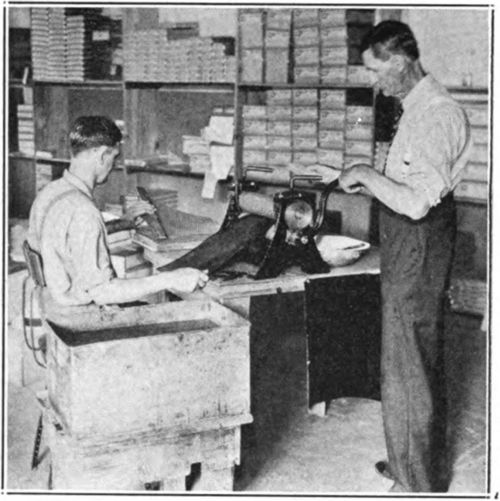
Impressing the sheets with a hand mill. Sheets were impressed with a hand mill in early days.
The idea of using an artificial base has persisted from an early time. The first recorded effort in this direction with which the author is familiar is that of Gottlieb Kretchmer, a German mentioned by Cheshire, who about 1843 dipped tracing linen in molten beeswax and afterwards passed it between engraved rollers. The bees would start their cells on this base, then reaching the fibers of the linen they destroyed the structure in their efforts to remove it. Kretchmer, however, appears to have been the first to make use of rollers in this field.
Continue to:


My Books

