


Wax Foundation And Reinforced Combs. Part 3
Description
This section is from the book "History Of American Beekeeping", by Frank Chapman Pellett. Also available from Amazon: History Of American Beekeeping.
Wax Foundation And Reinforced Combs. Part 3
In the meantime, others were giving attention to the improvement of the rolls.
Mrs. F. Dunham is credited with having improved the machine so that the foundation would have a thin base and high, thick side walls. Charles Ohlm improved the method of cutting the rolls and sold his rights to Root. Root thus remained in the lead, although a machine to make cells with flat bottoms was made by J. E.
Van Deusen. Van Deusen sold foundation in moderate amount for several years, but his product was not such as to stand the competition of that made from the improved mills which were by then available.
To Captain J. E. Hetherington, of Cherry Valley, New York, probably belongs the credit of originating the use of wire in supporting combs. * He also originated the foundation with flat bottom cells and obtained a patent for it. Van Deusen manufactured the flat bottom foundation, paying a royalty to Hetherington. Hetherington also obtained a patent covering the use of all kinds of wire supports for foundation, including wired frames. He seems to have made no attempt to profit from the use of wire but freely gave this invention to the public. The use of wire for supporting foundation is nearly universal, although many different methods of application are in practice.
* D. S. Given claimed priority. American Bee Journal, p. 2. 1881.
J. Vandevort, of New York, built mills which proved to be more perfect than any at that time available, and, for a time, he enjoyed a considerable reputation on this account.
In July, 1883, Charles Dadant wrote of him in Bulletin d'Api-cultura, "He is at the same time an excellent beekeeper, a mechanic outside the ordinary and a man outside the ordinary, too. " He was credited as being the one who had succeeded perfectly so far.
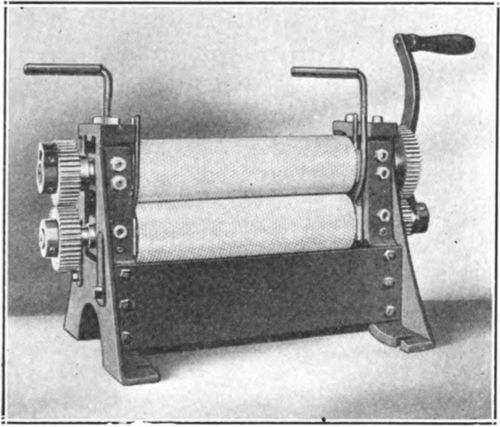
Later mills were adapted to heavy production of comb foundation.
Vandevort sent several mills to Dadant and never sent a bill for them. When fifty or a hundred dollars was forwarded, he would write, "I am overpaid. " Dozens of mills were thus purchased from him at different times with no definite price attached.
The first year that the Dadants manufactured foundation they sold 500 pounds during the entire season. The work was done under a tree in the open, by dipping a board in the tub of melted wax and then, when the sheet had cooled, running it through the hand mill. Six years later the amount had increased to 47,000 pounds in one year. At first, two men would work hard all day to get ten pounds of foundation of indifferent quality. Dadant saw the need of foundation with a thin base and heavier cell walls. When he went to see Vandevort and indicate his requirements, he was able to secure a mill to meet his needs.
About 1892, Dadants received a letter from E. B. Weed, of New York state, to the effect that he was developing a new process by making endless sheets of wax which would later be impressed with the cell forms. He required money in advance to enable him to visit Hamilton and demonstrate his process with the idea of selling it to them.
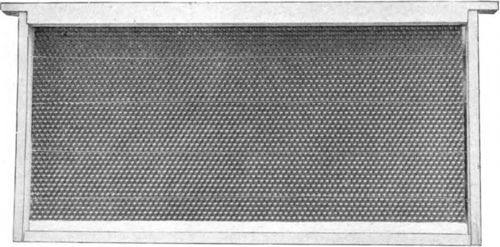
To Captain J. E. Hetherington probably belongs the credit for the use of wire in supporting combs.
The machine was described by C. P. Dadant as resembling a sausage filler, but as requiring refilling so often that little could be done with it, and as producing an irregular product. Dadants advanced further funds to enable him to return home and carry on some further experiments. Two or three years later he went to Medina, where he was able to complete his invention at the Root factory. When he made his contract with Root, he made the reservation giving Dadants the right to use it in consideration of their previous efforts in his behalf.
The new Weed machine forced the warm wax through a slot in the form of a ribbon which was wound on a spool and would provide a sheet of any required length. This solved the one remaining difficulty in foundation manufacture and resulted in the disappearance of all dipping and pressing. Weed process foundation soon superseded all others.
Continue to:


My Books

