


Mixed Waxes
Description
This section is from the book "History Of American Beekeeping", by Frank Chapman Pellett. Also available from Amazon: History Of American Beekeeping.
Mixed Waxes
No sooner did foundation come into use than an effort was made to cheapen it by the use of substitute waxes. Charles
Dadant records that the first foundation which he bought came from New York and astonished the bees as much as it did him, since it was made of paraffin so that the bees hastened to throw it out.
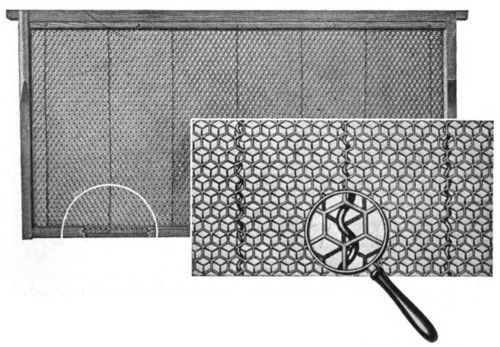
Vertical wired foundation with corrugated wire was perfected by Henry Dadant.
During his early experiments, A. I. Root recorded everything fully in Gleanings, including his arguments with those who differed from him. In 1876 he wrote that he had dispensed with beeswax for foundation because paraffin was cheaper, whiter, stronger, and more rapidly worked by the bees. To give it the necessary strength he added Burgundy pitch. Following this announcement, there appeared some rather caustic letters from readers who reported stretching of the foundation until it looked like drone cells. Later he tried two parts beeswax and one part paraffin. Concerning this he reported: "Several hundred pounds were made and sold before we discovered that, although it would work all right in the spring months, it would not do at all in the hot weather of June and July. The combs melted and fell down so badly that, after tolerating a few of them for a few years, we cut them all out, melted them up and used the material for waxing honey barrels. "
Little was heard of mixed waxes for many years until, about 1920, the Roots brought out their three-ply foundation. The object was to make a stronger comb and to accomplish this result they used a small amount of Carnauba wax in the inner layer when milling the foundation.
When Van Deusen made his flat-bottomed cell foundation, he found it possible to incorporate small wires during the process of manufacture. This ready wired foundation had some advantages, but because of the fact that the cells were not provided with the natural base, it never became popular.
Feeling the need of some vertical support, Doctor C. C. Miller experimented with wood splints (American Bee Journal, page 70, 1899). He cut small strips of wood about one-sixteenth inch square and one-fourth inch shorter than the inside depth of the frame. The strips were boiled in melted beeswax in a shallow pan and then pressed into the foundation so that they would be upright when the frame was hung in the hive. Five such splints were used to each Langstroth frame. When put in with sufficient care, good results were obtained, although some comb surface was wasted along the strips. Much was written about the Miller splints and a few beekeepers used them. The amount of time needed to prepare them and the difficulty of getting good results prevented them from coming into common use.
About 1920, Henry Dadant devised a vertical wired foundation by using corrugated wire of light weight and flexible properties. It would remain in position and resulting comb was much stronger than that obtained by ordinary wiring. With the wires put in place by machinery, he was able to secure satisfactory manufacturing conditions and to sell the product at little above the price of the regular foundation. Later, other manufacturers offered similar foundation with straight wires.
Continue to:


My Books

