


Chapter V. Package Bees - From Arrival To Honeyflow
Description
This section is from the book "Beekeeping for Beginners", by G. H. Cale, Jr.. Also available from Amazon: Beekeeping for Beginners.
Chapter V. Package Bees - From Arrival To Honeyflow
A PACKAGE of bees as its name implies, is a number of bees shaken into a screened cage, in which a queen is included. Though the queen may be shipped loose with the bees, she is usually suspended in a queen cage in the cluster of bees. This package may have a net weight of two, three, or more pounds of bees. All things considered, the three-pound package is to be preferred.
There are also produced packages of bees containing besides the bees and the queen, one, two, or more combs of honey, brood, and pollen. These are called comb packages. While these latter give the bees a better start when installed, they have never become popular on account of the possibility of transmission of disease through the combs. In fact, some states prohibit the importation of comb packages.
Since spring opens earlier in the South, that region has become our chief source of package bees and queens. Bees can be built to strength, queens reared and packages ready to ship by the time warmer weather arrives farther north.
The packages of bees should reach you at the time of early fruit bloom, which usually starts with apricot and pear and ends with apple bloom some four to five weeks later. The exact time will depend upon your location. Be sure to have your equipment ready for the bees upon their arrival, the hive set up and painted and the comb foundation placed in the frames. The equipment needed for installing a package of bees is a hive body, frames with full sheets of foundation, bottom board, empty supers or feeder shell, cover, entrance closer, and a feeder. The feeder commonly used is a 10-pound size, friction-top tin pail with about six small nail holes punched in the lid. Use nails of about the same size as those with which you nailed your frames together.
Packages of bees are shipped by railway express and upon their arrival should be examined carefully in the presence of the railway express agent. They usually arrive in good condition but occasionally will arrive with part or all of the bees dead, or with the queen dead. When such a situation occurs, accept the shipment but always remember to call the loss to the attention of the railway express agent and insist that he make a bad-order notation as to the extent of loss on the railway express receipt that he signs and gives to you. This receipt should immediately be sent to the shipper of the packages so that you may receive an adjustment. Package bee shippers guarantee safe arrival and invariably make replacements and adjust claims with the express company if bad order receipts are sent them.
A claim filed with this bad-order receipt - and only if accompanied by this receipt will be properly acknowledged and an adjustment made by the express company.
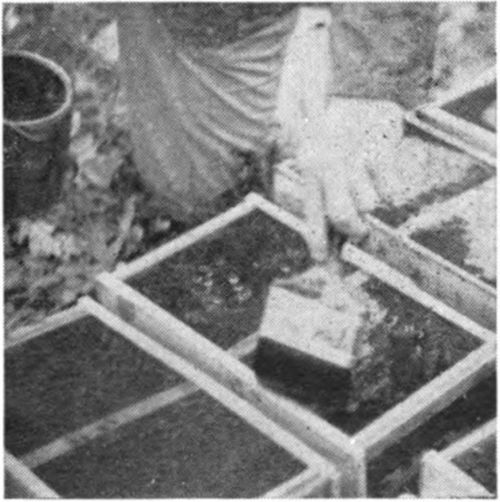
Brushing sugar sirup on the screen of a package of bees. Brush on as much as they will take.
Of late years the losses of package bees while in transit have become negligible except in the case of careless handling or crowding the packages too closely together in the express cars; or through suffocation due to extreme heat.
These package bees during the heavy spring shipping season, originating as they do in a relatively constricted area of the South, are moving north in such quantities that the shipments may be given the advantage of "pooling, " even full carloads being assembled at transfer points, as the move northward is made.
Express authorities have cooperated by special instruction to express agent and messengers on necessary procedure in package bee and queen shipments, so the shipments have maximum speed and care.
There is no particular rush about installing a package of bees after it is received. It is best to place the package in a cool, dry-and preferably dark-room, a basement answering well for this purpose, where they are fed sugar sirup. The sirup is made by mixing together one part of granulated sugar to one part of warm water. This sirup is fed to the bees by dipping a clean paint brush in the sirup and rubbing the brush on the wire cage. Caution should be taken not to apply too much sirup while the bees are confined in the package. When the bees do not remove the sirup quickly from the wire they have had enough.
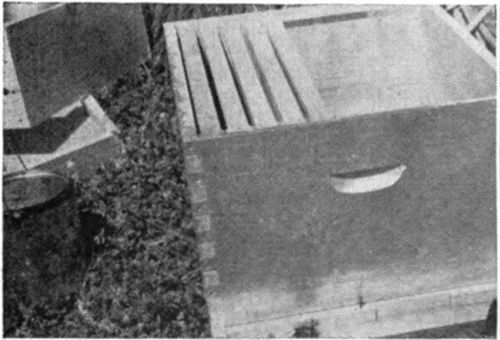
Hive body with some frames removed, ready for package.
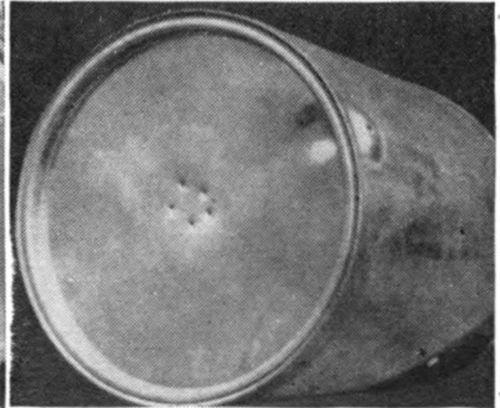
Friction-top pail with holes in lid. The full feeder can is inverted over the frames in an empty super.
The next step is to take your equipment (hive body, frames, bottom, cover, empty supers or feeder shell, feeder, and entrance closer) to the spot where the colony of bees is to be kept.
The following pages will show you step-by-step pictures telling how to install a package of bees.
Continue to:


My Books

