


Chapter XIV. Diseases And Enemies Of Bees
Description
This section is from the book "Beekeeping for Beginners", by G. H. Cale, Jr.. Also available from Amazon: Beekeeping for Beginners.
Chapter XIV. Diseases And Enemies Of Bees
ONE of the problems most frequently met by the uninformed person who attempts to keep bees, comes when the combs of those bees are attacked by the wax moth. "Why are my colonies full of worms? I am losing my bees. They are being cleaned out by these worms. "
The greater wax moth (Galleria mellonella) is similar to the meal moth and the clothes moth. If it can gain access to the beehive it lays its eggs in the combs or around the corners of the hive. When these eggs hatch, the small worms attack the combs, making tunnels through them as they make their growth. Their food consists of the combs themselves and the cocoons left by generations of emerging bees. Their tunnels are generally through the midrib of the comb so that the earlier depredations of the growing worm are scarcely noticed. By the time the moth worm is ready to spin its cocoon, the damage is done and the combs are useless.
Naturally, these moth easily gain access to the weaker colonies but if they should attack the stronger colonies, house cleaners that they are, the bees soon drive them out. So, the solution for the prevention of damage by the wax moth or worms in the colonies, is to keep all colonies strong. Vigorous young queens which can keep the hives populated are the best deterrent to wax moth attacks. Control of the hive entrance by the beekeeper, allowing only as much entrance space as the colony needs and can protect is desirable.
Bare drawn combs, not protected by bees, such as combs from dead colonies or stored combs, are particularly susceptible to the ravages of the wax moth, since they do not have the protection of the bees. Such combs should be placed in tight hives, tightly sealed stacks of supers, or in a room as nearly impervious to moth entrance as possible. Since the moth and their eggs are rendered ineffective by freezing weather, storage in buildings where the temperature is allowed to follow the winter cold, is desirable. During the summer, combs which are not protected by the bees should be fumigated at intervals. The commercial wax moth fumigator (paradichlorobenzine) may be placed in a small receptacle at the top of a stack of supers or over the combs. With all sealed, the fumes descend through the combs. A relatively new product, similarly used, called "Killmoth, " is especially effective and used above the super stacks as is paradichlorobenzine. If burning sulphur is used, the container should be in an empty super at the bottom of the super stack. Extreme care should be used if carbon bisulphide or calcium cyanide are used. The former is highly inflammable; the latter gives off a deadly gas.
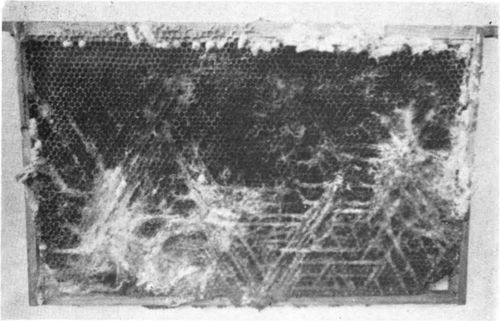
A comb ravaged by the work of the wax moth.
Wax moth are most destructive, naturally in the southern states since the moth can flourish during the entire year. In the North the few hibernating moth which carry through the winter must start a new cycle of brood in the spring, and do not become troublesome until midsummer when their numbers have multiplied.
Other Enemies
Ants often get into beehives but they are more of a nuisance than being harmful. Their nests should be destroyed and often poison is distributed to keep a locality free of them. Argentine ants are found in the South and can destroy a colony. Sometimes the hives are placed on stilts in pans of oil to protect them from these pests.
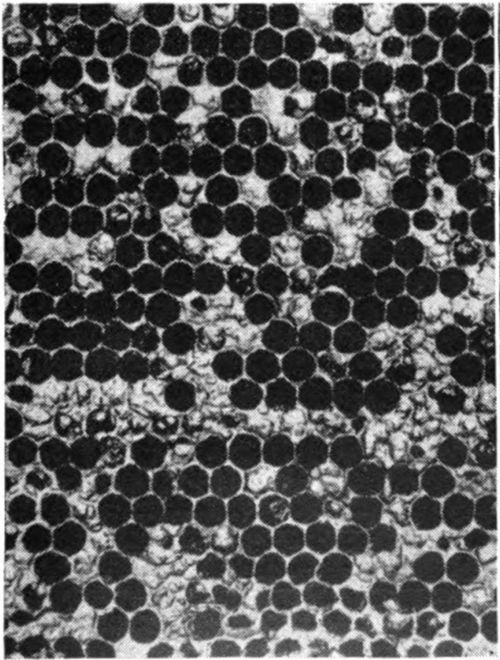
Brood comb with an advanced case of American foulbrood. Notice the perforated and sunken cappings on the cells and the scattered appearance of the brood. Many of the open cells, from which cappings have been removed by the bees, contain scales. When the larva has died with the foulbrood it dries down into this scale.
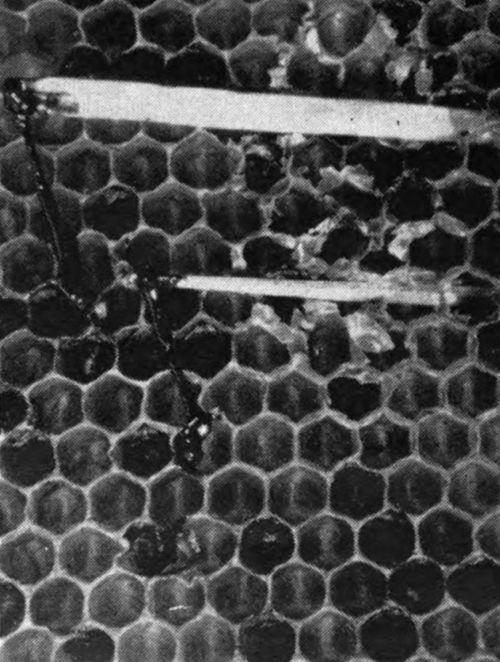
As decomposition of the larva progresses the dead larva sinks down in the cell and the color changes to dark brown. During this stage the larva has a ropiness to it. With a match or toothpick the remains may be drawn out like thick glue into fine threads. Typical dark brown foulbrood scales form on complete drying.
Diseases
There are two types of diseases harmful to bees, one which attacks the brood of bees and the other attacking the adult bee. Those attacking the adult bee have never been serious in America but the brood diseases have in the past caused considerable loss to the beekeepers.
If a beekeeper is in doubt as to the kind of disease he has in his apiary, he should consult his state apiary inspector or the Bee Culture Laboratory at Washington, D. C. They will be glad to examine samples of disease and give advice.
Continue to:


My Books

