


Stills And Distillation In Practice. Part 2
Description
This section is from the book "Distillation Principles And Processes", by Sydney Young. Also available from Amazon: Distillation Principles And Processes.
Stills And Distillation In Practice. Part 2
Table 112
Alcoholic content of liquid on plates of a rectifying column at the middle of the distillation.
Number of plate from bottom. | Alcohol. Volume, per cent. | Number of plate from bottom. | Alcohol. Volume per cent. |
49 | 96.3 | 19 | 94 |
44 | 95.9 | 14 | 93 |
39 | 95.6 | 9 | 92 |
34 | 95.3 | 4 | 87.5 |
29 | 95 | Still | 33.6 |
24 | 94.6 |
Continuous Distillation
The simple pot still does not economically deal with large volumes of wash. Stills were therefore designed which could be continuously supplied with wash.
Fig. 105 gives a diagrammatic representation of one of the earliest of these stills, introduced by Pistorius.
The wash is run from the pipe a into the heater (economiser) a, thence by the pipe bb into b, and finally into c through the pipe c; a and b are then filled with wash. The still c is heated either by a furnace, as shown in the diagram, or by steam, the wash being constantly stirred by a chain. The weak alcoholic vapours, pass through the pipe d into the second heater b, where they condense and heat the wash to the boiling point, the waste heat from the furnace being also utilised. The stronger vapours from B now pass by the pipe ee' into the outer chamber of a (where more weak alcohol is condensed and flows back by the pipe d into b) then up through the narrow passage ff into the dephlegmator g, shown on an enlarged scale below. After passing through two or more of these dephlegmators the strong alcoholic vapour reaches the condenser by the pipe h. The plan adopted here of passing the vapour evolved in one still into liquid in a second, led to the gradual evolution of the modern type of plate column which effects the concentration of the spirit by exactly the same principle differently applied.
One of the first efficient continuous stills with plate columns to be employed in England was that designed by AEneas Coffey in 1831, and stills of this type are still largely used to this day (see Fig. 121). The wash is distilled in one column called the analyser and the vapour so produced is led to a second column called the rectifier, in which the majority of the water and fermentation by-products are removed. This arrangement has formed the basis for most of the continuous stills used at the present day, all of which have some form of analysing or boiling column combined with a rectifying column. Before describing some modern stills an account will be given of the essential parts of various types of distilling or boiling and rectifying columns.
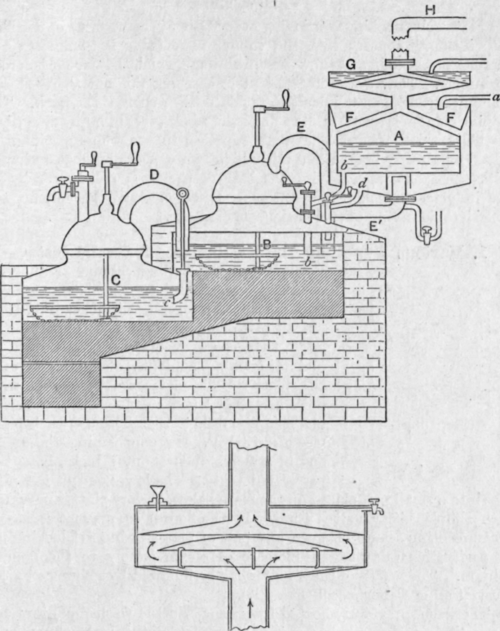
Fig. 105.
Distilling Or Wash Columns
The continuous boiling of the wash is carried out in a variety of ways, all of which have this in common, that the wash flows down some kind of column and meets a rising current of steam. By this means the wash is freed from the volatile products of fermentation, and flows away from the base of the column as "spent wash."
The methods adopted fall under two heads: (1) A. Plate columns. B. Sloping columns.
(2) Full columns.
Plate columns aim at bringing every part of the wash to be distilled into intimate contact with the vapour by causing it to flow over a number of plates in a shallow stream through which the vapour is forced to bubble. They are more efficient in carrying this out than the full column, but are more difficult to regulate when using thick wash. The sloping column is an attempt to unite the advantages of both types when distilling thick wash. The wash supplied to the boiling column is generally already heated to a fairly high temperature by heat exchange with the spent wash leaving the base of the wash column, or by its use in place of cold water in the condenser or rectifying column. A considerable saving of fuel is thus effected.
1. Various Types of Plate Columns. - Perforated Plates. - In
Coffey's still the boiling column or analyser consists of a series of copper plates arranged horizontally at intervals of 9 inches (Fig. 106). (In all plate columns it is most important to have the plates absolutely level so as to maintain an equal depth of liquid all over the plate.) The plates are perforated with holes arranged 1 inch apart. The number of plates is about 20 to 24. Through each plate (see Fig. 106) passes a copper pipe, the upper end of which stands about 1 inch above the perforated plate. The lower end of the pipe dips into a small pan placed on the plate below. Every plate is provided with simple safety valves (shown in the figure) to prevent excess of pressure being set up between any pair of plates owing to blocking up of perforations or sudden increase of steam supply to the boiling column. The action of these plates can be followed by reference to the illustration of Coffey's still (Fig. 121).
The wash, previously heated by passage (in the wash pipe) through the rectifying column, flows on to the top plate of the wash column, and passes by a zig-zag course from plate to plate by the drop or overflow pipes, a depth of about 1 inch of the liquid being maintained on each plate. The wash in its descent meets steam which is introduced at the base of the column. The vapour produced rises through the perforations and bubbles through the liquid on the plates. The pressure of steam is sufficient to prevent the liquid flowing down through the perforations. But if the necessary pressure is not maintained the liquid on the plates will flow down through the perforations and the charge of the column be lost; this disadvantage is avoided with the type of plates described subsequently; which do not empty themselves if by accident the pressure is allowed to fall too low. The liquid to be distilled is brought into very intimate contact with the vapour, and a very efficient separation of the volatile products of fermentation is produced. The spent wash which leaves the base of the column by a syphon pipe is practically free from alcohol. The dimensions of the syphon determine the maximum pressure in the column. This type of plate works well with thin and moderately thick wash, but would tend to become choked by very thick wash such as is used in some foreign distilleries. The chief objection to these plates is that the perforations are gradually enlarged by the passage of the vapours, and when they become inconveniently large the whole plate has to be replaced, which necessitates the complete dismantling of the boiling column.
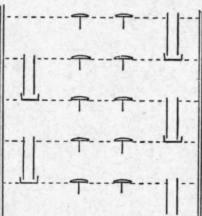
Fig. 106.
Continue to:


My Books

