


Chapter XV. Distillation On The Manufacturing Scale
Description
This section is from the book "Distillation Principles And Processes", by Sydney Young. Also available from Amazon: Distillation Principles And Processes.
Chapter XV. Distillation On The Manufacturing Scale
Plant Required
The plant required for the distillation of alcohol, acetone, coal-tar and its products, petroleum and its products, glycerine and essential oils on the large scale is fully described in the sections dealing with those substances, but a brief sketch of the chief forms of plant may be useful. .
When only a rough separation of the constituents of a complex mixture is required the vapour passes directly from the still to the condenser, but for the better separation of the components modified still-heads are employed.
Mansfield's Still
A simple contrivance, which was adopted by Mansfield, is to cool the still-head with water, the temperature of which is allowed to rise to a suitable extent. The head A (Fig. 58) is surrounded by water which becomes heated to its boiling point. Liquids which boil at temperatures higher than 100° are for the most part condensed in the still-head and return to the still; afterwards the stopcock b is opened and the vapour then passes directly to the condenser. With this still, Mansfield was able to separate benzene in a fairly pure state from coal-tar.
Dephlegmators
A constant or regulated temperature still-head, such as that employed in Mansfield's still, is now usually termed a dephlegmator ; it now forms a more or less important part of many plants. It has two functions, (a) fractionation, (b) the providing a sufficient amount of condensed liquid for the satisfactory working of the bubbling or other still-head. In Mansfield's still it performs the first function only, but in many modern plants the second function is by far the more important.
Coupler's Still
In Coupler's still (Fig. 59), a more elaborate cooling arrangement is combined with a bubbling still-head or column.
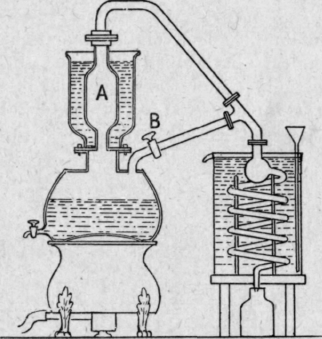
Fig. 58. - Mansfield's still.
The vapour from the still a passes first through the rectifier or column B, and then by the pipe c into a series of bulbs placed in a cistern d containing brine, which may be warmed by steam from the pipe e. The liquid condensed in the bulbs returns by the pipes p, f, to the column, the less volatile vapours being for the most part condensed in the first bulb and the liquid returning to a low part of the column, while that from the other bulbs reaches it successively at higher levels. The vapour, freed from substances boiling at higher temperatures than that of the water in the tank, then passes by the pipe g to the condenser h. The contents of the still are heated by the steam-pipe J.
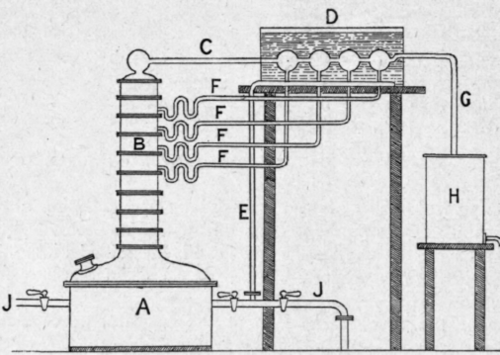
Fig. 59. - Coupier's still.
French Column Apparatus
A very similar arrangement is seen in the French column apparatus (Fig. 60). The liquid to be distilled is heated by a steam-pipe in the still A; the vapour rises through the rectifier b, passes through the series of pipes in the tank c, and then enters the condenser d. Cold water from the cistern e enters the condenser at the bottom, and in its passage upwards is warmed by the condensation of the vapour; the warm water passes through the pipe f into the tank, which is divided into sections by the vertical partitions shown in the figure. Here the water receives more heat owing to condensation of vapour in the pipes, so that it is hottest where it leaves the tank by the pipe G. Thus the vapour, in passing from the rectifier to the condenser through the dephlegmator, is cooled by successive stages, and the liquid which returns to the lower part of the rectifier through the pipe H is much richer in the less volatile components than that which reaches the top by the pipe h'.
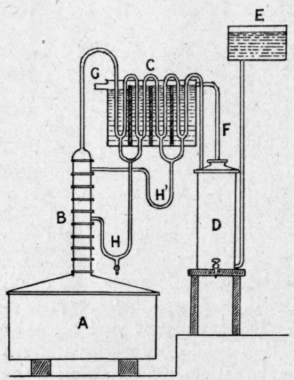
Fig. 60. - French column apparatus.
In the case of very complex mixtures, from which it is only necessary to separate fractions of different volatility, the successive condensates from such a dephlegmator may be collected separately instead of being returned to the rectifier. Fractionation is then the sole function of the dephlegmator, as in Mansfield's still.
Bubbling Still-Heads
In many still-heads part of the vapour is condensed and forms pools of liquid through which the rising vapour has to force its way, so that very complete contact between vapour and liquid is ensured. A dephlegmator is very frequently placed at the top of the still-head in order to provide sufficient liquid for the pools. The details of the various bubbling still-heads differ considerably ; a few of them are shown in Figs. 61 to 65 ; others are described in the special sections (pp. 302, 303, 331, 402, 403).
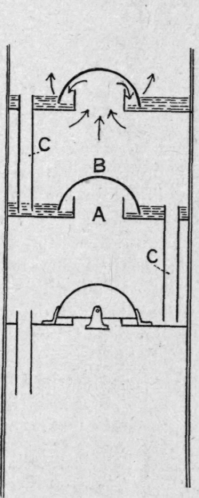
Fig. 61. - Dubrunfaut's still-head.
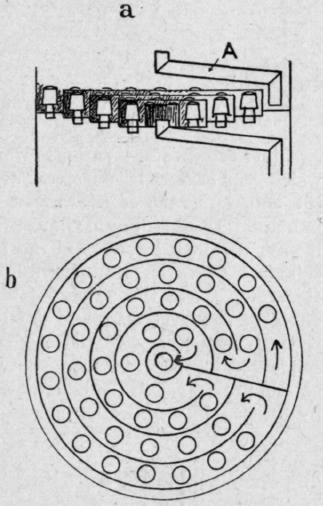
Fig. 62. - Egrot's still-head.
The condensed liquid collects on trays which in some cases are perforated ; in others they are plain and the vapour then rises through a central pipe a (Fig. 61) in the tray, but its ascent is barred by a dome B, and it bubbles through the condensed liquid in the tray. The dome may be serrated round its lower edge (Fig. 134, p. 331) or may have vertical slits (Fig. 109, p. 303) so as to break up the bubbles more completely. In some cases, as in the Egrot still-head (Fig. 62), there are numerous domes or similar contrivances on a tray, and the condensed liquid is made to follow a zigzag course from the circumference to the centre of each tray. The liquid reaches the tray by pipe A (Fig. 62a), and follows the course shown by the arrows in Fig. 626.
In all cases the excess of liquid flows back through a reflux pipe, the lower end of which is trapped by liquid in various ways, as shown in Figs. 63 to 65, c, Fig. 61, and a, Fig. 62a.
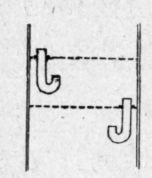
Fig. 63. Savalle's still-head.
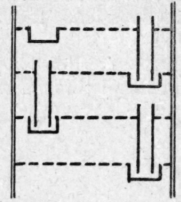
Fig. 64. Savalle's still-head.
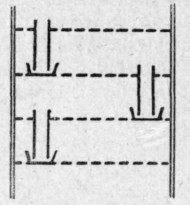
Fig. 65.
Coffey's still-head.
Continue to:


My Books

