


Fractional Separation Of The Naphthas And Light Oils. Part 6
Description
This section is from the book "Distillation Principles And Processes", by Sydney Young. Also available from Amazon: Distillation Principles And Processes.
Fractional Separation Of The Naphthas And Light Oils. Part 6
Combined Column And Dephlegmator
Many attempts have been made to combine the action of a column and dephlegmator in one. Miller (Eng. Pat. 25469, 1901) interposes dephlegmators between each section of the column. Vallat (Fr. Pat. 376872,1907) inserts horizontal water tubes in each section of the column. Lummas (U.S.A. Pat. 1216334, 1917) on the other hand surrounds the sections of the column with water coils. Wright and Atwood (U.S.A. Pat. 1278279 and 1278280) go still further, and besides surrounding the sections with coils they make arrangements to obtain, if desired, separate fractions off each. Barbet et Fils (Fr. Pat. 469979, 1913) insert water tubes in the liquid which collects on each tray in the column whereby more delicate control can be attained.
Other Stills
Perrier's Still
Perrier (Fr. Pat. 409041, 1909) invented a most ingenious device in which he entirely did away with column and dephlegmator. Two horizontal shafts, each carrying a series of discs dipping into the condensed liquid, rotate at a high speed in opposite directions in a horizontal oval drum through which vapours from the still pass. A series of partitions divides the drum into chambers, so that the vapours pass through the chambers in turn and are subjected to the spray produced by the rotating discs.
Foucar's Still
Foucar's "differentiator" column (Eng. Pat. 19999, 1908) is a double-walled cylinder, between the two walls of which a spiral is set. The vapours from the still pass into the space between the two walls and are there fractionated. Vapour may also be passed to the inside tube where it is refluxed back to the still. This maintains a regulating temperature on the column. The liquid descends on the spiral and is continuously brought in contact with ascending vapour. Wonderful results have been obtained with this column on a small scale, but engineering difficulties of manufacture seem to be the cause of its partial failure in works practice.
It is doubtful whether any of these ideas are of much practical value as they have not been adopted by present-day distillers.
4. Condensers and Receivers
Little need be written about these as the apparatus is so simple. Any tank containing a cast iron or drawn wrought iron coil will meet the requirements of a condenser provided it has cooling surface enough to condense all vapours completely. After leaving the condenser the liquid usually passes through a sight glass, so that the rate of flow can be noted by the operator. The receivers are arranged in duplicate and should not be too large, otherwise an unnecessary loss will be involved. For instance, if the still is just finishing to run pure benzene and a 200-gallon receiver has in it 150 gallons, it may not be possible to notice that the benzene is off until the receiver is full, so that the whole 200 gallons will have to be reworked. If the receiver had only been of 50-gallon capacity probably the expense of redistilling at least 150 gallons would have been saved. The receivers are connected directly to the storage tanks and also to a series of drums or other small tanks. When the whole charge is off, sampling and testing of these small receptacles will enable the whole distillate to be split up into the required fractions.
Description of some of the Modern Plants
Intermittent Types
Hodgson Thomas Plant. - The intermittent rectifying plant of Hodgson Thomas, Manchester, as' shown in Fig. 169, is one that gives good results.
The still is heated by steam passing through a nest of tubes fixed close to the bottom of the still and divided into two separate units. The column, upon which the efficiency of a still mainly depends, consists of a number of cast iron circular sections into each of which is fitted a loose plate, carrying four serrated caps. A liquid return pipe is fitted into each plate and is so arranged that a good seal is secured. The dephlegmator is carried on the top of the tower and is independent of it; it is built up of a number of tubes fitted into expansion tube plates, the cooling water passing through the tubes. Baffles are arranged to break up the vapours which enter the top of the dephleg-mator, and an outlet is provided for carrying the heavier fractions back to the tower. By dispensing with an analyser the initial cost of the plant is reduced and there is of course a constant economy in the use of water. The condenser is a large circular tank fitted with coil and stands, and of sufficient cooling surface to prevent waste of vapour. To the outlet of this coil is attached a special sight glass consisting of two glasses, one of which is graduated so that the rate of flow can be readily estimated, and being arranged at a convenient height the glass is visible from some distance. The receiver is made of cast iron ; it is circular in shape and fitted so that the distillate may be either run into barrels or direct into storage tanks.
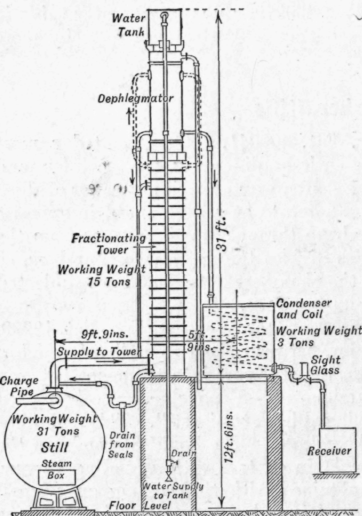
Fig. 169. - Hodgson Thomas Plant.
The cost of the plant maintenance is said to be low, whilst its efficiency is certainly high and there is an almost entire absence of pressure when working. The plant is also very adaptable, as with slight alterations it can be used for most coal-tar products. From a charge of crude benzole (60 per cent to 65 per cent below 120° C.) the plant will produce a good standard product (95 per cent below 90° C.) in one operation, the rate of distillation varying between 120 and 150 gallons per hour according to the available steam pressure. Should pure benzole be required, the plant will give, in one distillation of a standard product at the rate of 100 gallons per hour, a distillate with a range of 0.2 to 0.5° C, the quantity of water used in the dephlegmator varying between 100 and 120 gallons per hour. All the valves are operated from the floor level, and the whole plant can be shut down by Operating one valve.
Some makers still prefer the perforated plate type of column and maintain that it gives as good results as the cup type. Two such manufacturers are - The Chemical Engineering and Wilton's Patent Furnace Co., Ltd., and R. & J. Dempster, Ltd. Their columns are very much alike, so that it is only necessary to describe one of them.
Continue to:


My Books

