


Electrotyping. Part 4
Description
This section is from the "Encyclopedia Of Practical Receipts And Processes" book, by William B. Dick. Also available from Amazon: Dick's encyclopedia of practical receipts and processes.
Electrotyping. Part 4
3671. Electrotyping with a Battery
3671. Electrotyping with a Battery. For this purpose a Smee's battery (see No. 3667 (Description of a Smee's Battery)) is usually employed, in connection with a decomposing cell. (See No. 3664 (Decomposing Cell).) As the method for electrotyping, or coating with copper, is substantially the same as for other metals, a description of the first will suffice. The decomposing cell being charged with a solution of sulphate of copper (see No. 3661 (Solution of Copper for Electro-typing)), the object, duly prepared (see No. 3689 (To Prepare Non-Metallic Moulds to Receive Deposit)), to be electrotyped, is properly secured in position, and connected with the cathode or wire leading from the zinc plates of the battery. To the anode or wire leading from the silver plate, a positive electrode, consisting of a piece of the same metal as the solution contains (in this case, copper), is attached, and immersed in the solution, face to face with the object to be electrotyped; as the copper from the solution is precipitated on the object, the piece of copper is dissolved, and thus keeps up the strength of the solution. Any number of objects may be electrotyped in the same decomposing cell, provided that each is connected with the zinc pole of the battery, and hangs facing a positive electrode. The usual arrangement for this purpose consists of a water-tight trough of suitable size and shape (usually oblong), to contain the copper or other metallic solution, and is provided with metal bars, long enough to reach the length of the trough and rest on the upper edge at each end; the bars rest on dry varnished blocks of wood, and are laid parallel to each other at a distance of 3 or more inches apart, according as the space between them is required. Plates of copper of nearly the same length as the trough are suspended from the bars, and submerged in the solution parallel with them. These bars, and consequently the copper plates (which constitute continuous positive electrodes) are connected with copper wire or ribbons to the anode, or silver pole of the battery. Alternately between these bars, other bars are placed, exactly similarly arranged, but having small projections or buttons on one of their sides, to which the objects to be electrotyped are secured by a wire, and suspended in the solution, face to face with its corresponding copper plate. These latter bars are connnected with the cathode or zinc pole of the battery. It will thus be evident that each contiguous pair of bars are mutually positive and negative electrodes, and the objects on the one must closely face the copper plate on the other. The accompanying cut will give some idea of the arrangement of one pair of bars.
B B is the bar connected by the wire S with the silver pole of the battery, and supporting a plate of copper suspended in the trough. In the cut, the copper is supposed to be transparent, in order that the objects to
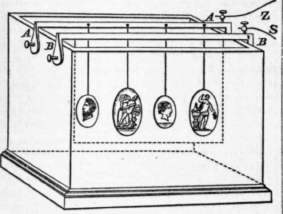
be electrotyped, suspended from the bar A A, may be visible; they are supposed to be behind and closely facing the copper plate. The bar A A is connected by the wire Z to the zinc pole of the battery.
Continue to:


My Books

