


Electrotyping. Part 2
Description
This section is from the "Encyclopedia Of Practical Receipts And Processes" book, by William B. Dick. Also available from Amazon: Dick's encyclopedia of practical receipts and processes.
Electrotyping. Part 2
3666. To Construct a Cheap Galvanic Battery
3666. To Construct a Cheap Galvanic Battery. Take a gallon stone jar, and place a sheet-zinc cylinder therein, and inside that a porous cup (a porous flowerpot with a cork fitted in the hole will answer after a fashion). Inside the porous cup place a piece of sheet copper. Use a solution of common salt next the zinc, and a solution of sulphate of copper next the copper in the porous cup, if a strong current be desired. The liquids inside and outside the porous cup should stand at the same level. Dilute sulphuric acid (1 part acid to 10 water) makes a very constant, but weaker current.
3667. Description of a Smee's Battery
3667. Description of a Smee's Battery. This apparatus consists of a vessel containing a mixture of about 15 or 20 (Mor-fit gives only 7) parts water to 1 part sulphuric acid, provided with a strip of baked and varnished wood, long enough to stand across the edge of the vessel, and grooved lengthways underneath, to receive the edge of
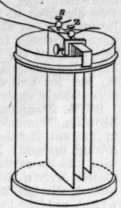
a silver plate, to which a short wire is attacked and connected through a hole in the wood with a screw cap on the upper side of the wood. Two plates of zinc are arranged, one on each side of the strip of wood, and secured by a screw clamp, the upper part of which is also fitted with a screw cap. The object of the screw caps is to receive and secure the wires connecting with the decomposing cell. The zinc plates must first be coated with amalgam (see No. 3662 (To Amalgamate Zinc), also No. 3663); and the silver plate must be covered with a coating of platina. (See No. 3670 (To Coat Silver with Platina).) The arrangement of the parts will be seen in the cut. When two or more cells are used in combination, forming a compound battery, the silver plate of the first cell is connected by a wire with the zinc plates of the second; the silver plate of the second cell is connected with the zinc of the third cell; the silver of the third with the zinc of the fourth, and so on through any number of cells. The two wires connecting the battery with the decomposing trough are attached, one to the zinc plates of the first cell, and the other to the silver plate of the last cell. In fact, the zinc pole of the first, and silver pole of the last cell, really constitute the battery, the intermediate cells each furnishing an additional quota, as it were, of intensity, to the galvanic current.
The wire connected with the zinc (or positive) plates is called the negative pole or cathode; and the wire connected to the silver (or negative) plate is called the positive pole or anode. The material used for connecting wires is usually copper, and should be clean and bright, and in order to insure perfection of contact, the ends of the wire may be amalgamated by dipping, first in a solution of nitrate of mercury, and then in metallic mercury.
Continue to:


My Books

