


Chemical Manipulations. Part 3
Description
This section is from the "Encyclopedia Of Practical Receipts And Processes" book, by William B. Dick. Also available from Amazon: Dick's encyclopedia of practical receipts and processes.
Chemical Manipulations. Part 3
3839. Filtering Powders
3839. Filtering Powders. In many cases a liquid will not readily become transparent by simply passing through the filter; hence has arisen the use of filtering powders, substances which rapidly choke up the pores of the media in a sufficient degree to make the fluid pass clear. These powders should not be in too fine a state of division, nor used in largo quantities, as they then wholly choke up the filter, and absorb a large quantity of the liquid. For some liquids these substances are employed for the purpose of decoloring or whitening them. In such cases, it is preferable first to pass the fluid through a layer of the substance in coarse powder, from which it will run but slightly contaminated into the filters: or, if the substance be mixed with the whole body of the liquid, to

pass it through some coarser medium, to remove the cruder portion, before allowing it to run into the filter. Fuller's earth, pipe clay, or potter's clay, washed, dried without heat, and reduced to coarse powder, are used to filter and bleach oils.
Fuller's earth or clay, 1 part, and 2 parts fine silicious sand, first separately washed and drained, then mixed together and dried, constitutes a filtering powder well adapted for glutinous oils.
Granulated animal charcoal, sifted and fanned free from dust, is used to filter and bleach syrups and vegetable solutions.
Carbonate of magnesia and powdered glass, or pumice stone, are used for filtering weak alcoholic solutions of essential oils, and in the preparation of perfumed waters. (See Nos. 976. 1029, 10S0, and 1081.)
3840. Self-Feeding Filter
3840. Self-Feeding Filter. It is usually a matter of more or less importance in filtration, that the filter should be kept full. To effect this requires unremitting attention, which, when the filtration occupies a consid-
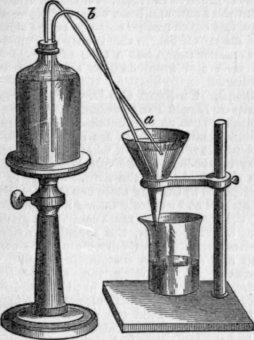
erable time, is at least tedious. By the use of a simple apparatus, this is avoided, and filtration will continue, without any personal attention, until the operation i:s complete. A bottle or jar, of sufficient capacity to contain the liquid to bo filtered, is placed in a convenient position, above the level of tho filter (see illustration); through the cork, which must fit air-tight, aro inserted two bent tubes; one end of the tube b must reach nearly to the bottom of the jar, the other end descending deep into the filter; the tube a terminates at one end Just below the cork of the jar, the outer end being adjusted in the filter at the height which it is desired that the liquid shall bo kept at in tho filter. The apparatus is set in working order by Bucking the liquid into the tube b, so as to fil it. The liquid will continue to flow until its surface in the filter rises sufficiently to reach to and close the end of the tube a, cutting off the ingress of air into the bottle, and thus stopping the further flow, until, by the falling of the filtrate into the vessel placed to receive it, the liquid in the filter again sinks below the tube a, and allows the flow to be resumed until again stopped as before. (See No. 17 (Filtration), Fig. G.)
Continue to:


My Books

