


Definitions. Part 5
Description
This section is from the "Encyclopedia Of Practical Receipts And Processes" book, by William B. Dick. Also available from Amazon: Dick's encyclopedia of practical receipts and processes.
Definitions. Part 5
17. Filtration
17. Filtration. The word filtration is absolutely synonymous with straining; but, in the language of the laboratory, the former is usually applied to the operation of rendering liquids transparent, or nearly so, by passing them through fine media, as filtering paper, for instance; the latter to the mere separation of the grosser portion, by running them through coarse media, as flannel, horsehair cloth, etc., through which they flow with considerable rapidity. Filtration is distinguished from clarification, by the former removing the solid matter, or cause of opacity or foulness, by mere mechanical means, whereas the latter consists in the clearing of a liquid by depuration, or the subsidence of the suspended substances or faeces, arising from their gravity being naturally greater than the fluid with which they are mixed, or being rendered so by heat or the addition of some foreign substance. (See Fining.)
The apparatus, vessels, or media, employed for filtration, are called filters, and are commonly distinguished from strainers by the superior fineness of their pores, as above noticed.
Both strainers and filters act on the same principles as the common sieve on powders; they all, in like manner, retain or hold back the coarser matter, but permit the liquid or smaller and more attenuated particles to pass through. The term medium has been applied to the substance through the pores of which the liquid percolates.
The forms of filters, and the substances of which they are composed, are various, and depend upon the nature of the liquids for which they are intended. On the small scale, funnels of tin, zinc, copper, wedgwood ware, earthenware, glass, or porcelain, are commonly employed as the containing vessels. The filtering medium may be any substance of a sufficiently spongy or porous nature to allow of the free percolation of the liquid, and whose pores are, at the same time, sufficiently fine to render it Limpid or transparent. Unsized paper, flannel, linen, muslin, cotton-wood, felt, sand, coarsely-powdered charcoal, porous stone or earthenware, and numerous other substances of a similar kind are employed for this purpose.
Filters of unsized paper are well suited for
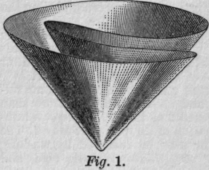
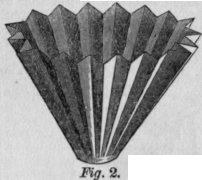
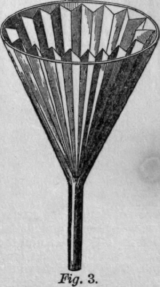
all liquids that are not of a corrosive or viscid nature, and are universally employed for filtering small quantities of liquids in the laboratory. A piece of the paper is taken, of a size proportionate to the quantity of the substance to be filtered, and is first doubled from corner to corner into a triangle (see Fig. 1, below), which is again doubled into a smaller triangle, and the angular portion of the margin being rounded off with a pair of scissors, constitutes a paper cone, which is placed on a funnel and nearly filled with the liquid. A piece of paper so cut, when laid flat upon a table, should be nearly circular. Another method of forming a paper filter, preferred by some persons, is to double the paper once, as above described, and then to fold it in a similar way to a fan, observing so to open it (see Fig. 2) and lay it on the funnel that a sufficient interval be left between the two to permit of the free percolation of the liquid. (See Fig. 3.)
To promote the same object, a funnel should be deeply ribbed inside, or small rods of wood or glass, or pieces of straw, or quills, should be placed between it and the paper. The neck of a funnel should also be deeply ribbed or fluted outside, to permit of the free outward passage of the air when it is placed in a narrow-mouthed bottle or receiver. Unless this is the case, the filtration will proceed but slowly, and the filtered liquid will bo driven up the outside of the neck of the funnel by the confined air, and will be continually hissing and flowing over the mouth of the vessel. The breadth of a funnel, to filter well, should be about three-fourths of its height, reckoning from the throat or neck. If deeper, the paper is liable to be continually ruptured from the pressure of the fluid; and when shallower, filtration proceeds slowly, and an unnecessa-
rily large surface of the liquid is exposed to evaporation. To lessen this as much as possible, the upper edge of the glass is frequently ground perfectly smooth, and a piece of smooth plate-glass is laid thereon. When paper filters are of large dimensions, or for aqueous fluids that soften the texture of the paper, or for collecting heavy powders or metallic precipitates, it is usual to support them on linen or muslin to prevent then breaking. This is best done by folding the cloth up with the paper and cutting the filter out of the two, in the same way as would be done with doubled paper, observing so to place it in the funnel that the paper and muslin may remain close together, especially towards the bottom.
The filtration of small quantities of liquids, as in chemical experiments, may often be conveniently performed by merely placing the paper on the circular top of a recipient; or on a ring of glass or earthenware laid on the top of any suitable vessel. A filter of this kind, that will hold one fluid ounce, will filter many ounces of some liquids in an hour.
Good filtering paper should contain no soluble matter, and should not give more than one two hundred and fiftieth to one two hundred and thirtieth of its weight of ashes. The soluble matter may be removed by washing it, first with very dilute muriatic acid, and secondly with distilled water.
For filtering a larger quantity of a liquid than can be conveniently managed with a tunnel, and also for substances that are either too viscid or too much loaded with feculence to allow them to pass freely through paper, conical bags made of flannel, felt, twilled cotton cloth or Canton flannel, linen, or muslin, and suspended to iron hooks by rings or tapes, are commonly employed. (See Fig. 4.) The
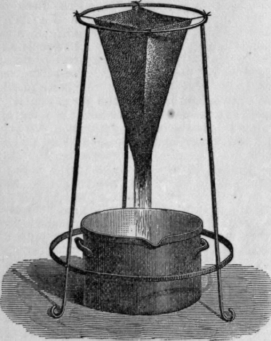
Fig. 4.
first two of the above substances are preferable for saccharine, mucilaginous, and acidulous liquids; the third for oily ones; and the remainder for tinctures, weak alkaline lyes, and similar solutions. These bags have the disadvantage of sucking up a considerable quantity of the fluid poured into them, and are therefore objectionable, except for large quantities, or when continued in actual use as filters for some time. On the large scale, a number of them are usually worked together, and are generally enclosed in cases to prevent evaporation, and to exclude dirt from the filtered liquor that trickles down their outsides.
A very simple mode of filtering aqueous fluids, which are not injured by exposure to the air, is to draw them off from one vessel to another, by means of a number of threads of loosely twisted cotton or worsted arranged in the form of a syphon. The little cotton rope at once performs the operations of de-cantation and filtration. This method is often convenient for sucking off the water from small quantities of precipitates.
When pulverulent substances, as sand, coarsely-powdered charcoal, etc., are employed as the media for filtration, vessels of
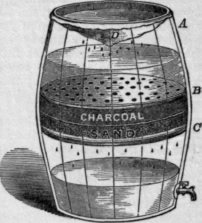
Fig. 5.
wood, or stoneware, are employed to contain them and the supernatant liquid. In these cases, the filtering medium is usually arranged as a shelf or diaphragm, and divides the vessel into two compartments; the upper one being intended to contain the liquid, and the under one to receive the same when filtered. Such an apparatus is set in operation by merely filling the upper chamber, and may, at any time, be readily cleaned out by reversing it and passing clean water through it in an opposite direction. The following is a filter of this description, and very simple in its arrangement. (See Fig. 5.) A is a common cask, B and C are false bottoms, fitting in perfectly air tight, but perforated with one-fourth inch holes. C should be covered with canvas, and above that a sheet of cotton wadding; above the wadding is abed of perfectly clean sand, 3 inches deep. The sand should be covered over with flannel, and above the flannel should be a bed of granulated animal charcoal (sifted and fanned from the dust), 4 inches in depth. After having done this, fit in the false bottom, B, and cover it with a piece of cotton cloth. I) is a bag made of Canton flannel to prevent the liquor being filtered from coming with too much force upon the false bottom. By substituting cotton wadding instead of the charcoal in the above filter, a fine filter for brandy and other liquors may be obtained.
A filter which possesses the advantages of being easily and cheaply cleaned when dirty, and which very thoroughly purifies brandy or water with great rapidity, may be formed by placing a stratum of sponge between two perforated metallic plates, united by a central screw, and arranged in such a manner as to permit of the sponge being compressed to any required degree. Brandy or water, under gentle pressure, flows with great rapidity through the pores of compressed sponge.
It is often of great advantage to render a filter self-acting, or to construct it in such a way that it may feed itself, so that it may continue full and at work without the constant attention of the operator. On the small scale, this may bo readily effected by an arrangement as represented in Fig. 6; and on the large scale by placing the vessel containing the unfiltered liquid on a higher level than the filter, and by having the end of the supply-pipe fitted with a ballcock, to keep the liquid in the filter constantly at the same height. (SeeNo.3840.)
The rapidity of filtration depends upon the porosity of the filtering medium — the extent of filtering surface - the relative viscidity or limpidness of the filtering liquid, and the porosity and fineness of the substances it holds in suspension. The most efficient filter is produced when the first two are so graduated to the latter, that the liquid filters rapidly and is rendered perfectly transparent. (See No. 3838 (Bunsen's Method of Rapid Filtration).) (Cooley.)
Tinctures and dilute spirits are usually filtered through bibulous paper placed on a funnel, or through thin and fine cotton bags. In general, tinctures clarify themselves by the subsidence of the suspended matter, when allowed to repose for a few days. Hence it is the bottoms alone that require filtering; the supernatant clear portion need only be run through a small hair sieve, a piece of tow or cotton placed in the throat of a funnel, or some other coarse medium, to remove any floating substances, as pieces of straw, etc.. Spirits largely loaded with essential oil, as those of aniseed, etc., run rapidly through paper or muslin, but usually require the addition of a spoonful or two of magnesia before they will flow quite clear. When possible, tinctures, spirits, and all similar volatile fluids, are better cleared by subsidence or clarification than by filtration, as, in the latter way, part is lost by evaporation. (See Nos. 3834 (To Filter Vegetable Juices), etc..)
Continue to:


My Books

