


Aromatic, Odoriferous, or Perfumed Waters, etc. Part 3
Description
This section is from the "Encyclopedia Of Practical Receipts And Processes" book, by William B. Dick. Also available from Amazon: Dick's encyclopedia of practical receipts and processes.
Aromatic, Odoriferous, or Perfumed Waters, etc. Part 3
1074. To Remove the Burnt Smell of Freshly Distilled Waters
1074. To Remove the Burnt Smell of Freshly Distilled Waters. The burnt smell of waters, frequently arising from careless stilling, is usually lost, or greatly lessened, by freezing, or by exposure to a temperature approaching the freezing point; but if the water be highly charged with essential oil, | part of the latter will separate, and thus the water will lose some of its fragrance. (See No. 1076 (Practical Suggestions for Making Distilled Waters).)
1075. To Prevent Distilled Waters from Souring
1075. To Prevent Distilled Waters from Souring. To prevent carelessly prepared distilled waters acetifying or turning sour, and to recover those which have begun to spoil, a common plan is to shake them up with a little calcined magnesia, or to dissolve in each pint of them 1 grain each of powdered borax and alum. This, however, is not to be recommended, as it unfits the waters for use as vehicles. "Whenever it is unavoidably had recourse to, the best plan is to re-distill the water a few days afterwards.
1076. Practical Suggestions for Making Distilled Waters
1076. Practical Suggestions for Making Distilled Waters. There are certain general rules or points to be adhered to in distilling perfumed waters: Dry, hard, or fibrous substances should be mechanically divided, and macerated in water before undergoing distillation. Too great a quantity of materials should not be introduced at one time into the body of the still; if this precaution be neglected, there is a risk of the liquid boiling over or spirting into the receiver. Ebullition should be attained as quickly as possible, and be continuous. Sufficient water should be left undistilled to cover the matter in the still, to guard against its coming in contact with the sides of the vessel. In this case the matter would be decomposed by the heat, and yield empyreumatic products; besides, if the distillation is carried too far, a slimy formation is apt to adhere to the sides of the still, which would also be decomposed by the heat, and have a similar effect on the product. These risks may be greatly lessened, if not entirely avoided, by applying heat by means of an oil-bath, regulated by a thermometer; and still better by a bath containing a solution of chloride of calcium (muriate of lime). Any degree of heat between 212° and 285° Fahr. may be obtained and sustained by regulating the strength of the solution. (See No. 7 (Table showing the Boiling Heat of various Saturated Solutions).) Another convenient method is by steam. (See No. 1077 (Soubeiran's Steam Apparatus for Distilled Waters).) Waters distilled from plants are apt to have a smoky odor at first, even when the greatest care and precaution have been observed in their distillation; exposure for a short time to the air will remove this, after which they should be kept in closely-stoppered bottles, and preferably in bottles 'containing only sufficient for probable use at one time; they should be entirely filled and closed air-tight.
1077. Soubeiran's Steam Apparatus for Distilled Waters
1077. Soubeiran's Steam Apparatus for Distilled Waters. The illustration given is a vertical section of Soubeiran's apparatus used in Prance for obtaining distilled waters. A cylindrical tinned-copper or iron boiler, A, of convenient size, say 31/2 feet high and 2 feet in diameter, is surmounted by an expanded head or capital, B, which is furnished with an inner ledge, forming a kind of gutter, to receive the liquid condensed on the inner surface of the capital, and opening into the exit tube, i e. About 6 inches from the bottom of the I cylinder is placed a false bottom or diaphragm, I c, pierced with small holes. A steam pipe, d, having a stop-cock, a, is introduced in the cylinder in the manner shown, terminating in an expansion, b, perforated like the rose of a watering-pot, and located a little below the diaphragm.
The material to be distilled, after proper preparation, is placed upon the diaphragm, the capital, B, is applied and luted with dextrine paste; steam is passed through the tube,
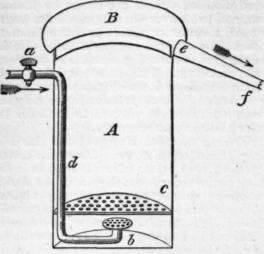
and issuing from b, passes through the material, becomes loaded with the volatile matter, rises into the capital, condenses, and passes through f, into a worm or other suitable condenser.
Continue to:


My Books

