


Gingko
Description
This section is from "The American Cyclopaedia", by George Ripley And Charles A. Dana. Also available from Amazon: The New American Cyclopædia. 16 volumes complete..
Gingko
Gingko (Salisburia adiantifolia), a large tree from China and Japan, belonging to the yew suborder of coniferae. No tree can appear less like a member of the pine family than the ginkgo; it is a rapid grower, with a straight trunk clothed with a light gray bark; its deciduous leaves are alternate, fan-shaped or wedge-shaped, with the broad apex notched or cut more or less deeply, frequently two-lobed, thick and leathery, with fine longitudinal ribs, and of a light yellowish green color. The leaves are so like those of some maidenhair ferns that it is by some called the maidenhair tree. The staminate and pistillate flowers are borne upon separate trees; the former are in slender catkins about 1 1/2 inch long, while the female flowers are either solitary or in small clusters at the ends of the branches; the female flower, which consists only of a naked ovule, is seated in a small cup-like disk; this increases in size and covers the base of the ripe fruit, which is a globular or ovate nut. In its native countries the ginkgo attains a large size; Bunge mentions one 40 ft. in circumference and still vigorous; a specimen in the botanic garden at Pisa is 75 ft. high.
It is supposed that it was introduced into Europe from Japan by the Dutch; it was first planted in this country in 1784 by Mr. Alexander Hamilton, who lived near Philadelphia; the trees are still standing, though the grounds have been converted into a rural cemetery; there are also some fine specimens in Boston. The wood is of a yellowish color without any resinous qualities, and useful as lumber, though the Chinese cultivate the tree mainly for its nuts, which are edible but insipid; medicinal virtues are attributed to them, and they are considered essential, roasted or boiled, at entertainments. Though the tree was for many years regarded as a great rarity in the United States, it is now not uncommon in cultivation, and is used in the ornamentation of lawns and pleasure grounds; it should be planted where the peculiarity of its foliage can be readily observed. By frequently heading back the branches, it can, if desired, be kept in the form of a large bush. As it is perfectly hardy at Boston, it will probably endure the climate in most parts of the country. It is raised from seeds, cuttings, and layers; it has not fruited to any great extent in this country, but has done so abundantly, in Europe, and the seeds are imported by seed dealers.
Cuttings of the old wood or of the partly ripened new- wood take root readily, as do layers. Trees grown from cuttings and layers are not likely to be so well shaped as those obtained from seed. Gingko is one of the Chinese names for the tree, and was adopted by Linnauis as the generic name; he described it in 1771 as gingko biloba, but Sir James Edward Smith, considering the name uncouth and barbarous," in 1796 altered it to Salisburia, in honor of R. A. Salisbury, an English botanist; the specific name recognizes the resemblance of the leaves to the fronds of adiantum, the maiden-hair fern. Although this change of name was against the rules of scientific nomenclature, and strongly protested against at the time, later botanists have generally adopted it.
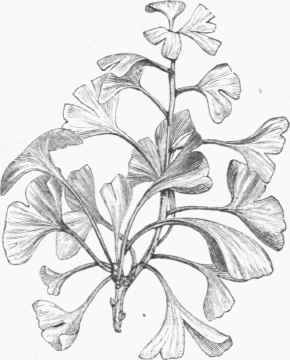
Gingko (Salisburia adiantifolia).
Continue to:


My Books

