


Ginger
Description
This section is from "The American Cyclopaedia", by George Ripley And Charles A. Dana. Also available from Amazon: The New American Cyclopædia. 16 volumes complete..
Ginger
Ginger, the scraped and dried rhizoma of zingiber officinale, a plant of the order zingi-beracem, a native of Hindostan, but cultivatad both in the East and West Indies, and in Sierra Leone. It has a tuberous root, an annual stem 2 or 3 ft. high, and smooth, lanceolate leaves, 5 or 6 in. long. Its flowers are yellowish and emit an aromatic odor. Its medicinal virtues reside in its root, of which two varieties are found in the market, the black and the white or Jamaica ginger. The difference is chiefly in the retention or removal of the epidermis, and perhaps a subsequent bleaching process applied to the lighter variety. In commerce the whole ginger is called race ginger. A preserve is made by boiling the young and tender roots in sugar; large quantities of it are imported from China. Ginger is used both for cooking and as a medicine. Its odor is aromatic and characteristic, its taste spicy and pungent. It contains a volatile oil and resins, with other constituents of less importance, and enters into many officinal preparations, its virtues being usually extracted by alcohol; but an infusion may be used. The popular aromatic stimulant sold as extract of Jamaica ginger is a concentrated alcoholic tincture.
Ginger is a grateful stimulant and carminative, and is chiefly used either alone or in combination in disorders of the alimentary canal. It will often relieve flatulence and the griping pains of a mild colic. It renders bitter infusions and tinctures more acceptable to the stomach, and may be advantageously combined with tonic powders. In many cases it palliates, if it does not allay, the distress of seasickness. The dose of the powder is 10 grs. or more; the fluid extract and tincture are the best form for administration.
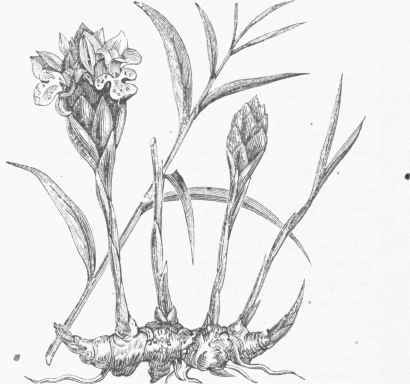
Ginger (Zingiber officinale).
Continue to:


My Books

