


Gecko
Description
This section is from "The American Cyclopaedia", by George Ripley And Charles A. Dana. Also available from Amazon: The New American Cyclopædia. 16 volumes complete..
Gecko
Gecko, a name applied to a family of nocturnal lizards (ascalabotae of Dumeril and Bi-bron), numerous in species, living in warm climates, and presenting characters of form, structure, and habits which make the group as distinct as that of the crocodiles or chameleons. Their size is small; the head wide, flattened, covered with scales, with marginal scuta at each jaw; the neck short; the body depressed, stout, thickest in the middle, without crest on the back, generally covered with small imbricated scales and scattered tubercles, smallest on the back; the tail moderate; the feet five-toed, the thumb often very short, and the other lingers equal, flattened below and lobed at the end; the tongue is fleshy, short, slightly protractile, free and scarcely emarginate at the tip; the eyes very large, covered as in serpents by a transparent immovable lid, behind which these organs have free motion; the pupil vertical, and often linear as in nocturnal animals generally; the opening of the ear is distinct, and the tympanum depressed; there are no teeth on the palate, those of the jaws thin, entire, numerous, with cutting edges, and adhering to the internal margin; femoral pores occasionally present, but usually absent; besides the leaflike expansion at the end of the toes, nails are generally present, capable of retraction, as in the cats, the latter favoring their progression in climbing on smooth surfaces.
The tail is shorter than in ordinary lizards, and the flatness and width of the head give them somewhat the aspect of salamanders; the mouth is deeply cleft, and the widely expanded jaws may be kept open for a long time, the cavity of the mouth being shut off from the throat by the application of the base of the tongue to the posterior part of the palate; from the shortness of the robust legs, the abdomen touches the ground in walking. This reptile is mentioned by Aristotle, and the modern name gecko is derived from the sound made by some of the Indian species, resembling the click of the hostler urging on his horses, and was first given by Laurent!; this genus was the ascala-hotes of Aristotle, the stellio of Pliny, and the tarentola of the ancient Italians. Their colors are generally gray or yellowish, but some have brighter tints which can be varied like those of the chameleon, probably by the same changes in the reflecting surface of the integuments; the sides of the body, limbs, and tail are sometimes fringed with membranes. In many species there is a line of pores along and under the thighs, from which a fatty moisture distils; some species of a genus will have these, and others not, and sometimes one sex only will be destitute of them.
The tail, as in salamanders, is ruptured with facility, and is reproduced readily, often in a deformed manner. Their food consists of larvae and insects, which they pursue into their leafy retreats; the imbricated plates on the bottom of their feet, like those of the tree frog and flies, enable them to climb smooth walls and similar surfaces, and to adhere to them with the back downward; by means of their sharp, curved, retractile claws, they can ascend trees and rough objects with ease and rapidity; from the quickness of their movements, their suddenly becoming motionless, and remaining so for a long time, and their resemblance to the colors of the substances on which they are placed, they are difficult to obtain, and not easy even to see; they hunt for food both by night and day; the same qualities which fit them for the pursuit of living prey enable them to escape their bird enemies. These reptiles are objects of horror and repugnance, from the erroneous idea that they exude a poison so powerful and subtle that their touch, a drop of their saliva, or a scratch with their nails, will produce leprosy and other cutaneous diseases, often ending fatally.
They like to approach human habitations, as there they find in greatest abundance their insect food; their ill-shaped body, smooth or spiny, dull colors, large head, their enormous staring eyes, rapid and silent motions, and familiarity in houses, render them very disagreeable, but by no means dangerous inmates. Found in all warm climates, they are very uncommon in Europe (two or three species), and most abundant in Asia, America, and Africa, and the Pacific islands are well supplied with them. They have been divided into genera according to the form and structure of their toes; but these generic characters in a family so nearly alike in its members are very unsatisfactory, and great and unnecessary multiplication of genera has been the result of the labors of various systematists. The arrangement of Dumeril and Bibron, which differs but little from that proposed by Cuvier in 1829, is as follows: 1. Platydactylus (Dum. and Bibr.), with toes enlarged for their whole length, with finely plicated striae beneath; of those species having the feet cloven, some have all the toes unarmed, others all unguiculate, others with the thumb only or with the second and third fingers unarmed; of those with pal-mated feet the fingers are either all unguicu-lated, or the thumb alone is unarmed; there are about 20 species, of which the varieties have been made into genera by Fitzinger, Wieg-mann, Kuhl, and others. 2. Hemidactylus (Cuv.), with the toes widened only at the base into an oval disk striated beneath; about 15 species. 3. Ptyodactylus (Cuv.), with the toes enlarged at the extremity into a cleft oval disk, striated below like a fan, and all armed with claws; destitute of femoral pores; four described species. 4. Phyllodactylw (Gray), with the terminal disk as in the last genus, except that two plates take the place of the fan-like striae; eight species. 5. Sphoeriodac-tylus (Cuv.), small species, with the toes ending in a single, simple, smooth cushion; nails absent, as well as femoral pores; three species. 6. Gymnodactylus(Spix), with toes not widened, but striated beneath; 12 species. 7. Stenodac-tylus (Fitz.), with simple toes, granulated below, and all provided with nails; with a single species.-As specimens of this animal the following may be mentioned: The wall gecko (PL muralis, Dum. and Bibr.; PI. facetanus, Aldrov.) is 6 in. long, of a grayish color, the upper part of the body and head rough; this species occurs all around the Mediterranean, and conceals itself in walls and stone heaps, delighting to cover itself with dirt and filth; it likes the heat of the sun, and, though beneficial in houses by destroying insects and vermin, is generally feared and persecuted, like the toad and other useful creatures.
The common gecko (PI. guttatus, Cuv.) of the continent of Asia and its archipelago is 11 in. long, of which the tail is about half; the general color is dark gray, with whitish spots. A common gecko in the walls of houses in theWest
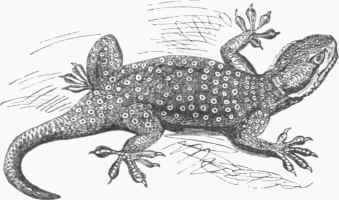
Common Gecko (Platydactylus guttatus).
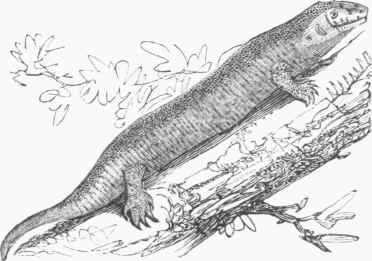
Hemidactylus mabouia.
Indies is the II mahouia (Cuv.), about 5 in. long, of a grayish color marbled with brown, with the posterior half of the tail ringed with black. The house gecko (Pt. Hasselquistii, Dum. and Bibr.), found in Egypt, Arabia, and countries bordering on the eastern part of the Mediterranean, is about 5 1/2 in. long, of a reddish gray color, spotted with white and pale brown, and whitish below; it is common in the damp and" gloomy parts of houses, and is called at Cairo "father of leprosy," from the belief that it communicates this disease to persons who partake of food over which this animal has walked, the poison being supposed to exude from the lobes of the toes. The truth is, that neither its bite nor any of its secretions are hurtful to man or beast; cats pursue it and eat it eagerly. The Egyptians are said to keep it from their kitchens by large quantities of garlic. The flat-tailed gecko (G. phyllurus, Dum. and Bibr.) has the tail flattened like a leaf, and the upper part of the body rough with spines; it is a native of Australia, and is about 9 in. long, dark gray, marbled with blackish above, and whitish beneath.
Continue to:


My Books

