


Timely Tips On Scout Protection
Description
This section is from the book "Camping Manual For Troop Scouters", by Boy Scouts of America. Also available from Amazon: Camping Manual For Troop Scouters.
Timely Tips On Scout Protection
Dirty Dish Danger. Will You Do the Driving? Scratches, Cuts and Punctures Fireworks Fatalities. Hot Water Health.
Have you ever visited a City or County Health Department laboratory and observed tests being made of samples of restaurant dish water and of smears taken from supposedly clean drinking cups, glasses and cutlery?
"Eating utensil distribution of disease first came to our attention in the U. S. Army during the measles and influenza-pneumonia epidemics of 1918. It was found that among troops provided with boiling water for the washing of mess-gear there was only about one-fourth as many cases and deaths as among those who washed their gear in luke warm water. Evidently warm wash water was a central focus of disease transmission and its high rate of distribution resulted in an infection rate four times greater than in the group protected by using boiling water.
Eating utensil transmission of disease organisms is a short chain consisting of five links: first, the saliva of the infected person; sec ond, his contaminated dishes; third, the wash water; fourth, the uten sils used by a non-infected person; and fifth, his mouth. This chain of transmission can be broken by disinfection at the central focus-the wash water-by using either hut water or disinfectants. This preventive measure will, if properly and intelligently carried out. block the distribution that usually occurs through this avenue."
Col. J. G. Cumming, M.D., Dr.P.H., "Blocking Infection Distribution."
If you have visited such a laboratory, then the method shown below of sterilizing the mess gear used on Troop hikes and at camp will probably be very welcome. If you have not made such a visit and there is any doubt in your mind as to the need of thoroughly disinfecting eating utensils after each use, then I can strongly recommend that you do so; it's quite an education.
Practically all the so-called "children's diseases" - measles, mumps, scarlet fever, etc.-may be transmitted through contact or articles which come in contact with the mouth. This is also true of many other communicable diseases ranging from common colds to tuberculosis.

San Antonio Scouts Observe Dish Water Tests mode in City Laboratory
How Hot Is "Hot"?
Water to be hot enough to sterilize dishes must reach a temperature of 180 degrees. As you arc not likely to carry a thermometer with you, the only way to be sure that the water is hot enough is to see it actually boil.
"But," someone may ask, "if it is so hot that I can't bear to keep my hands in it, isn't that O.K.?"
That is not a good test. 180 degree* would be far too hot for the hands to bear but so would 150 degrees or even much less for most persons. The temperature of a good hot bath is usually less than 105 degrees.
The use of boiling water for sterilization should of course follow the scraping off of all food particles and thorough washing in water hot enough to remove the grease completely. The dishes will dry so quickly when boiling water is used that dish towels are unnecessary. This latter is a real sanitary advantage for it is almost impossible to keep dish towels clean. Generally they seem to be used to clean half washed dishes rather than dry clean ones.

Sterilization of those utensils that touch the mouth is essential to health protection and easy to accomplish. Water is boiled in a No. 10 food can or a pail, cutlery is placed in smaller can in which holes have been punched to permit drainage. Cups are hung on a wire hook, or piece of cord. Illustrations at right show use of Army Dixies and garbage cans for water boiling. and quick draining, inexpensive wire baskets for carriers. Utensils submerged in boiling water for one minute will be thoroughly dry within three minutes. Use of unsanitary dish towels is eliminated along with the expense of purchase and care.
Transporting Scouts In Your Car
You are probably a good driver and in that case you do not need to be cautioned against driving Scouts at high speed, because you take seriously your duty to protect those boys for whom you have voluntarily assumed responsibility. It is a statistical fact, however, that "Persons injured in automobile accidents are two and a half times as likely to die as persons injured by any other means." (•)
You may be interested to know that we have what we believe to be a pretty sound speed rule in the Health and Safety Service. No member of the staff may drive a car at a speed in excess of that permitted in the state in which he is travelling, and under no circumstances faster than 50 miles per hour. There are three excellent reasons for this rule-
1st. Scouting stands for good citizenship and good citizens obey the law.
2nd. We believe in the power of example.
3rd. We believe in reducing the danger of injury of these men to the very minimum; we need them alive and whole.
The Blood Price of Fireworks
LAST FOURTH OF JULY 20 persons were killed, 16 made blind in one or both eyes, and 7,205 others injured in fireworks accidents.
"Heck," someone says, "kids have to do something to celebrate," and they are right. It takes a good program, mixed with the intelligent cooperation of everybody concerned, to satisfy a group of wide awake, eager young patriots.
What will your Troop do on the "4th" ?
Outdoorsman's Friend Skill and the Axe

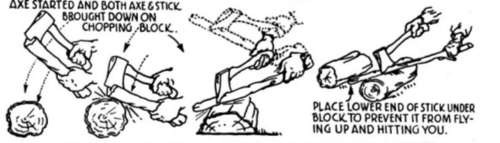
Harry Jordon, a great woodsman. shows how to protect the feet. Note that the stick to be split is on the opposite side of block from the splitter.
If-One Thing Only?
Ask any group of experienced outdoorsmen - hunters, trappers, timber cruisers, mountaineers, cow punchers, sailors or forest rangers -to name the one single piece of equipment they would choose if through sudden disaster, they found themselves alone, far from human habitation and limited to one piece of equipment only. The chances are that a convincing majority would answer, "An Axe."
And how many people aside from farm dwellers and those in the groups named know much if anything about this important tool? Very few indeed know how to sharpen it if it is dull (and isn't it always dull); how to tighten its head if the handle (helve) has dried out and shrunk; or how to use it without injuring themselves if it is in first class condition. And how can they learn? Can they turn to you and your Troop for a proper demonstration and for instruction? You are probably too modest, so we will say "Yes" in your particular case, but we hasten to add that in thousands of other Troops the answer would be an emphatic "No!"
The question becomes "Why not?" The best answer: "Let's go."
So- "Let's Go!"
The chances are that over 50 per cent of the members of your Troop own belt axes right now, and with Christmas just around the next bend in the trail, by January 1st nine out of ten will own them. If you get busy now there isn't going to be a lot of first aid necessary for bleeding wounds or neighbors shade trees.
Exhibition Of Axe Safety
Just recently at Meridian, Mississippi, six Scouts and a Patrol Leader from Troop 3 of that city put on both a health and a safety demonstration before 400 Scouters from all over the Central South gathered at a convention banquet The safety demonstration consisted of chopping kindling with belt axes against time-minus danger.
Equipment Used By Each Team:
1 Voyageur (Official) belt axe.
1 White Pine board about 10" x 12" x 7/8" (end of a fruit crate.)
1 Chopping block 18" x 12" sawed off square and stood on end (on side will do).
Rules:
Two teams, three Scouts each, lined up in single file 20 feet from chopping block. Board and axe lying on top of block.
Boards, unless green, should be soaked in water a minute or two, and dried for an hour or so, to reduce brittleness and consequent breaking.
Each board to be split into eight pieces, then each of the eight pieces cut in two across the approximate center - total, sixteen pieces.
Time limit, 1 1/2 minutes. Start and stop with whistle. (At Meridian the Patrol Leader was timer.)
No blow permitted to be struck with axe and stick separated.
Procedure:
At the whistle, number one Scout runs to the block, grasps bottom edge of board, places edge of axe blade firmly against its top edge, brings both up and then down together with force against the block, splitting the board in half lengthwise. He then splits each half again in half, lengthwise. When this has been done the Scout lays the axe on the block and runs back to the line and touches the hand of number two Scout who then advances and in a like manner splits each of the four pieces lengthwise leaving eight pieces beside the block. He runs back touching number three Scout as he crosses the line. Number three Scout then runs to the block and taking each of the eight pieces that have been split, cuts them in two across the grain at the approximate middle, thus making sixteen pieces. When this is done he runs back to the line.
Outcomes
Both teams of the Meridian Patrol won in their contest against the time standard, completing the cutting in slightly over a minute, to the long and hearty applause of the crowd.
This method of preparing kindling is fast and safe. Of course, the axes were sharp. Sharp axes bite into the wood and are not likely to skid off and cut the chopper. When sharp axes cut into flesh, the cut is straight, clean and much more likely to heal without infection than a dull axe cut which leaves a jagged wound, more likely to contain foreign substances.
As a demonstration this exhibition of axe chopping makes an excellent educational show-a lot of fun that really teaches safety skill. Lots of folks will enjoy seeing it put on. Maybe your Troop could do it at a number of places-if you do, train your team frequently and well in advance.

Continue to:


My Books

