


The Age Of Salmon
Description
This section is from the book "Some Fish And Some Fishing", by Frank Gray Griswold. Also available from Amazon: Some Fish And Some Fishing.
The Age Of Salmon
According to Malloch it is easy not only to tell the age of an Atlantic salmon by its scales but also to follow its journeyings and occupations through life.
As the rings on a cross-section of a tree show the tree's yearly growth, so do the rings on a salmon's scale determine the age of a salmon.
The scales of a parr hatched in March when a year old have sixteen rings, and thirty-two rings can be counted after the expiration of another twelve months.
Two months or so later the parr becomes a smolt and goes down to the sea and may return the following May or June as a grilse with fifty-two rings, more or less.
If the rings on a fish's scales number less than fifty-eight it is a grilse, if more than that number show it is a salmon.
All the grilse and salmon that enter a river are supposed to spawn and those that remain long in fresh water have the edges of their scales broken off. When the kelt-grilse and the kelt-salmon return to the sea and begin to feed, a ring forms around these broken parts and these rings increase in number according to the time the fish remain in the sea.
In the Grand Cascapedia River a grilse is seldom seen or taken. This may account for the great average size of the salmon in that river. These fish may pass their grilse term of life in the sea, where, with good food and without the fatigue of spawning, they grow in weight accordingly, and enter the river later on as full-fledged salmon. Few salmon are taken in the Grand Cascapedia under 20 pounds in weight, and it was there that Dr. S. Weir Mitchell took in 1896 40 salmon that averaged 28 pounds.
In order to determine the time the salmon remain in the sea it is necessary to count the rings from the broken or uneven lines outwards. No rings are formed on the scales in fresh water.
The great majority of salmon are said to spawn but once although some spawn twice or more often.
It is claimed that salmon, during the period of their stay in a river and after having fulfilled their mission, lose twenty-five per cent of their weight.
The very large salmon, those from forty to fifty pounds, are cock-fish, generally old bachelors, gourmets and gourmands that have remained in the sea where the food is good and plentiful rather than undertake the up-stream struggle with perhaps little or no food, and with domestic troubles awaiting them at their journey's end.
For example, the 61 pound cock-salmon taken in the Tay in Scotland on July 13th, 1902, proved by its scales to be 7 years and 2 months old, and the scales also showed that it was this salmon's first return from the sea.
It is claimed that as far as rivers are concerned the life of an Atlantic salmon is 8 years. No fish have been taken of a greater age.
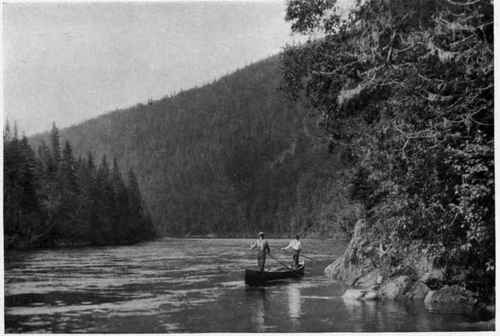
JOE MARTIN POOL.
Continue to:


My Books

