


Game Fish
Description
This section is from the book "Some Fish And Some Fishing", by Frank Gray Griswold. Also available from Amazon: Some Fish And Some Fishing.
Game Fish
From the standpoint of a fisherman I divide game fish into two classes namely, the forked-tailed and the square-tailed fishes.
The former travel great distances, swim rapidly, and are nearly all surface feeders and strong surface fighters.
The latter dwell on the bottom, are bottom feeders, and generally have a local habitat.
The forked tail has been given to the swordfish, tarpon, bonefish, bluefish, spear-fish, dolphin, and all the pampano, herring, and mackerel tribes.
The tail is forked for the purpose of leaving a free space directly behind the axis of the body where the stream-lines following the sides of the moving fish converge. This means ease and speed in swimming. A round or square tail is a drag for it fills this space.
The whales and porpoises have horizontal forked tails which they move up and down, for they rise to the surface when swimming.
Among the square-tailed fish I classify the bass family, the snappers and groupers, and the salmon family.
The square-tailed fish are slow swimmers and seldom travel far. Those that do, such as the drumfish and the striped bass, proceed at a leisurely pace. The latter during their yearly pilgrimages travel and feed so close inshore that it has been possible by netting to almost destroy what was at one time one of the most numerous of our game fishes.
The forked-tail fish journey great distances and often at a high rate of speed, seeking food or a change of water temperature, and do not hibernate as do some of the square-tailed fish.
The square tail of the salmon is one proof, to my mind, that when they leave a river they do not journey far but dwell in the deep sea near the mouth of their summer home.
Although the seafood of the salmon when off the mouth of a river is known to be herring and the like, their square tails would lead one to believe that they are bottom feeders and that they feed leisurely and well, which would account for the fresh-run fish's superabundance of fat.
According to Alexander Agassiz the pelagic animals are very short-lived but they reproduce marvelously. Some of the Cope-pods, which are minute crustaceans, have no less than thirty generations in three weeks.
As they are constantly dying there is a shower of food falling over the ocean floor which joins the food that comes from the littoral regions. It is stated that there is a thick broth of food over wide areas of sea bottom which can readily be obtained with very little effort on the part of the fishes.
The progress of large bodies of salmon in the sea, judged by the catches in nets at different stations, is said to be four or five miles a day. They only travel in the daytime; no salmon are taken in the nets at night.
After entering the river, these conditions are changed for then the salmon travel mostly by night.
Previous to entering the pure fresh water they remain for some time in the estuaries, moving in and out on the tides and becoming gradually acclimatized to the change from salt to fresh water.
A considerable portion of the salmon that spawn before the rivers freeze return to the sea the same autumn, but a large number winter in the rivers and come down stream in the spring as kelts or "slinks".
The French Canadians call these fish lingards - a corruption of "long gars".
The kelts that descend the rivers in the autumn are dark in colour and slimy, whereas those that leave in the spring, having molted, are bright fish. This, at least, is the present day theory.
It is supposed that the grilse are four or five years old and that their rate of growth after that period is from four to six pounds a year.
A salmon was caught at West Baldwins half a mile from Channel Head, Newfoundland, by Louis Sheaves on June 5, 1919, with a silver tag attached to its dorsal fin marked A1124. The fish when caught measured 40 inches in length, 23 inches in girth and weighed 26 pounds. R. Mosdell, the station master at Port aux Basques, obtained the fin tag and submitted it to the Game and Inland Fisheries Board for inquiry as to where the fish had been liberated.
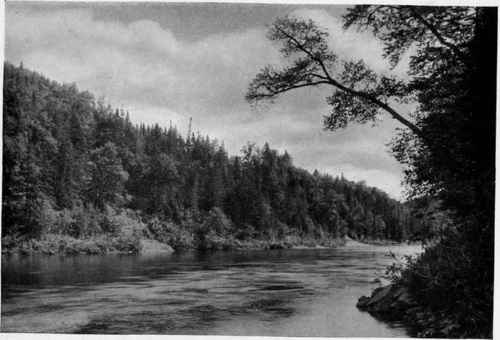
DUTHIES POOL.
On July 15 he received a message from the Game Board stating that the fish was liberated from the salmon hatchery at Mar-garie, Nova Scotia, November, 1917; at that time it measured 34 inches in length and weighed 12 pounds.
This dislodges the theory that salmon always frequent the same water yearly, and also shows a remarkable growth within the given period.
This fish in nineteen months grew in length 6 inches, being an average of almost an inch every three months, and gained an average of three-quarters of a pound in weight per month for the same period.
Continue to:


My Books

