


Ellipsis Of "With
Description
This section is from the book "The Science And Art Of Phrase-Making", by David Wolfe Brown. Also available from Amazon: The science and art of phrase-making.
Ellipsis Of "With
137. With may be omitted and implied at the end of such phrases as in conjunction with, etc. (See Paragraphs 328-329.)
In the following phrases, with may be omitted:
in accordance (with) in (com)parison (with) in (com)bination (with)
in (con)junction (with) in (conn)ection (with) in harmony (with)
ellipsis of "to."
138. To is frequently omitted and implied at the end of such phrases as in reference to, in regard to, in reply to, in relation to, etc.
139. To phrases from which the last word is thus omitted, additional words may be attached, if the form of the last stroke will admit of such additions; and the stroke itself may be modified by circles, hooks, ticks, half-length-ing and double-lengthing. Illustrations: in regard to this,

in reply to them,

in reference to the

in reference to their,
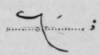
in respect to your,

(For explanation of method of writing phrases beginning with in re-, see Paragraph 385.)
Exercise
Write the following phrases, omitting to and joining the following word:
in reference (to) that
in reference (to) the
in reference (to) the matter
in reference (to) this
in reference (to) which
in reference (to) your
in regard (to) it
in regard (to) its
in regard (to) that
in regard (to) that which
in regard (to) them
in regard (to) this
in regard (to) this one
in regard (to) you
in regard (to) your
in reply (to) him
in reply (to) it
in reply (to) many
in reply (to) several
in reply (to) some
in reply (to) such
in reply (to) that
in reply (to) their
in reply (to) theirs
in reply (to) this
in reply (to) you
in reply (to) your
in reply (to) yours
in respect (to)
in respect (to) him
in respect (to) his
in respect (to) many
in respect (to) many more
in respect (to) one
in respect (to) several in respect (to) some in respect (to) such in respect (to) that in respect (to) them
in respect (to) themselves in respect (to) this in respect (to) which in respect (to) you in respect (to) your
140. To, following the word according, is generally omitted, and, if convenient, the next word is joined, as in the phrase according to this

Exercise
Write the following phrases, omitting to and joining the next word:
according (to) its own according (to) justice according (to) law according (to) that according (to) the according (to) their according (to) them according (to) these (vocalize these) according (to) this according to those according (to) such according (to) which according (to) your
141. To, the sign of the infinitive, may in many case3 be omitted and implied, when it is immediately followed by the verb to which it belongs.
Exercise
Write the following phrases, omitting to, the sign of the infinitive:
every reason (to) think
have (to) be
help (to) make
is this (to) be
it seems (to) be
it seems (to) have
it seems (to) make it is never (to) be it is not (to) be it is sure (to) be it is (to) be said (to) be
seems (to) be
seems (to) make
seems (to) take
so as (to) be
so as (to) become
so as (to) make
that is (to) be
that is (to) say (vocalize
say) there is (to) be
want (to) be
want (to) say
was (to) be
we wish (to) do (I. D.*)
we wish (to) say (I. D.
when is this (to) be
wish (to) be
wish (to) do
wish (to) say
you are (to) be
142. In the following phrases, to, the sign of the infinitive, is to be omitted after the special phrase in order

in order (to) answer in order (to) be in order (to) become in order (to) carry in order (to) determine in order (to) develop in order (to) distinguish in order (to) do in order (to) effect in order (to) encourage in order (to) enjoy in order (to) have in order (to) inquire in order (to) judge
in order (to) keep
in order (to) know
in order (to) observe
in order (to) pay
in order (to) say
in order (to) see (vocalize
see) in order (to) send in order (to) show in order (to) take in order (to) test in order (to) touch in order (to) turn in order (to) understand
143. But to, the sign of the infinitive, should not be omitted if a better junction can be obtained by writing it.
*These letters, meaning "Initial Displacement," indicate that the first word of a phrase is written out of its ordinary position in order that the second word may be written in its normal place. Occasionally they indicate that the first two words are displaced in order to bring the third into its ordinary position.
Exercise
In the following phrases, insert to:
designed to make in order to blame in order to charm in order to deliver in order to direct in order to limit in order to make in order to manage in order to modify in order to move in order to place in order to receive in order to refuse in order to reject in order to remember in order to reply in order to retain in order to tell in order to throw in order to treat in order to write mean to make want to make who is to make
144. The preposition to may be omitted in the midst of a phrase, where the sense or construction will supply it. Illustrations: it seems (to) me, it seemed (to) me, it appears (to) me.
Exercise
Write the following:
appears (to) me in addition (to) this it appears (to) me it seemed (to) me it seems (to) me
say (to) you seemed (to) me seems (to) me there appears (to) me there seems (to) me
145. To, the sign of the infinitive, is never omitted and implied at the beginning of a phrase, though, by some writers (following the teaching of Mr. Graham), it may be omitted and indicated by dropping the next word to "the fourth position."
Continue to:


My Books

