


Spelling By Position
Description
This section is from the book "Haven's Complete Manual Of Practical Phonography", by Curtis Haven.
Spelling By Position
The invisible alphabet also need not necessarily be altogether presented in this first lesson, but its use and three of its letters are best given. The invisible alphabet is really a method of spelling by position. That is, writing a visible letter (any one of those in foregoing list, for instance) in a certain position in accordance with the ruled line of the paper you are writing upon, and by that position indicating after the written letter the presence of some other letter not written. The letters written to indicate invisible letters are called consonants; the sounds indicated without being written are called vowels. Three of the vowel sounds, which are thus indicated invisibly, are I, A, and U, the mode of indicating them being to write a consonant above the ruled line of your writing paper when you desire to indicate I; write the consonant resting on the line to indicate A; and strike the consonant through or place beneath the line to indicate U.
For instance, suppose you desired to write the word nigh in shorthand: That word in shorthand would be spelled with only the two letters n and i, thus, n-i, nigh. Now, N is a visible consonant, as will be seen by referring to your list of letters at the beginning of this lesson. And we have just said that the sound of I may be indicated after a written letter without writing I, by placing any visible consonant above the line of the paper you are writing upon. So, by simply placing our shorthand letter N above the line, we indicate the sound of I after it, and thereby spell n-i, nigh, as with sign I in Exercise.
Then, in accordance with the rule for indicating the sound of the letter A, without writing it, we have only to place our letter N on the line, and we invisibly indicate after N, the sound of A, thus spelling n-a, nay, as with sign 2 in Exercise.
Finally, by writing N under the line of our paper, we indicate after N the sound of U, and thus spell n-u, knew, as with sign 3 in Exercise.
By the above description, the student sees that it is the position of the written consonant that indicates the sound of the invisible letter; and, therefore, any consonant of the visible alphabet may thus invisibly indicate the sound of I after it, if such written letter be placed above the line of writing; A, if placed on the line; and U, if struck through or placed below the line.
The horizontal letters K, Gay, M, and N can not be written through the line, which is why they are written under the line to indicate U after them, the other letters being easily struck through the line, as in signs 6, 7, 15, 17, etc., in Exercise.
The dotted lines in our Exercise represent the ruled lines of ordinary writing paper.
If the student has carefully read all of Part I, of this book, especially noted the explanation under heading of "Preliminary Information," on pages 20 to 22, and also memorized the sixteen letters so far given of the Visible Alphabet, commencing this lesson, he or she is now ready to proceed with the study of Exercise I, at end of this lesson, which should be done in accordance with the following plan:
1. Read carefully the entire Exercise, tracing over with a dry pen each shorthand letter, as you read it. The tracing helps to train your hand to a familiarity with the correct formation of the shorthand letters.
2. Write with pencil each separate word or combination of Exercise at least twelve consecutive times on your practicing paper.
3. Transcribe the entire Exercise into long hand, afterward comparing your interpretation with the Key below Exercise. Repeat until perfect.
4. Looking only at the Key, write it into shorthand, afterward comparing your shorthand writing with the shorthand of the printed Exercise, repeating this wholesome practice until satisfactory, but without attempting to write faster than you can write well. Speed will come with careful practice.
These rules are alike applicable to every lesson of this course. And, in addition, in private study, the name of each sign should be repeated aloud as it is written, a proceeding which will train the ear to recognize the proper sound, and, at the same time, train the hand to form the sign upon the writer hearing the sound represented.
Use a soft pencil for practicing, holding it between the first and second finger, keeping it in place by the thumb. This position enables the student to write with more ease than by holding the pencil between the thumb and first finger, besides insuring quicker writing generally, and more perfectly formed shorthand.
The best pencil for shorthand practice or professional use is a soft medium pencil, called by different manufacturers No. 2, or SM; and the best paper is ordinary ruled foolscap, providing it does not have too smooth a surface, as pencil writing can not be done well on highly calendered paper. The more common the foolscap, therefore, the better, the finest qualities being only suitable for pen and ink, with which shorthand practice should never be attempted.
Exercise I
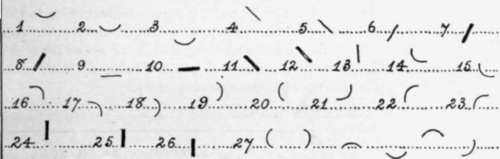
Key I.
1, Nigh; 2, nay; 3, knew; 4, pie; 5, pay; 6, chew; 7, Jew; 8, jay; 9, cue; 10, gay; 11, bay; 12, by; 13, tie; 14, fie; 15, few; 16, vie; 17, view; 18, sue; 19, sigh; 20, thy; 21, shy; 22, lie; 23 lay; 24, die; 25, day; 26, due; 27, They say May knew my shoe.
Note i - The figures accompanying each word or outline in the above Exercise and Key, and others of this course, are inserted for the student's convenience in referring from the one to the other. They are not to be considered as any part of the phonographic signs. The same is true of all subsequent lessons as well.
Note 2 - Home students should learn every lesson of this course perfectly enough to write each sign correctly when the key is slowly read aloud to them. This practice of writing from dictation should be done with every Exercise, and done well, before commencing another lesson. The lessons may be learned without such aid, but speed comes more quickly with it.
Note 3 - Students of these lessons, desirous of having their written exercises criticised, or desiring to ask any questions whatever, in regard to the lessons, or relative matters, can address the author, Curtis Haven, P. O. Lock Box 1162, Philadelphia, Pa.
Continue to:


My Books

