


Pen Or Pencil
Description
This section is from the book "Haven's Complete Manual Of Practical Phonography", by Curtis Haven.
Pen Or Pencil
Before closing this lesson, there is one subject, the importance of which the author desires to properly impress upon the minds of his students: It is the necessity of an immediate choice between pen and pencil, in regard to which shall be made use of in the student's phonographic writing practice. Student are, of course, at liberty to use both if they choose, and alternate their use as frequently as they wish, but such inconstant use, the student is informed, will greatly delay her or his acquisition of speed. Each instrument differs from the other in facility of execution, and whichever the hand becomes most accustomed to, it writes much quicker and better with. The author prefers a pencil because it can be used under most any or all circumstances, while a pen cannot be employed except under certain favorable conditions. The pencil will glide over the paper much more quickly, and thus affords greater rapidity of execution than the pen, while rapid pencil writing is easier to read than rapidly-made penmarks, for the reason that the use of the pencil avoids the little meaningless ticks and dashes which the pen is almost always certain to leave attached to rapid shorthand writing. It is, however, even better to make constant use of a pen than to be continually changing from one to the other, for the reasons given.
Exercise II
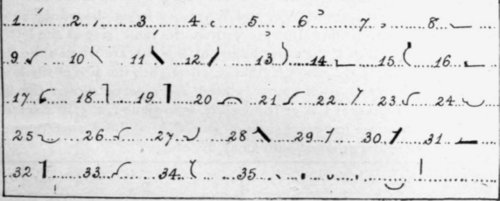
Key II.
1, High; 2, hay; 3, hue; 4, weigh; 5, whew; 6, why; 7, whey; 8, Ike; 9, oil; 10, ape; 11, Abe; 12, age; 13, ace; 14, ache; 15, oath; 16, oak; 17, owl; 18, ate ; 19, aid ; 20, aim ; 21, ail; 22, itch ; 23, ill; 24, inn ; 25, Ann ; 26, Al; 27, ash; 28, ebb; 29, etch; 30, edge; 31, egg; 32, Ed; 33, eel; 34, youth; 35, I owe you a new tie.
Continue to:


My Books

