


A Carpenter's Clamp
Description
This section is from the book "Handy Man's Workshop And Laboratory", by A. Russell Bond. Also available from Amazon: Handy Man's Workshop And Laboratory.
A Carpenter's Clamp
For holding work together while being glued or nailed, a clamp of some description is indispensable. The one herewith illustrated has the advantage of being easily made by a blacksmith or the mechanic himself.
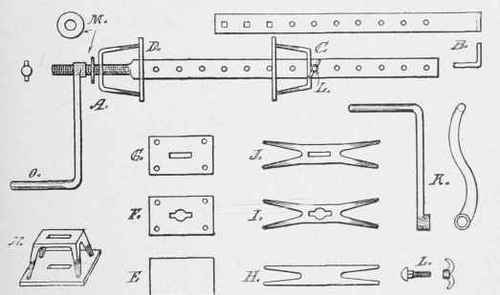
Fig. 57 - Details of the carpenter's clamp.
In Fig. 57, A, with the extension B, shows the clamp complete. The extension B is used on large work, such as door frames. It is about 20 inches in length, after the end has been turned up, as shown, 1 1/2 inches. The first three holes are made square, to bite the thumbscrew L, by which it is connected to the body A. The clamp is made of 1 1/2 by 5/16-inch wrought iron. A is 30 inches long, including the threaded end, which is 3/4 inch diameter by 6 inches long. The holes are made to suit the thumbscrew L, 3/8 inch diameter. The stops D and C are identical, except that D has the slots rounded out to pass over the threaded end of the clamp, as shown in detail at I and F. Two plates are cut out as shown at E, 5 by 3 by 1/4 inch, and four holes bored in the corners, 1/4 inch diameter. A slot is cut in the center, large enough to slip easily over the body of the clamp. As already stated, in one case this slot must be rounded out in the center to pass over the threaded end of the clamp. Two pieces H, 3 by 1/4 by 9 inches, are cut out as shown, the legs being 3 inches long, and tapered down to 1/4 inch diameter. The legs are spread to suit the holes in the plates F and G, into which they are riveted, after being bent into shape as indicated in the sketch marked N.
The crank 0, detailed at K, is made from a 5/8-inch diameter bar about 15 inches in length; the part forming the handle being 4 1/2 inches long. A boss one inch long is formed at one end, and threaded to suit the end of the clamp A. A washer M, to take up the wear, and a thumbscrew L complete the list.
Continue to:


My Books

