


The Rolling Pin
Description
This section is from the book "Art And Education In Wood-Turning", by William W. Klenke. Also available from Amazon: Art And Education In Wood-Turning.
The Rolling Pin
The rolling pin, Plate XI, like all wooden kitchen utensils, is made of maple, because maple does not sliver easily, is hard, and holds its shape fairly well. To make it somewhat easier to understand, the rolling pin will be divided into two parts; the shaft and the handle.
The stock for the shaft is 2 5/8"x2 5/8 XI21/4". (a) Cut to 2 1/2 " in diameter; (b) cut to length, leaving the waste wood at each end 1" in diameter; (c) taper the ends, making a cut from 1/8" back to the 1 " diameter. After the wood is thoroly sandpapered, (d) cut off the waste wood. At each end, the centers have left a small hole which locates the center for the holes to be bored. Great care must be taken to bore the holes at each end absolutely true, otherwise the handle will not work well when glued in place.
In order to have the hole of the handle in the exact center, bore the hole first, and turn around the hole. To do this, turn a piece of maple to fit the hole just bored, leaving about 1 1/4" of the waste wood 1" in diameter at one end, Fig. 39. The 1 9/16" part is to be 5 3/8" long. The reason for this length will be explained later.
Glue 1/4" at each end, Fig. 39. When the glue has set, turn the handle, being careful not to turn the ends until everything is completed. Sandpaper carefully, and with an 1/8" chisel, cut the 450 at the one end; this makes that end free. Out of the remaining piece of maple, turn the spindle part of the handle, fitting the 1 1/2" of the dead center end to a 1/2" hole. In order to make the curve of both handle and spindle continuous, place the handle over the spindle while turning the rounded end.

Fig. 39.

Rate XI.
Plate XII.
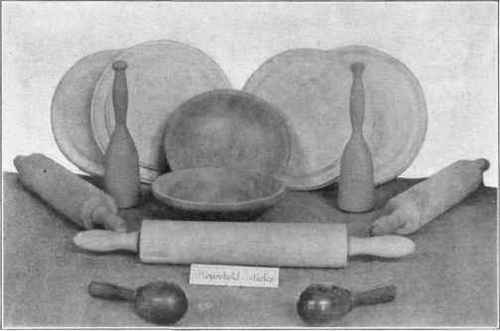
Fig. 40. Household Articles.
When gluing the spindle into the shaft, great care must be taken not to allow any glue to get into the hole of the handle, and not to force the handle up too tight against the shaft.
Continue to:


My Books

