


Geometry And Square-Root. Geometry
Description
This section is from the book "Text-Book Of Modern Carpentry", by Thomas William Silloway. Also available from Amazon: Text-book of Modern Carpentry.
Geometry And Square-Root. Geometry
"Geometry is the foundation of architecture, and the root of mathematics." Such being the case, a knowledge of its leading principles is essential to a successful practice of the art of carpentry. While only a part of the science is necessarily called into requisition, that part is all-important.
It is presumed that every apprentice will make himself familiar with the science by the study of some good treatise on the subject. A few rules, however, for making calculations will be given in this work. They are introduced, as in other cases of like nature, more for the purpose of refreshing the memory than for imparting original information.
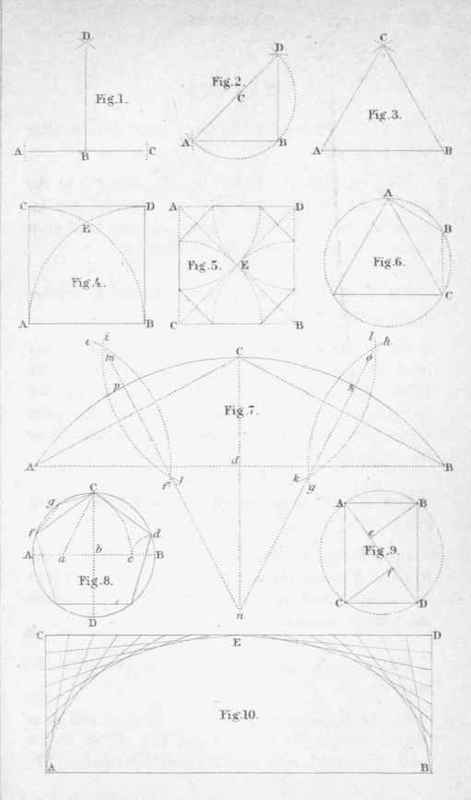
The diagrams on Plate I. exhibit such general principles as are most frequently used by the carpenter; and it is believed they will convey all the information he may require.
Plate I
Fig. 1. - To draw a line perpendicular to another at a given point.
From the points A and C, equally distant from the given point B, with the radius AC describe arcs intersecting each other at D. From this point to B draw the line DB, which will be the line required.
Fig. 2. - To draw a line perpendicular to another at its extremity.
Let B represent the extremity of the line. From any point above the line AB, as a centre, describe the arc DBA. Draw AD from the point where the arc cuts the line AB. Through the centre C, and from the point where AD cuts the arc, draw the line DB, which will be the line required.
Fig. 3. - To draw an equilateral triangle to any given base.
Let AB represent the base. From the points A and
B, with the radius AB describe arcs cutting each other at
C. From C, draw the lines CA and CB, which produce the triangle required.
Fig. 4. - To construct a square of any given dimensions.
Let AB represent the given side. From A and B, as centres, describe the arcs AD and BC. From E, the point of intersection, set off EC and ED equal to EF, which are one-half the line EA; then draw from the points the figure CABD.
Geometry P1.I
Smith Knight & Tappap.Engrs..
Fig. o. - To describe a regular octagon, or figure of eight equal sides, of a given dimension.
Let AD represent the diameter of the octagon. From this, draw the figure ADBC; then draw the diagonals AB and CD. With the radius AE, on the points ADBC, describe arcs cutting the square. From the points of intersection, draw diagonals, and the octagon is formed.
Fig. 6. - To draw a regular hexagon or triangle within a given circle.
Apply the radius of the circle six times around the circumference, as at AB; and the line is a side of the hexagon. Draw a line from the points AC, and the line is the side of an equilateral triangle.
Fig. 7 exhibits a method for finding the centre of a circle when an arc is given; also for describing a segment of a given height.
Let AB represent the base, and dC the height. Produce the lines AC and CB. On the points A and B, with a radius of more than half the line AC describe the arcs ef and gh. On the point C, with the same radius, describe the arcs ij and kl. Through the points of intersection, draw the lines mn and no, cutting each other at the point n; which will be the centre required.
Fig. 8. - To inscribe in a circle a regular pentagon, or figure of five equal sides.
Draw two lines, AB and CD, perpendicular to each other. Divide the radius A6 into equal parts, as at a.
On a as a centre, with the radius aC describe the arc Cc; then, on B as a centre, with the radius Be describe the arc cd, and from the point of intersection d to C will be a side of the pentagon. A decagon, or figure of ten sides, is described by drawing the lines fg and gC, and then proceeding thus with each of the five sides till the figure required is completed.
Fig. 9. - This figure exhibits a method of determining the dimensions and form of a rectangular stick of timber cut from a round stick, which shall be callable of supporting the greatest weight when lying in a horizontal position.
The circle represents the outline of the log or stick, and ABDC the stick to be cut therefrom. To determine which, divide the line AD (the diameter of the log) into three equal parts. On the points e and f erect perpendiculars; which produced, cut the circumference at the points BC; which, together with the points AD, give the corners of the required stick.
Fig. 10. - To describe an elliptic arch by intersecting lines, the base and height being given.
Let AB represent the base, and AC the height. Divide AC and BD into any number of equal parts; then divide CD into two equal parts, as at E. Divide CE and DE each into the same number of parts as AC and BD. Then, from the points described, draw lines as shown in the figure; and the points where these intersect will be the track of the curve. Trace a line through them, and we have the figure AEB.
Definitions
The diameter of a circle is a right line drawn through its centre, and terminated at each end by the circumference, as AB, fig. 8.
The radius of a circle is a right line drawn from the centre to the circumference, being half the diameter; as C6, fig. 8.
An arc of a circle is any portion of the circumfe-ference; as DB, fig. 2.
A chord is a right line joining the extremities of an arc; as AB, fig. 7.
A segment is any part of a circle bounded by an arc; as ABC, fig. 6.
A semicircle is half a circle; as ACB, fig. 8.
A sector is any part of a circle bounded by an arc and the radii; as pus, fig. 7.
A quadrant is a quarter of a circle; as A6D, fig. 8.
Problem I. To Find The Area Of A Parallelogram, Whether It Be A Square, A Rectangle, A Rhombus, Or A Rhomboid
Rule. - Multiply the length by the perpendicular height, and the product will be the area.
Problem II. To Find The Area Of A Triangle
Rule. - Multiply the base by the perpendicular height, and half the product will be the area.
Continue to:


My Books

