


An Upholstered Stool (Fig. 4)
Description
This section is from the book "Handcraft In Wood And Metal", by John Hooper, Alfred J. Shirley. Also available from Amazon: Handcraft In Wood And Metal.
An Upholstered Stool (Fig. 4)
Note
The model is based upon stools of the Queen Anne period so far as general outline is concerned. The treatment of the under-railing is essentially modern. Turning for work of this character is best studied from old examples, the first and third examples are adapted from Queen Anne detail. The method of connecting the under-railing is described on p. 53 in connexion with occasional tables. Wainscot oak may be used for models of this type, but Italian walnut is preferable. Various methods of building up the turning are illustrated in the diagram Fig. 5 on p. 49.
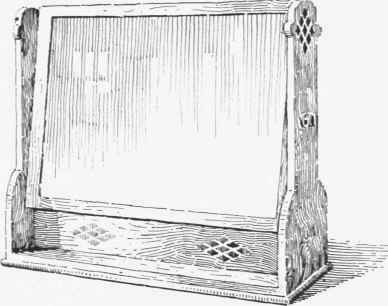
Fig. 3.-A swing toilet mirror.
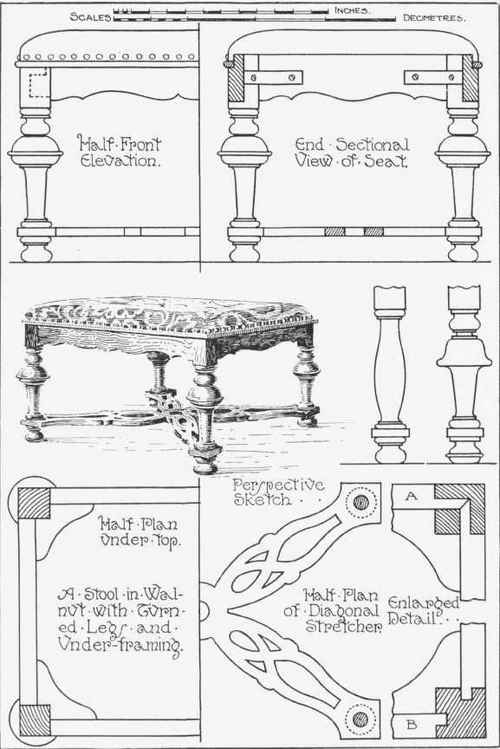
Fig. 4.-An upholstered stool of Queen Anne style.
The Process
Saw out and plane up to width and thickness the following material:-
English. | Metric. | |||||||||||||||
4 | Legs | 10 1/2 | in. | X | 2 | X | 2 | in. | Ital. walnut | 26 | X | 4.5 | X | 4.5 | cm. | |
4 | Feet | 3 1/2 | in. | X | 2 | X | 2 | in. | ,, | 8 | X | 4.5 | X | 4.5 | cm. | |
2 | Long Rails | 1 ft. | 7 | in. | X | 2 3/4 | X | i | in. | 48 | X | 7 | X | 2.25 | cm. | |
2 | Short „ | 1 ft. | 1 1/2 | in. | X | 2 3/4 | X | 7/8 | in. | 34 | X | 7 | X | 2.25 | cm. | |
2 | Under ,, | 2 ft. | 2 | in. | X | 3i | X | 5/8 | in. | 66 | X | 8 | X | 1.5 | cm. | |
I | Moulding | 6 ft. | in. | X | 4 | X | 3/8 | in. | 165 | X | 1.75 | X | 1 | cm. | ||
For Brackets | 1 ft. | 8 | in. | X | 4 | X | 7/8 | in. | beech | 5° | X | 10 | X | 2.25 | cm. | |
1. Set out tenons on rails and mortises on legs, cut same. (Bone-faced tenon is employed, see detail A in sectional plan.)
2. Halve together the under-rails, glue together and level off.
3. Execute turning on legs and glue up rails and legs.
4. Level off top, gauge for rebates (see sectional view), and execute same.
5. Set out with templet the shaping on under rails, cut same, and finish with files and glass-paper, bore for pins.
6. Glue feet through rail into legs, clean up framing, and mitre moulding round rebate.
7. Cut and fix the angle brackets.
A, Fig. 5. Shows leg turned with groove to receive a separate bulb part, foot pinned through under-frame into leg.
B, Fig. 5. Shows an alternate design with similar constructive detail.
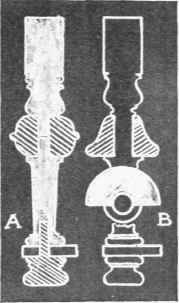
Fig. 5.-Diagrams showing construction of turned legs.
Continue to:


My Books

