


Plain Miter Joint
Description
This section is from the book "Shop Projects Based On Community Problems", by Myron G. Burton. Also available from Amazon: Shop Projects Based on Community Problems.
Plain Miter Joint
Paragraph 64. The plain miter joint is the most frequently used in the construction of various kinds of rectangular frames, such as picture frames, window screens, frames of moulding in various trimmed work, panel work, and almost every kind of construction in which the rectangular frame is employed. The miter joint is very easily constructed, for it is usually sawed in a miter box. If a miter box is not available, this joint can be laid out by the use of the steel square. It is the regular half-pitch cut shown in Chapter II., Paragraph 24, and in Paragraph 75 of this chapter. The T-bevel should be set at the 45 degree angle. This is done by laying out the 45 degree angle with the steel square or compasses and setting the T-bevel on the line thus laid out.
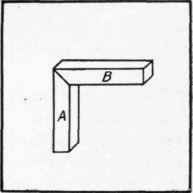
Figure 49.
To Lay Out And Execute The Miter Joint
Make sure that the material is perfectly square. With the T-bevel perfectly set, working from the working edge (on piece A), lay out the 45 degree angle. With the try-square, square this line down on each edge of the material. Hold the material in the bench vise or with the bench hook, and carefully saw these lines. If the material is of such a nature that it can be reversed, the other piece of material (piece B) may be turned around in such a way as to make the one cut answer for both pieces. This, however, cannot be done if the material is of such a nature as to have a face side, which must be up, as in the case of moulding. In this case it is necessary to make another cut in the same way in which this cut was made, except on the opposite end of the piece of material. Assemble the joint with glue, or with glue and brads, or with corrugated nails, as the nature of the work may demand.
Continue to:


My Books

