


Wood Turning. Continued
Description
This section is from the book "Carpentry for Boys", by J. S. Zerbe. Also available from Amazon: Carpentry for Boys.
Wood Turning. Continued
The Tail Stock
This part of the structure is made of the following described material:
Procure a scantling (J), planed, 4" × 4", 24 inches long, the upper end of which is to be provided with four bolt holes, and a centering hole (15). At the lower end of the piece is a slot (16) 8 inches long and 1½ inches wide, and there are also two bolt holes bored transversely through the piece to receive bolts for reinforcing the end.
A pair of cheekpieces (K), 2" × 4", and each 12 inches long, are mitered at the ends, and each has four bolt holes by means of which the ends may be bolted to the upright (J).
Then a step wedge (L) is made of 1⅜" × 2" material, 10 inches long. This has at least four steps (17), each step being 2 inches long. A wedge 1⅜ inches thick, 10 inches long, and tapering from 2 inches to 1⅜ inches, completes the tail-stock.
The Tool Rest
This is the most difficult part of the whole lathe, as it must be rigid, and so constructed that it has a revolvable motion as well as being capable of a movement to and from the material in the lathe.
Select a good 4" × 4" scantling (M), 14 inches long, as shown in Fig. 243. Two inches from one end cut a cross gain (I), 1½ inches deep and 1 inch wide, and round off the upper edge, as at 2.
Then prepare a piece (N), 1 inch thick, 8 inches wide, and 10 inches long. Round off the upper edge to form a nose, and midway between its ends cut a cross gain 4 inches wide and 1½ inches deep. The lower margin may be cut away, at an angle on each side of the gain. All that is necessary now is to make a block (O), 8 inches long, rounded on one edge, and a wedge (P).
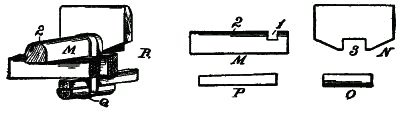 Fig 243. Tool Rest.
A leather belt or strap (Q), 1½ inches wide, formed into a loop, as shown in the perspective view (R), serves as a means for holding the rest rigidly when the wedge is driven in.
The Tool Rest
This is the most difficult part of the whole lathe, as it must be rigid, and so constructed that it has a revolvable motion as well as being capable of a movement to and from the material in the lathe.
Materials
Then procure the following bolts:
| 4⅜" | bolts, | 10" | long. |
| 8⅜" | bolts, | 6" | long. |
| 20⅜" | bolts, | 5" | long. |
| 5⅜" | bolts, | 9" | long. |
The Mandrel
A piece of steel tubing (S), No. 10 gage, ¾ inch in diameter, 11½ inches long, will be required for the mandrel. Get a blacksmith, if a machine shop is not convenient, to put a fixed center (1) in one end, and a removable centering member (2) in the other end.
On this mandrel place a collar (3), held by a set screw, and alongside of it a pair of pulleys, each 1½ inches wide, one of them, being, say, 2 inches in diameter, and the other 3 inches. This mandrel is held in position by means of the posts of the frame which carry the split journal bearings. This form of bearing will make a durable lathe, free from chattering, as the bolts can be used for tightening the mandrel whenever they wear.
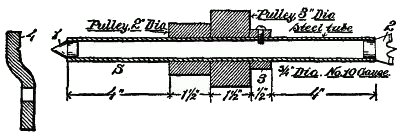 Fig. 244. Mandrel.
The center point (1) is designed to rest against a metal plate (4) bolted to the wooden post, as shown in the large drawing.
Fly-Wheel
It now remains only to provide a fly-wheel and treadle with the communicating belt. The fly-wheel may be of any convenient size, or it may be some discarded pulley or wheel. Suppose it is two feet in diameter; then, as your small pulley is 2 inches in diameter, each revolution of the large wheel makes twelve revolutions in the mandrel, and you can readily turn the wheel eighty times a minute. In that case your mandrel will revolve 960 revolutions per minute, which is ample speed for your purposes.
The wheel should be mounted on a piece of ¾-inch steel tubing, one end having a crank 3 inches long. This crank is connected up by a pitman rod, with the triangularly shaped treadle frame.
Such a lathe is easily made, as it requires but little metal or machine work, and it is here described because it will be a pleasure for a boy to make such a useful tool. What he needs is the proper plan and the right dimensions to carry out the work, and his own ingenuity will make the modifications suitable to his purpose.
The illustration (Fig. 245) shows such a lathe assembled ready for work.
The Tools Required
A few simple tools will complete an outfit capable of doing a great variety of work. The illustration (Fig. 246) shows five chisels, of which all other chisels are modifications.
A and B are both oblique firmer chisels, A being ground with a bevel on one side only, and B with a bevel on each side.
C is a broad gage, with a hollow blade, and a curved cutting edge, ground with a taper on the rounded side only.
D is a narrow gage similarly ground, and E is a V-shaped gage.
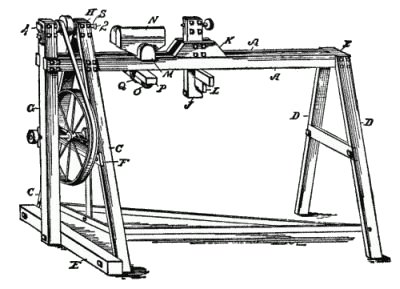 Fig. 245.
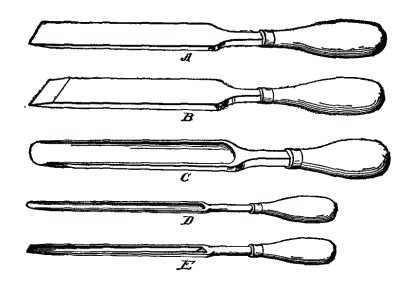 Fig. 246.
It may be observed that in wood-turning sharp tools are absolutely necessary, hence a good oil stone, or several small, round and V-shaped stones should be used.
Continue to:


My Books

