


Special Tools And Their Uses. Part 4
Description
This section is from the book "Carpentry for Boys", by J. S. Zerbe. Also available from Amazon: Carpentry for Boys.
Special Tools And Their Uses. Part 4
Dovetail Tongue And Groove Plane
This is a very novel tool, and has many features to recommend it. Figure 280 shows its form, and how it is used. It is designed to make the dovetailed tongue as well as the groove.
It will cut any size groove and tongues to fit with sides of twenty degrees flare, where the width of the neck is more than one-quarter of an inch thick, and the depth of the groove not more than three-quarters of an inch. The tongue and groove are cut separately, and can be made with parallel or tapering sides. The operation of the plane is very simple.
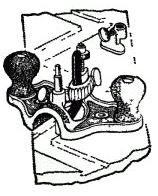 | 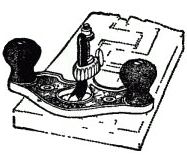 |
Fig. 281. | Fig. 282. |
Router Planes.
Router Planes
This is a type of plane used for surfacing the bottom of grooves or other depressions parallel with the general surface of the work.
The planes are made in two types, one, like Fig. 281, which has a closed throat, and the other, Fig. 282, with an open throat. Both are serviceable, but the latter is preferable. These planes will level off bottoms of depression, very accurately, and the tool is not an expensive one.
Door Trim Plane
This is a tool for making mortises for butts, face plates, strike plates, escutcheons, and the like, up to a depth of 5/16, and a width of 3 inches. The principal feature in the plane is the method of mounting the cutter, which can be instantly set to work from either end of the plane or across it.
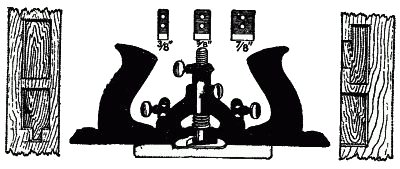 Fig. 283. Door Trim Plane.
The cutter, as shown in Fig. 283, is cushioned by a spring which prevents taking a heavier chip than can be easily carried. A fence regulates the position of the cut and insures the sides of the cut being parallel. The depth of the cut is governed by a positive stop. By removing the fence and locking the cutter post with the thumb screw, instead of using the spring, a very superior router plane is obtained.
Continue to:


My Books

