


Jacobean. Part 2
Description
This section is from the book "Style In Furniture", by R. Davis Benn. Also available from Amazon: Style In Furniture.
Jacobean. Part 2
The most elaborate of all the pieces are the cupboard, cabinet, or press, Fig. 4, Plate I.; the "Bread-and-Cheese" cupboard, Fig. 4, Plate II.; and one or two other similar types; and even they are free from all constructional difficulties, save such as are mastered in the A B C of the craft. It will be clear, then, that but very little study will enable anybody possessed of average intelligence to master quickly the general forms of the Jacobean "carcase." The next step is to acquire an equally complete knowledge of the ornamental detail, carved and inlaid, by the addition of which it was determined, in the old days, that those forms should be rendered pleasing to the eye. Here our task becomes somewhat more varied, and calls for more extensive study, though it cannot even then be regarded in any sense as difficult.
The importance of the part played by the oaken chest in the sixteenth and seventeenth - century home has been so strongly insisted upon in my introductory review that, in considering which of these household gods to deal with first, we cannot do better than fix upon this honourable and honoured ancestor of so many modern articles. I have been exceptionally fortunate in securing a goodly variety for examination, so that every type that can be regarded as in any degree characteristic is represented in one or other illustration. Of these I may say at once that they are, without exception, made of oak, and that the enrichment is almost invariably carved, though it is, in rare instances, relieved by a touch of inlay here and there.
With regard to this carving, a word or two as to classifica tion may be given at this stage. Much of it is of the description technically known as "flat"; that is to say flat surfaces predominate in the design, being thrown into relief by the spaces round and between them having been gouged-out, or "sunk," by means of the gouge or chisel - as, for example, in the chest portrayed in Fig. 3, Plate I. Much more is of the "modelled" type of carving, as in the chest, Fig. 5, Plate I.; but none ever projects beyond the general surface of the article so decorated, or, rather, it is very rare indeed for it to do so. In order to keep to this rule, the carving, whenever employed in very high relief, was almost invariably sunk deep into the panels, so that even those details which stood out most prominently from the ground were still- on, or below, the plane of the surface.
"Jacobean." III. Plate 10
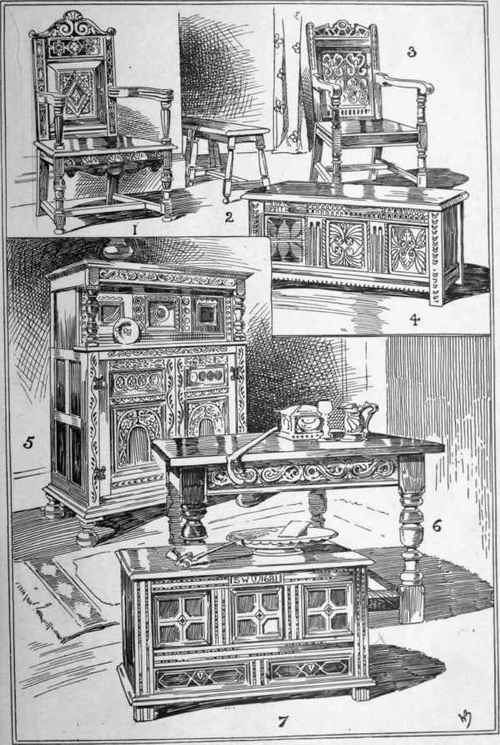
Reference In Text
Page | ||||||
Fig. | 1. | See | 43. | 44 | 54. | 55 |
" | 2. | " | 64 | |||
" | 3. | " | 43 | 44. | 48 | |
Page | ||||||||
Fig. | 4. | See | 42, | 43 | ||||
" | 5. | " | 43. | 44. | 45. | 46, | 48. | 52 |
" | 6. | " | 44. | 64 | ||||
" | 7 | " | 49. | 51 | 52 | |||
Over and above these two classes of carving, the chisel and gouge, more particularly the latter, were employed in yet another way, producing a result fairly effective, it is true, but one which the skilled manipulator of the tools will hardly dignify by the appellation "carving." The method adopted may be described as follows: The design to be executed, consisting usually of simple leaves and stems, was roughly sketched in upon the wood to be ornamented, and, that having been done, the lines of it were merely cut in, or incised, with a vigorous hand, so that, instead of standing out in relief, as in ordinary carving, they did just the reverse. This produced what is now styled "scratch carving"; and as it was very easy to execute, and cost but little, its employment was most extensive. It really belongs, in a measure, to the same school, technically speaking, as the monotonous "chip carving" over which so many ladies at the present day spend time which might be much more profitably employed, and with such painfully feeble and uninteresting results. But the old work is far more vigorous and pleasing than its modern descendant.
Having made a note of the foregoing explanation, let us observe now how these various kinds of carving actually look in situ; and we will study them first in the dated example which appears in Fig. 5, Plate I. This chest, as indicated by the date, "1611" - and the indication is true this time - is very early "Jacobean," having been made but eight years after the accession of the first of the Stuarts; yet it is quite distinctive in character, and has little of the "Elizabethan" feeling about it. In the five smaller panels we have carving of the "modelled" type, though of a most simple description, and in very low relief. The panels above, with their diamond patterns, furnish us with examples of the "flat" carving already referred to; and the enrichment in the frieze above that, and down the two front ends, is incised. Beneath the panels is a long, thin strip of carving, of a class exceedingly simple to "cut"; yet it comes out most effectively, and was very largely used at the period of which I am writing. Two lines, parallel to one another, were incised; the long, narrow strip of wood between them was then slightly "rounded-off," and so made to resemble what is technically known as a "reed"; in this a succession of notches on the slant was made, as indicated. This gave a spiral effect, much as if a long, thin shaving, or a long "corkscrew curl," had been let into a groove. A similar treatment was often adopted on the corners, or angles, of cabinet work; as, for example, on the lower edge of the "Court Cupboard" on Plate VII. Again, while writing of incising, I may point out the simplicity of the means employed to "break-up " the long space just below the diamond panels, which is nothing more nor less than a succession of "digs" with the gouge. Yet it serves its purpose. The chest we are at present studying is a rather ornate example, but not by any means unusually so. A still more elaborate one is pictured in Fig. 3 above, in which we find a greater variety of enrichment, though no essential difference in general character. The detail, however, in this case, is more closely allied to the Italian than is that of the former, the repetition of double foliated scrolls," tied" together, reminding us strongly of the "Cinque-Cento"
Continue to:


My Books

