


Elizabethan
Description
This section is from the book "Style In Furniture", by R. Davis Benn. Also available from Amazon: Style In Furniture.
Elizabethan
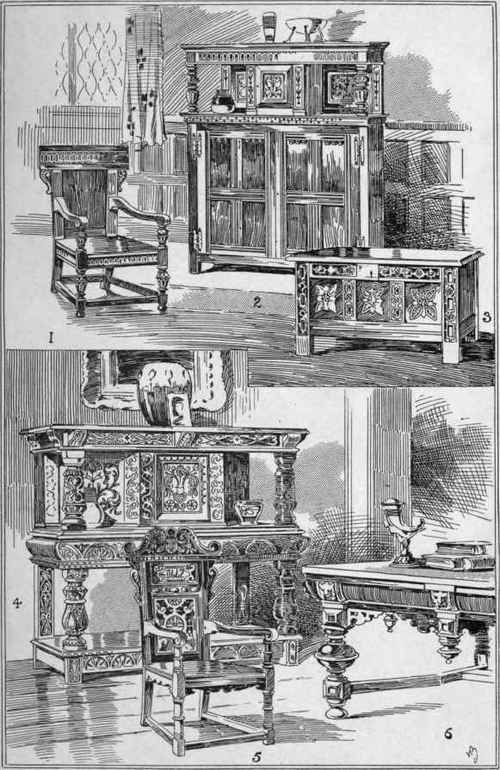
Now that we have completed our general survey of the influences at work to render the English furnishings of the greater part of the seventeenth century what they ultimately became, it is time that we should analytically examine representations of typical examples, which will enable the reader to acquire sufficient knowledge of the form and detail portrayed to decide, without any great degree of hesitation or difficulty, as to the approximate date of any old piece belonging to this period. To the "Elizabethan" we shall look first, making that the starting-point for our studies.
Those who still retain sufficient recollection of their schooling to recall the fact that their cordially detested "dates" included the item, "Queen Elizabeth, 1558-1603," will, if they have followed the preceding pages carefully, deem it somewhat strange that I have classified this style with those of the seventeenth century. I will, therefore, recall the fact that the "Elizabethan" did not attain its full development until after James the First had ascended the throne. It is, of course, true that the style was originated during the earlier reign, and, indeed, was assiduously cultivated in the days of the "Virgin Queen," but it was then young, and had not had time to arrive at full maturity.
I have explained that of furniture actually designed and made prior to the commencement of the seventeenth century, comparatively little remains, and what has been handed down to us in any state of preservation is most jealously guarded in a few private collections, and in national museums. Any aspiring collector, therefore, who entertains the hope of encountering specimens in out-of-the-way dealers' shops or auction salerooms may regard himself as almost inevitably doomed to disappointment. Even to the vast majority of students they are equally unavailable. As a natural consequence, most of us must rest content to note the lines of this furniture from such pictorial illustrations as we may be able to obtain, and even they are few.
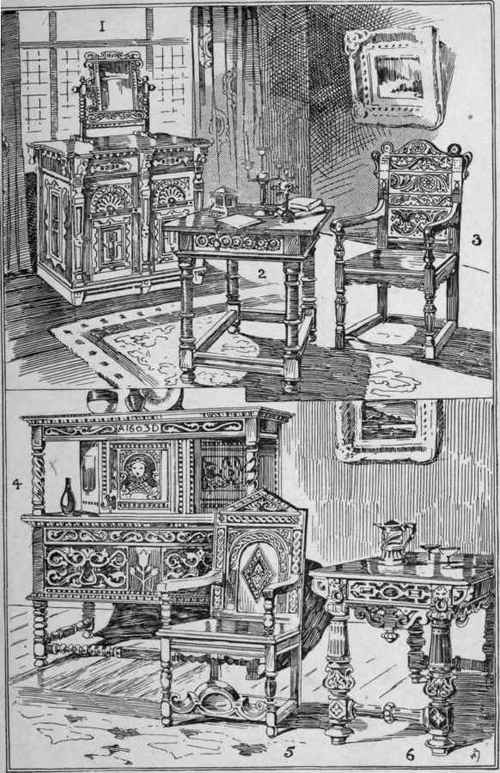
Reference in Text - Page Fig, 1. See 34 Page Fig. 4. See 30, 31
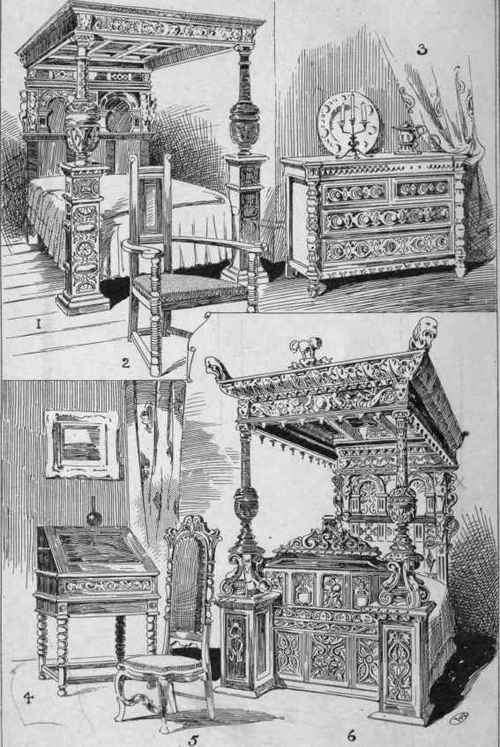
Passing on to our examples, and leaving out of our calculations interior architectural woodwork - joinery, wall-panelling, and the like - we shall see that the most complete object-lessons perhaps in "Elizabethan" carving and ornamental detail generally to be found are the stately and elaborate "four-post" bedsteads - "tester" beds - which have withstood the wear-and-tear of centuries, and bear testimony to the grandeur of the stately homes of England of the days when Drake was scouring the seas in pursuit of glory or booty; when Raleigh was revealing to his friends the mysteries of the pipe and the potato; when Essex was composing his sonnets to his royal mistress; and the "Immortal Bard" was moving the people to laughter or to tears by the magic of his wondrous pen. With the bedstead, therefore, we will seriously commence our analytical and comparative study of this period.
Speaking of old furniture whose interest is supposed to be enhanced by some particular association, it is said that Charles Dickens, in a letter to a friend who was an ardent collector, stated, with mischievous glee, that he had discovered a veritable "find," in fact no less a treasure than a chair which "the Duke of Wellington had positively refused to sit in!" But, if we are to place credence in the histories that have accumulated round the sixteenth, and more particularly seventeenth-century bedsteads treasured i in country houses throughout the kingdom, it would be difficult, if not almost impossible, to meet with a single one which Good Queen Bess had refused to sleep in! One and all appear to be honoured on account of the cherished and cumulative tradition that they constituted, at one time or another, the resting-place of that sovereign's precious and august form.
If all these traditions be accepted as true, we must come to the conclusion that this monarch cannot possibly have enjoyed many waking hours over and above those occupied by her travels from one mansion to another. Be that as it may - and the question of the authenticity of such stories does not concern us much - the genuineness of the date and design of the bedsteads is beyond dispute. It will be sufficient for our purpose if we study them carefully as types of style, and leave the verification of the traditions associated with them to others who may be more immediately interested in that question.
In our study and analysis of the ornamental detail of the "Elizabethan," we shall find, as a general rule, that the earlier the date of the piece we have to examine the more refined it will be in every particular. It will bear a closer relationship to the models set up by the Italian and French artists and craftsmen who were brought to this country by the liberality of Henry the Eighth, and by his ministers and court, who desired to enhance the material splendour of his regal surroundings - and of their own at the same time.
It will be remembered that I have pointed out how it was not at all uncommon for French and Italian painters, carvers, and other craftsmen of the highest renown, during the sixteenth century to be paid large sums in order to take up their abode in this country for a space, and work in the cathedrals, palaces, castles, and mansions of royalty and the nobility. Hence arose the English Renaissance, or "Elizabethan," as it is more generally styled; and thus four distinct and most powerful influences were brought to bear in our midst.
First and foremost was that of the pure and unadulterated Italian Renaissance; then that of its French and equally beautiful offspring, the "Francois-Premier," with which came the "Henri-Deux"; and finally the Renaissance of the Netherlands, which played no inconsiderable part in supplying inspiration to the style whose name heads this chapter. That this inspiration was readily and freely drawn from all four sources by the English designer of those times, as well as of succeeding centuries, is amply demonstrated by the work of the period. We sometimes find, indeed, a curious, though by no means unpleasing, combination of the four styles in a single piece of furniture; in fact, this may be noticed to some extent in the bedstead which appears in Fig. 6, Plate I., in this chapter. Let us consider this carefully and in detail.
Plate I "Elizabethan." I.
"Elizabethan." III. Plate 3
Continue to:


My Books

