


Elizabethan. Part 4
Description
This section is from the book "Style In Furniture", by R. Davis Benn. Also available from Amazon: Style In Furniture.
Elizabethan. Part 4
Figure 4, Plate III., calls for no special comment further than that already offered, save that we may note, in passing, the presence of the "strap-work" in the upper turned pillars, and the superiority, regarded from the technical point of view, of the carving throughout. Both pieces, however, may be considered as belonging to approximately the same period.
To return to Plate I. for a moment: the chair sketched in Fig. 2, according to apparently well-authenticated report, once formed part of the worldly possessions of Shakespeare himself, and, so far as I am aware, no cryptogram has yet been discovered in the details of its design to upset that tradition. But, if we view the chair from above, the curve of the arms, taken in connection with the line of the front of the seat, will be seen to form most distinctly the half of a B! I present this important discovery most readily to the Baconian theorists. Can it be another link in the chain? Who shall say?
Reverting, with brevity, to the subject of turning as employed in the construction of chairs, the type illustrated on the opposite page is not infrequently found in the Elizabethan, and later, Jacobean mansions. But, more often than not, it was imported from abroad, and cannot be regarded as a home production. We sometimes see such chairs as these described as " Elizabethan," but their only claim to that description is to be found in the fact mentioned, viz.: - that they won a certain amount of favour in this country during the reign of the sovereign after whom they are thus named. Even if some were actually made here, they were Italian, or Flemish, in form and detail nevertheless.
Figure 5, Plate I., I must deal with in my next chapter, as it belongs to a much later period; so, indeed, do Fig. 5, Plate II., Figs, 1, 2, 3, and 5, Plate III., and the tables and chairs on Plate IV. Some of these, notwithstanding that they are later as regards date than the types we have been studying, retain "Elizabethan" characteristics, and, for that reason, they are not out of place here. This is specially the case with the massive arm-chair, Fig. 5, Plate III., with its "strap-work" carving in the back; and with the chair above, with its tastefully enriched turning. Of these I shall say more byand-bye, and I will conclude my remarks on individual examples of the style with brief reference to the cupboard that appears in Fig. 1, Plate II. In my opinion this is Flemish work; or, if not exactly from the Netherlands, it is a remarkably faithful copy of a Flemish original. The style of the panels, with their projecting "lozenges" in the centre; the semi-circular "shells" in the arches above them, and the little turned knobs, "drops," or pendants so freely introduced, taken together with the "building-up" of the pilasters, tell at once of the country of their origin, and mark the design throughout as essentially Flemish. The example itself is only introduced here in order to show the closeness of the relationship which subsisted between the Renaissance of Flanders and that of our own land.
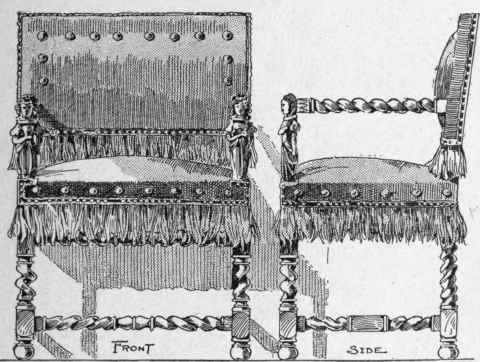
Chair of Italian Type (Not infrequently found in "Elizabethan" and "Jacobean" Interiors) (See page 66 for reference)
In bringing this chapter to a close, I shall invite my readers to study, for a brief space, a scheme of interior woodwork which will enable them to conjure up in their minds a more complete picture of the inside of the old Elizabethan mansion as it actually was than they could do through studying mere isolated examples of furniture.
The truly beautiful room of which a corner is limned on Plate IV. originally constituted one of the principal charms of Sizergh Hall, or Castle, in Westmorland. The whole of the joinery and panelling came into the market a few years ago, and was purchased for the nation by the Science and Art Department for the comparatively small sum of one thousand pounds. It was re-erected in one of the courts of the Victoria and Albert Museum, South Kensington, where, fortunately for all lovers of fine old craftsmanship, it may now be studied at leisure, and its charms appreciated to the full. The authorities of the Department displayed the best judgment in making this acquisition, for the panelling in question is not only most interesting and valuable as an object-lesson in late sixteenth-century structural woodwork, but is also an exceptionally fine practical demonstration of the possibilities of pure "Elizabethan" marquetry, of which not any too much has been preserved. The panelling throughout, with the exception of the inlaid detail, is of oak; and the general structural scheme, with its graceful pilasters, surmounted by Ionic capitals, and colonnade of arches within arches, is wholly Italian in character, Italian, moreover, of the best period of the "Renaissance." In the long broad bands of the enrichment, which is in holly and bog oak, the effect is more than a little suggestive of the sgraffito, which was employed so extensively by the architects of the "Quattro-Cento" and "Cinque-Cento" for the external decoration of their buildings. The frieze of this room, in the old days, was, without doubt, of modelled plaster; and it is more than likely that the ceiling was decorated by means of the same medium. Time has, of course, considerably darkened the tones of the woodwork; but, in its original state, with the black bog oak and almost white holly, standing out in contrast to the oaken "field," the effect must have been delicate and charming indeed, and very different from that of the sombre interiors usually associated with the period. The long panels with the diamond-shaped centres have the "strap-work" feeling, but the detail is more free and less conventional in treatment than actual "strap-work" usually is. This panelling is of a character so exceptional that I have deemed it worthy of being presented to greater advantage than is possible in complete interior form, so on Plates V. and VI. it will be found drawn to a larger scale. The reader, therefore, will experience no difficulty in marking even the minutest characteristics, and will gain a truer conception of the beauties of the whole scheme. All the furniture in this room, apart from the bedstead, which has already been discussed, is of a period later than that to which the panelling belongs, and represents various phases of a style which we must consider in the next chapter. Another fine Elizabethan interior is illustrated on Plate VII. This may be seen in entirety to-day in "Ye Olde Reine Deere" Hotel, at Banbury. A cast of the ceiling is in the South Kensington Museum.
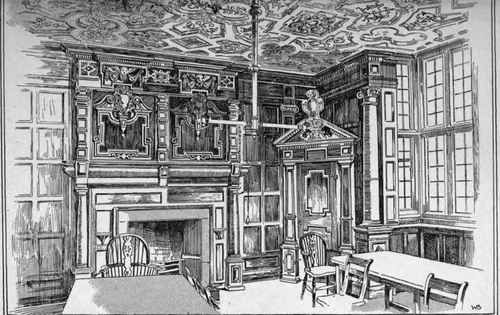
Sixteenth-Century Room In Ye Olde Reine Deere Hotel, Banbury - Reference in Text. See page 35 - "Elizabethan." VII. Plate 7
Continue to:


My Books

