


Turkish And Russian Rug Types
Description
This section is from the book "Home Furnishing", by George Leland Hunter. Also available from Amazon: Home Furnishing.
Turkish And Russian Rug Types
Oushak, with a population of over 100,000, is one of the most important rug-weaving centers in Turkey. As at Tabriz and Sultanabad the industry is principally under European control. The large, thick, coarse rugs woven here, with wool filling and warp, are sold in several qualities under various names - Kermans, Ghiordes, Yaprak, Sparta, Gulistan, Enile, etc., some in Persian, some in Turkish, and some in European designs. Prices per foot range according to the fineness of weave and intricacy of pattern from seventy-five cents for Ghiordes rugs to $4 for Sivas rugs. The colors are strong greens, green-blues, reds, maroons.
Anatolia is another name for Asia Minor. Under the name Anatolian are sold small odds and ends of every variety of Turkish weave. Imperfect pieces 2 x 4 or smaller are sometimes offered as low as fifty cents a foot.
Ghiordes, home of the Ghiordes knot that ties the pile of most Oriental rugs - the other rug knot being the Sehna - and said to be Gior-dium, the home of the knot that was cut by Alexander the Great, is a Turkish city which has long been famous for prayer rugs. Ghiordes antiques are among the most cherished pieces in European museums. The contrast of the solid-blue - or rich red, or pale yellow - arched field, with the alternating colors of the border stripes, is fascinating. Florals - in form mid-way between the straight lines of Caucasian designs and the curves of Persian - break up the border stripes into tiny blocks of color that balance in a wonderful manner. Reproductions of antique Ghiordes, Kulah, Melez, Bergamo, Ladik and other small Turkish rugs that had a high reputation in the past are still produced, but are often inferior in quality of wool, fineness of weave, and delicacy of coloring. Ghiordes antiques sell for from $ 10 a foot up; modern reproductions, from $1 to $3.
Many Americans - some of them in the trade, at that - seem not to be aware that many of the finest Oriental rugs are woven in Russian Central Asia and in the Russian Caucasus. All of these rugs are pronouncedly geometrical in design, with straight-line figures and motifs predominating. This differentiates them definitely from most Persians, and particularly from Ker-mans.
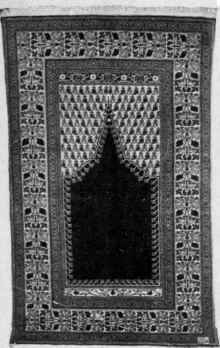
5. A Ghiordes prayer rug, 6 feet by 4 feet 2, at $ 100.
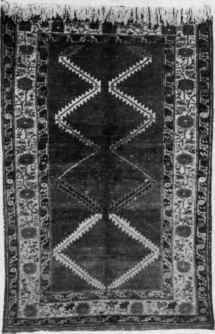
6. A Mosul, 6 feet 4 by 4, at $80.
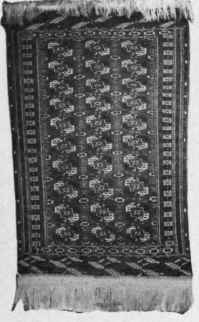
7. A Bokhara, 5 feet by 3, at I30.
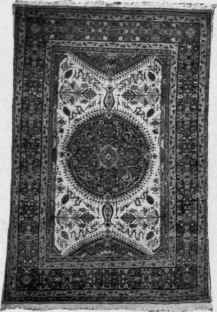
8. A Daghestan, 6 feet by 4 feet 6, at $ 165.
Bokhara, capital of the Khanate of Bokhara in Central Asia, north of Afghanistan, was merged into the Russian empire in 1868. Bokhara rugs in medium sizes sell for from $3 to $5 a foot and are well worth the money. The wool is of high quality and the pile is short. The web is entirely of wool and frequently extends three or four inches beyond the pile at the ends, where it is finished with long fringe. The weave is fairly fine and the shapes tend toward squareness.
Samarkand, a city in Russian Central Asia, 234 miles by rail east of Bokhara and only a little over 300 miles west of the present Chinese frontier, attained its greatest magnificence at the close of the fourteenth century, as the capital of Tamerlane the Great, who adorned it with the "grandest monuments of Islam." Henry Norman calls it the most interesting city in the world after Athens, Rome, and Constantinople. Samarkand rugs are almost exclusively Chinese in pattern, with fretted field that bears from one to five equilateral or round medallions. In these, Chinese pheasants or dragons or flowers often appear. Yellow, that is as typically Chinese as green is typically Turkish, is the dominant color, with reds and blues that form superb contrasts and harmonies. The web is usually of cotton and the weave is fairly fine. Samar-kands 5 x 9 sell for about $2 a foot.
Daghestan, Kabistan, Derbend, Chichi, Shir-van, Kazak and other Caucasian rugs are woven in the Caucasus, a Russian isthmus six hundred miles wide, between the Black and the Caspian seas, and connecting Europe with Asia. A large part of the territory represents conquests made during the nineteenth century from Persia and Turkey. Just as nature abhors a vacuum, so Caucasian rugs abhor the curves characteristic of Kerman and other Persian rugs. Caucasian rugs represent the highest development of the straight line designs with which primitive peoples always start to interpret nature forms. Here we have mosaic-like patterns that are as interesting as they are intricate, and that occasionally combine symbolism with interpretation - Noah's ark, animals, and human figures not to be mistaken, set in frames that are now purely geometrical, though once also alive.
Both filling and warp of Daghestan rugs are of wool, and the weave is fine. They come only in small sizes - often in prayer-rug patterns - and sell for $2 a square foot. Their usual colors are ivory and grayed reds, blues, yellows and greens, that do not shade into each other but sharply accentuate the preciseness of the tile and trellis effects, stars, squares, hexagons, and other geometrical forms.
Kabistan rugs are finer in weave, shorter in pile, and more interesting in design than Da-ghestans. The color contrasts are less violent, and crude bird and animal shapes are frequently introduced. The individuality of Kabistan rugs is remarkable, exact duplication of pattern being rare. Each is the product of the imagination of a weaver who loves his task. The average price per foot is $3.
Small Anatolian silk rugs, usually with cotton web, bring from $ 1.75 a foot up.
Persian silk rugs, frequently with silk web, bring from $7 to $60 a foot according to fineness, weight and size. I saw a most interesting Tabriz silk rug 10 x 15 feet in the warerooms of a New York importer, which was being held for $ 10,000, and was well worth the money. It is easy to go wrong in the purchase of silk rugs, as there are numerous mercerized and wood silk imitations, many of them not even hand-knotted. These imitations are seldom beautiful and never durable.
Continue to:


My Books

