


Some Persian Rug Types
Description
This section is from the book "Home Furnishing", by George Leland Hunter. Also available from Amazon: Home Furnishing.
Some Persian Rug Types
The finest rugs in the world are woven in Persia. For centuries Persian rugs have been the pride of Shah and provincial governors, and just as in France, at the Gobelins, tapestries of wonderful fineness and surpassing design are woven for the French government, so in the palaces of Persia reproductions of the famous rugs of old, as well as original creations true in every detail to the traditions of a glorious past, are woven without regard for cost as gifts for mosques and for powerful friends, and as treasures to bequeath to posterity.
Some writers have lamented the fact that at the two principal Persian rug-weaving centers, Tabriz and Sultanabad, the industry is under European control. Their lamentations hardly seem justified, inasmuch as it is in these two cities that more has been done to raise the standard of materials, dyes, and designs than anywhere else, and the improvement in qualities has been rewarded by a constantly increasing foreign demand.
To the high quality of Kerman wool is due part of the fame of Kerman rugs, that are also distinguished for boldness and originality of design, in which were formerly introduced birds, beasts and even human figures, as well as flowers, trees and landscapes. To-day the patterns are mostly floral, and the birds and flowers are shown in relief - like the French rugs that they inspired over two centuries ago - not flat as in most other Orientals. The warp is usually of cotton, the filling of wool, the pile short, and the weave fine, the colors delicate but at the same time rich and soft. Large Kermans sell for from $4 to $ 15 a foot, small ones from $2.50 a foot up. Care should be taken not to confuse these Persian Kermans with the Turkish Kermans woven at Oushak, which are of a greatly inferior type. It is probably to avoid this that Persian Kermans are frequently called Kermanshahs.
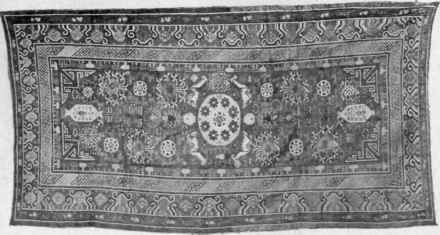
2. A Samarkand, 10 feet by 5 feet 4, at $185.
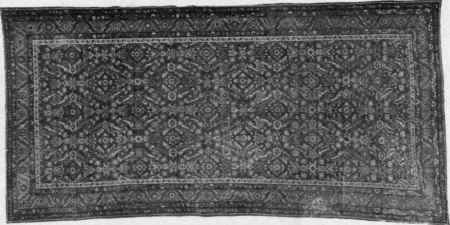
3. A particularly fine Feraghan, 10 feet by 5, at $320.
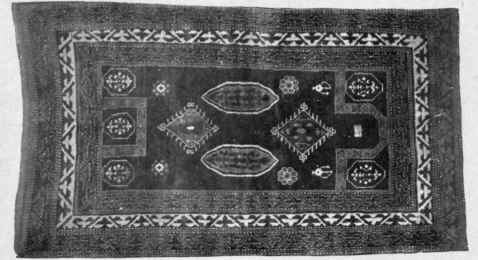
4. A Kazak, 6 feet by 3 feet 8, at $80.
Tabriz rugs come in small and large sizes and are sold for from $ 2.50 to $ 10 a square foot. They are well worth the price, for they excel in intricacy of design and in fineness of weave, the average number of knots to the inch being about 200 - but not infrequently 300 or 400. The wool used to form the pile, and the cotton of the web, are of the best quality; the colors are durable, and the workmanship is of the highest type. For durability they are unsurpassed, although many prefer the softer surface and more pliant body that go with coarser and more loosely spun yarns and longer pile. Tabrizes bear the same relation to other Oriental rugs that Gobelin tapestries bear to Flemish, and while executed with fidelity to the best Persian traditions, show a tendency toward that calculated beauty which is characteristic of the Occident rather than of the Orient. The patterns are brilliantly harmonious, and usually have in the center a medallion on an ivory field, with the corners of the field and the wide borders overrun with florals exquisitely fine in detail. These are florals that do not lose by comparison with those of the finest Kerman rugs from which they draw their inspiration. The colors are delicate pastel pinks, greens and blues.
Sehna is famous for small and medium rugs that excel in fineness of weave. The pile of Sehnas is clipped surprisingly close and the surface is like velvet to the eye. The most usual patterns show a white or ivory field covered with small cones, also called pears, or palms, or river loops, or crown jewels, or flames. The border consists of stripes, of which the middle one is the widest and bears the Herati design - two lanceolate leaves framing a rosette. The dominant colors are red and yellow. Small Sehnas are worth from $2 to $6 a foot.
Modern Feraghans, named after a Persian province near Sultanabad, sell from $1 to $2 a foot, and are of coarse weave, with pile of medium height, and with cotton warp and filling. The Herati design is characteristic of the field, and the dominant colors are dark green, blue and red.
Continue to:


My Books

