


The Regency And The Periods Of Louis XV And XVI. Part 3
Description
This section is from the book "Interior Decoration: Its Principles And Practice", by Frank Alvah Parsons. Also available from Amazon: Interior Decoration: Its Principles and Practice.
The Regency And The Periods Of Louis XV And XVI. Part 3
The period of Louis XIV embraced this naturalistic idea, and the period of Louis XV used it in the expression of the social ideals for which the period stood. Very natural gardens of flowers, very suggestive cupids, very naturalistic lords and ladies and very intimate ceremonials were combined with the rocaille motifs, particularly in tapestries, paintings and the decorations of pottery.
Even on fans, snuff boxes, buttons and other small articles are found, handled in the most extraordinary and delicate manner, naturalistic pictures whose charm lies in the delicacy of their treatment, the exquisite garments which are represented and the spirit of the time which they so clearly reflect. When examined from the standpoint of decoration, they of course lack the fundamental qualities of the decorative idea, except as it appears, in this extraordinary period, to be in harmony with the other modes of expression.
In colour the period of Louis XV presents a considerable range of choice. In tapestries the backgrounds are light and are worked with the idea of background effect. Upon these appear various human incidents, flower forms and other motifs in a pictorial way. The general effect is not very dark or very light, but somewhere around middle value. The period, however, is more generally expressed in brocades of gorgeous colours and wondrous weaves, and in taffeta and damask whose quality and texture bespeak the same refined and extravagant sense. A printed linen was also made, which, when contrasted with the same material in England, gives one a keen sense and appreciation of the qualities in this period of Louis XV. These, like tapestries, seem to present a value a little above or a little below middle, never strong and rugged, seldom weak and insipid.
The hues of colours used are inexhaustible. It is the French period for the development of colours. There seems to be the widest range of colour choice of any period in France, and probably of any period of human expression. This is due probably to extravagance in all fields, to the desire of each person to outdo his neighbour, and to the fact that nature, to be at all ade-162 quately expressed, requires the whole range of the colour spectrum.
The colours of this period are quite intense and have a life and sparkle which is softened wonderfully by time and sometimes by the combinations of the colours themselves. A certain vitality and imaginative effect is presented which make textiles of this period particularly interesting to study.
Much, very much, might be said of the development of smaller decorative articles. Their name is legion, their varieties innumerable; but they, one and all, seem to owe their existence to the same underlying ideas, and each undoubtedly expresses as nearly as possible the answer to a demand. This is what every art object in every period does if it submits to the influence of the period. In summing up this period of Louis XV it is per-haps sufficient to say this is the social period of French art in which two centuries of national life find their full flower in an art expression which combines the weakness and the strength of the system which it represents. When seen purely from an artistic stand-point, no period in France, and few in history, contribute so clearly defined an elemental force for design and composition; few periods are less suited to modern use except through adaptation, and few in selective quality are so little understood.
This, too, is a style in which the power of keen discrimination is the key to successful use. This discrimination must come not from the acceptance of all things in the period of Louis XV as good, but from a most intimate knowledge of what is being expressed and how it has been done. One must never fail to reckon with the forms, the scale, the material and the colour, in their various combinations as they relate to the aesthetic ideal. He must compute their value and, knowing his own problem, use with the utmost discretion these subtle forces to express subtle ideas. These ideas are generally out of place when seen in huge groups or entirely by themselves, but, when commingled and interrelated with others, may form one of the most pleasing of all period suggestions.
The period of Louis XVI, from 1774 to 1793, perhaps developed its fundamental idea more radically than any other in so short a time. During the period of Louis XIV two fundamental impulses or strains of domination are clearly defined, namely: the classic and the naturalistic. These were fused into a unit in which the latter is prominent in the decorative scheme and the former in the architectural idea. The period of Louis XV expresses the culmination, decline and extinction of this idea as used for merely sensuous exploitation.
The period of Louis XVI stands for the fall of this ideal and the restoration of the classic to first place in the decorative field, which was the place it always had held in French architecture. At the death of Louis XV the people of the French court were surfeited and debauched by pleasure, and their very nature cried out for rest and change. The finances of the country were drained by reckless extravagance while money for increased splendour was not forthcoming. The people were in no frame of mind to submit to further taxation or to continue the old methods of supplying the royal treasury. Dissatisfaction was rampant not only in Paris but in the outlying communities, and murmurs of revolt were not infrequent before the accession of Louis XVI.
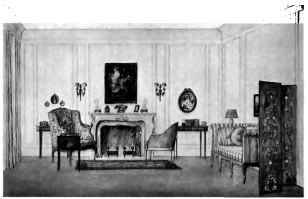
SKETCH FOR A MODERN DRAWING-ROOM WHOSE BACKGROUND TREATMENT AND CAREFULLY SELECTED FUR-X1KIIIXOS CREATE A CHARMING UNITY IS THE USE OF LOUIS XV AND XVI STYLES.
Continue to:


My Books

