


The Principles Of Form And Their Relation To The Decorative Idea. Part 5
Description
This section is from the book "Interior Decoration: Its Principles And Practice", by Frank Alvah Parsons. Also available from Amazon: Interior Decoration: Its Principles and Practice.
The Principles Of Form And Their Relation To The Decorative Idea. Part 5
It sometimes happens that a round table must be used in a room. This is possible from the standpoint of function, in the dining-room, if over the table there is a decorative circular ceiling treatment, a circular chandelier - if chandeliers are used - or a curve-lined rug which may help to harmonize such a table with the straight-lined floor effect. In this case the colours chosen should be such that the transition in shape from table to floor will be less apparent because of the rug. If, however, the transition created is hard and apparent, then the rug pattern would better be of the floor shape since it gives no help in harmonizing unrelated forms.
It may not be necessary to mention that a square lunch cloth on a round table is less harmonious than a round one, or that a round one on a square table is less harmonious than a square cloth. There are many other interesting applications of this rule to every article that may be decoratively used, but the reader will find interest in detecting things for himself and correcting the wrong usages as fast as the right ones seem better to him than the wrong ones.
The second application of this principle, that which relates to consistent size, is more difficult to treat in a limited space. It has taken centuries for the Japanese to produce a national consciousness in which the feeling for the best and most subtle relationships in size is intuitive. The Greeks gave one thousand years of concentrated thought to finding the best way to develop ideal pure form, not only in the human figure, but in all phases of expression. This people, whose God was beauty, and whose beauty was truth in its highest form, presents, as no other people ever has, the tangible effects of a nation working unitedly for a common end - namely, the realization, intellectually, of pure form.
The Greek ideal brought out an art expression, particularly in architecture and ornament, whose essential principles have been fundamental in the development of all succeeding expression, except perhaps the Gothic, which is the result of an entirely different ideal. So effectually was their scheme of education planned from youth to old age, and so carefully was the religious, political and social fabric woven, that these people became imbued with the one idea of creating beauty, which was the expression of divinity in its noblest form. To create or use an ugly thing was impossible with this code of life. Because of the psychological result which followed such training, the subtleties in shape and size of parts expressing a whole are still the criterion for architects and constructional designers in all fields of expression involving the classic idea.
From buildings, architectural details, ornament, sculpture and the lesser crafts has come, quite consciously through the Renaissance, down to us the Greek relations in size which really furnished the key to their special excellence.
Greek art, unlike that of other nations, is not an emotional one in which forms, lines and colours excite the aesthetic sense without thought; every size, shape and arrangement is the product first of an intellectual calculation. That is what has made it possible to get at, somewhat scientifically, the relationships in size which made the Greek objects standards upon which other nations have based their ideas of proportion.
In the days of the High Renaissance in Italy Leonardo da Vinci and other great artists worked out, by measurements and by copy and by analytical and synthetical methods, certain statements of proportion which are helpful in modern times. One in particular has been known as the Golden Mean, the Greek Law, the Greek Deduction or the Ideal Proportion.
This, of course, is an abstract idea, and to abstract spacing applies in finding out interesting relationships. This statement of proportion originated in the ratio of the diameter of the top of the Doric or Ionic column to the diameter of its base, in the relative widths of spaces in the frieze of the Parthenon and other Greek temples, in . the proportions of the various well-known ornaments, the vertical to the horizontal proportions, and even to the calculation of the proportions of the ideal human figure.
Exact divisions, like the half, third, fourth, eighth, etc., are mechanical, are easily measured in inches, and easily grasped by the mind. Having no subtlety they lack the one feature that stimulates the imagination and lends interest to the object.
The idea of variety, which is a consistent one, is fundamental in all artistic things. Training in schools or in business, which leads to a constant creation, in any field, of purely mechanical things, blunts and stunts the aesthetic perception, destroying the ability to enjoy subtle relationships.
The first point to note in this law is the fact that mechanical divisions are not artistic ones. That halves, thirds and fourths are mechanical ones, and therefore, monotonous, so that the habitual consideration of them must result ultimately in a loss of power to appreciate more subtle ones.
The second step in the evolution of the idea reveals that in the case of two objects, very unlike in size, each becomes more pronounced because of its association with the other. A very tall man seen with an exceedingly short one not only seems taller than he otherwise would, but by comparison makes the short man seem shorter than if he were seen by himself.
Wherever these great contrasts occur, the mind fails to make any comparison between the two objects, sees no relationship whatever, and fails to feel satisfied. If they are totally unrelated they cannot be a part of a unit or a whole. The applications of this idea are legion in the choice of articles for the furnishing of a house.
The third step is the perception of when it is that sizes or areas are nearly enough alike to be easily compared by the mind and sufficiently differing in size to be interesting because of their difference. This is the most vital point in the evolution of the idea.
If a vertical oblong, say four and one-half inches high and two and three-fourths inches wide, is drawn and divided exactly in the centre by a horizontal line, two areas are created which are monotonous, mechanical and uninteresting. On another oblong of the same proportion a horizontal line may be drawn five-eighths of an inch from the bottom. Two areas will be created which are incomparable, inconsistent, unlike in their direction and inartistic in their feeling. If a third ob-74 long be drawn and the exact centre of the right-hand edge found, so that the right-hand vertical line is divided into two equal parts, then this same line divided into thirds, we have a basis for a horizontal-line division which will result in subtle and interesting areas for comparison. Select a point somewhere between the half and third. It must not be a point exactly in the centre between the two, nor one which would divide the figure into thirds or quarters. The division must come at some uneven distance between the half and third. Then draw a horizontal line dividing this oblong into two areas which are not equal, but which are so related as to seem comparable when seen together.
FIG. I.
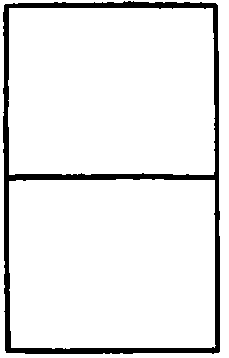
FIG. II.
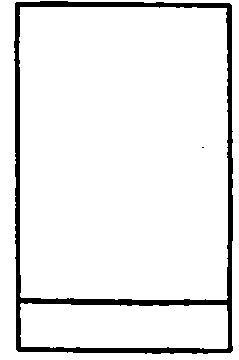
FIG.III.
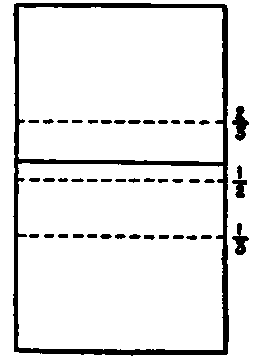
I. Two areas equal and monotonous II. Two areas unrelated and incomparable III. Two areas subtle, comparable and interesting.
These area divisions may be used in many ways in designing facades of buildings, in the interior panelling of houses, and parts of doors and windows. They should be considered also with reference to the relations of these to each other, to furniture and its proportions and to decorative motifs as they are used upon any furniture or textile.
The Greek law of areas or lines may be approximately stated in these words: "Two areas or lines are comparable, interesting, subtle and desirable when one of them is between one-half and two-thirds the area or length of the other."
Any one interested in seeing the application of this idea to concrete things will find plenty of opportunity for comment and disapproval in the relation of windows to wall space when function would admit of a different arrangement; in the placing of plate rails in a room; in the widths and positions of dadoes; in the bands of rugs; in rugs as they relate to floor space; in panels on cabinets, chests and other articles of furniture; in motifs whose parts are totally unrelated because of badly chosen sizes; in dishes, in lamp bases with their shades, and other articles in every room in which the owner has never given a thought to subtle relationships. If more than two sizes are compared a ratio may be established between the smaller of the first two compared and a third size which is to be used.
One of the most pleasing and simple applications of this rule is seen in a well-margined book page where the law of optics requires the widest margin at the bottom, the next at the outside, and narrower ones at the top and inside, thus presenting four well-related sizes in a field in which every one is interested and where the most uncultivated can see the result and sense its correct application.
We might extend the discussion to the relation of the size of the table cover to the table top, the position of the band to the edge of the china plate, or to any other lesser matters, but for the further application of this principle it may be well to allow the reader to extend his application as far as he can, in the hope of discovering new possibilities in realms not mentioned in the text.
Continue to:


My Books

