


Chapter III. Balance And Movement
Description
This section is from the book "Interior Decoration: Its Principles And Practice", by Frank Alvah Parsons. Also available from Amazon: Interior Decoration: Its Principles and Practice.
Chapter III. Balance And Movement
SPEAKING from the standpoint of appearance as it expresses rest, repose or artistic skill, no one term means so much as the word balance. In fact, the arrangement of colour tones, forms and lines in a perfectly balanced scheme will always result in the appearance of just these qualities named. It is difficult at first to appreciate how important this element is in room arrangement.
The term balance means a perfect equalization of attractions, whatever the attractions may be, if they make an appeal through the sense which transmits them to the mind. The feeling for this quality is an instinct, inherent because man is a part of a created whole in which there are general laws touching every element of the universe.
The law of gravitation plays a certain part in optical effects, and this attracting force, pulling all matter in a given direction, is one of the influences that affects the nature of man. This term attraction applied to the sense of sight is balance. Where a perfect balance exists one experiences unconsciously a feeling of satisfaction which comes from a sense of rest and repose through finished action.
Balance, then, may briefly be defined as that principle by which an equalization of attractions is obtained, or by which a sense of rest, repose or finished movement is produced. The feeling resulting from balanced conditions has in it the quality of rest and satisfaction because nothing further having a sense appeal of attraction is presented to the mind.
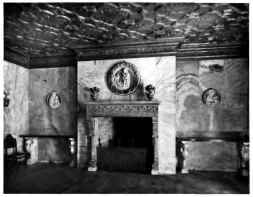
DECORATIVE TREATMENT EXPRESSINC; SIMPLICITY, DIGNITY, FORMALITY AND ELEGANCE. BISYMMETRIC ARRANGEMENT (SIMILAR OBJECTS AT SIMILAR DISTANCES FROM THE VERTICAL CENTER) ACCENTUATES THESE FEELINGS. NOTICE THE CHARM PRODUCED BY CIRCULAR DECORATIVE MEDALLIONS; THEIR LINE BEING REPEATED IN THE VASES, CEILING. BENCHES, ETC.
There are two types of balance which may be described.
The first type of balance is known as bisymmetric. If a side wall entirely covered with one-tone wall paper has a vertical line drawn through its centre from top to bottom, this vertical line may be said to be the balancing point for all objects right and left of this line in relation to the wall space. So long as the wall is covered with one tone, no other thing appearing upon it or against it, it is in a balanced condition. That is, there is nothing on one side which makes a stronger appeal for attention than there is on the other. If one but drives a nail at the right of the line, and centres vision on the balancing line, he is at once invited by the presence of the nail to transfer his attention from the line to the nail.
If this nail becomes a picture, an ornament, an object of furniture or a person standing against or adjacent to the wall, the desire to give attention in that direction is increased proportionately to the attractive qualities of the object under consideration.
Returning to the first statement, in which a nail is placed at the right of the centre line: I shall restore the equilibrium and again find my wall balanced if I drive a nail of the same size, shape and colour exactly as far to the left of the centre line as the first one was to the right of the same line.
If my purpose in driving these nails is to arrange upon the wall two pictures, I find in placing one at the right I have again, notwithstanding my nail, completely unbalanced the wall; that is, there is something on the right that by its shape, size, colour, position and human appeal bids me look, become interested, and remain attentive.
Again, because I have placed a material thing on the right of this line, I have also added more matter to be unconsciously attracted by gravitation to the right side than I have to the left. This again, from another standpoint, unbalances the wall and makes the right side seem heavier or more drawn down than the left. If I wish to restore balance I must place on the second nail at the left a picture exactly equal in attraction to the one placed on the right, bearing in mind, of course, that each nail is as far from the centre line as the other.
The reason for starting with the nail is not, of course, on the supposition that a nail is to become a part of the decorative scheme, but to lead the mind to see that even the nail, should it be left without a picture, or the hole in the wall made by the nail if not properly covered, becomes an attracting force, which may ultimately figure in the destruction of balance on the wall.
This centre line on a wall space is an important thing to reckon with in all cases before attempting to balance the wall. If the wall were again cleared and I should decide to put two chairs exactly alike, each equidistant from the centre line, I should have a balance. If a cabinet be placed on the line so that exactly half falls to the right and half to the left; two chairs, exactly alike, one on each side of the cabinet, equidistant from the centre line and equidistant from the cornice upon the cabinet; a row of three pictures, half on either side the vertical line; at the ends of the cabinet two tall candlesticks, both alike and equidistant from the centre; in the centre of the cabinet a well-chosen decorative jar or piece of pottery, the wall will balance, having equal attractions in size, shape, colour and texture on each side of the vertical line. This type of balance is known as bisymmetric.
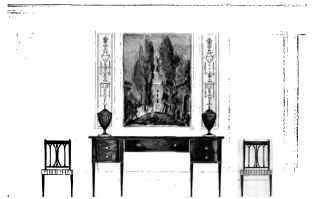
Elevation color sketch OF dining-room, which illustrates subtle relationships in wall spacing also produces the qualities of simplicity, dignity and rest through a disymmetric arrangement of furnishings.
The natural feeling one experiences from this type of balance is one of dignity and formality first. The very fact that one sees on each side of the centre exactly the same forms, colours and textures, makes the mental grasp of the situation easier, and consequently, in the simplest possible way, with the least mental effort, produces the effect of dignity and formal arrangement.
Continue to:


My Books

