


Scale, Motifs And Textures As They Relate To Furnishing And Decorating. Part 2
Description
This section is from the book "Interior Decoration: Its Principles And Practice", by Frank Alvah Parsons. Also available from Amazon: Interior Decoration: Its Principles and Practice.
Scale, Motifs And Textures As They Relate To Furnishing And Decorating. Part 2
A notable example of lack of feeling in scale is the manner in which the tops of tables jut beyond their structural leg formation. Certain periods in the Italian Renaissance have established a projection long enough to seem to be adequate for the scale and height of the table itself. This same strict adherence to scale in its jut may be seen in the roofs of Italian palaces of the same period, notably in those of the Strozzi, Antinori and Riccardi in Florence. These have cornices projecting in a scale charmingly related to the scale of the facade, the height of the building, the material of which it is made and to the general proportions of the exterior of the building.
By comparing Italian tables with those of the Elizabethan or Early Renaissance in England, where the projection is from two to three inches, instead of eight or nine inches, one easily perceives the cut or dwarfed feeling of the top. One gets an impression of lack of material as well as lack of proportion in the top as it relates to the rest of the table.
It is a curious and interesting study to note this one instance of scale relationship through the remainder of the English periods. Starting with the Italian as a basis and taking the Elizabethan as a matter of comparison, let us look at the ways in which the Jacobean period worked out this idea. As the material lessened in amount, in thickness and in scale, the top extended a bit, and a better relation in scale resulted than in the Elizabethan period, where the proportion, so far as the top is concerned, seemed to be entirely lost. In the Queen Anne and Georgian styles one can readily see the effect as each interpreter saw it of the scale relation of the object and the scale feeling of its material influencing the matter of the distance in the extension of the top.
This relation is quite as apparent in cabinets, dressers, chests of drawers and writing tables, which articles of furniture were developed with the need for them as civilization advanced.
With this period illustration in mind, one should examine his own furniture and the furniture of others to see whether in each case he considers every part and detail to be in perfect scale relation to every other part. If some one feature is unduly prominent or so undersized that it loses its functional power or fails to play its part in the construction of a significant form, or to conform to the rule of unity in scale, he will then discover it.
Having looked over each article, one should see these different articles as they relate to each other; and more important still, should consider whether the single articles of furniture are too large or too small for the room in which they are placed.
It often happens that assembling many horizontal pieces of furniture in a room which is as tall as it is wide or long creates a very queer feeling. The same feeling would be created in the room if all the articles it contained were vertical in their effect.
To understand how to make a room look larger or smaller than it is, is to help know how to choose furniture in correct scale relationships - first, to the room itself, and then to every other article with which it must be associated. Constant care is necessary to determine anything like a reasonable standard of scale relationship unless one is trained through years of study by either drawing, measuring or calculating in some way the exact relation of details as they have to do with each other in the construction of any unit.
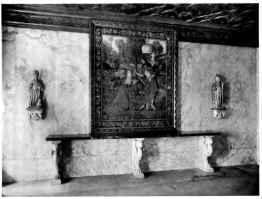
FORMAL, BISYMMETRIC WALL TREATMENT, ILLUSTRATING REST, FORMALITY AND SIM-P1JCITY. SUCCESSFUL EMPHASIS GIVEN THE CENTRE AND BUNCH BY THE SELECTION AND PLACEMENT OF WALL DECORATION. STRUCTRALLY DECORATED.
In analyzing the concept or mental picture one has of any object which he sees or sound which he hears, he is quite likely to forget that consciousness is the result of impressions received in five ways. These five ways, represented by the five senses - sight, hearing, touch, smell, and taste - are the avenues through which our ideas or impressions of external things come.
Some persons see more correctly than they hear; others hear more correctly than they see; many gain a large part of their ideas of objects from the tactile sense, or the sense of touch.
We are quite likely to believe that all ideas come from the sense of sight, if we see more correctly than we hear, or gain ideas more easily that way than by any other. To all persons many ideas come originally through the sense of touch. This fact has given to all visual objects a quality which we call texture. That is, because we have touched a round object some time and acquired the idea of rotundity, we see an object as round, mentally, when one is presented to the sense of sight. The quality of roughness, smoothness, flexibility, rigidity, and similar qualities, were first acquired through the sense of touch.
A burlap cloth looks rougher than an India silk; chiffon looks more flexible than taffeta; oak appears coarser, firmer and more rugged than mahogany or boxwood; olive wood has a silk-faced look; Italian walnut approaches this but still shows traces of grain, making it somewhat coarser because of this.
A tightly woven linen looks and feels firm, more decided, harder, less yielding and less graceful in its possibilities than charmeuse silk, the qualities of which are exactly opposite to those described.
Continue to:


My Books

