


Colour And Its Relation To The Decorative Idea. Part 7
Description
This section is from the book "Interior Decoration: Its Principles And Practice", by Frank Alvah Parsons. Also available from Amazon: Interior Decoration: Its Principles and Practice.
Colour And Its Relation To The Decorative Idea. Part 7
A colour is neutralized by introducing into it as a normal colour the normal complement. In proportion as the complement enters into it, it loses its own natural vital force, and not only holds itself in restraint, but takes on a certain proportion of the qualities of the other two elements which have been introduced into it. The result is a colour neutralized by its complement. See how subtle relationships may become to him who understands grayed or neutralized colours.
Green - a union of light, cheer, coolness, and restraint, harmonized and modified by the proper amount of heat and vigour - becomes a subtle compound of the essential qualities of colour. It expresses one's idea of the dominant position of each in the individual problem which is being worked out.
Due regard to this matter of intensity in colour and its right management is probably the most effective means by which one may use ordinary things, so that their effect shall at least not be aggressive, commonplace, or harmful.
When one-half the vitality of a colour has been destroyed by its complement it is said to be half neutralized. It then has one-half itself plus one-fourth each of the other two elements of colour. Its own idea or quality is still dominant and it controls the quality elements of the other two, but uses them to soften its own appeal.
Colour tones may be less or more than one-half neutralized; in fact, there may be as many tones between a normal colour and a perfect gray as one's eye is able to distinguish, and no more. This process by which the colour loses its self-force by the introduction of its complement is called the process of neutralization.
The application of the principle of intensity to the problem of the house is the same as the application of the value power, except that its relation to the background is even more important than in the case of any other colour quality.
Full, intense colour is the loudest, strongest, most forceful appeal of the idea for which it stands. It should, then, be reserved for the few things which one wishes to make emphatic in any scheme of colour composition. If the vital force of each colour tone is expended on unnecessary and unimportant things, what shall we do about the things to which we would call particular attention?
In music special stress or emphasis of tone is reserved for those chords or passages which must be brought home to the hearer with particular strength. If the full power of an orchestra is expended on introductory, explanatory, and non-essential passages, in what way shall the vital ones receive particular stress? The analogy between this idea and the human voice in talking is easily grasped, and the same idea should be seen with equal clearness in reference to the intensity emphasis in colour appeal as to when and where to use it with effect.
Applied to backgrounds there is one principle that is fundamental and final in any field of expression. "Backgrounds must be less intense in colour than objects which are to be effectively shown on them."
What a revelation in window dressing there would be if persons responsible for them were not more anxious to show an inartistic and ugly grained or highly polished woodwork than they were the modest articles displayed upon this background! Or what a change would be seen if the velvet or velour drapery backgrounds of these windows were not of a colour far stronger in intensity than any of the goods the shopkeeper asks the public to observe.
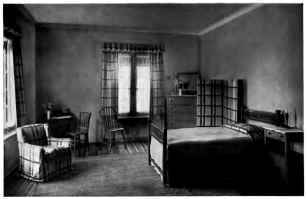
BEDROOM IN COUNTRY INN, WITH SUITABLE WALL AND FLOOR, EXPRESSING REST AND QUIET. CHINTZ IS THE DECORATIVE MOTIF, PRACTICALLY USED AND PLEASINGLY DISTRIBUTED TO GIVE TOUCHES OF MORE INTENSE COLOUR.
The room, particularly one in which people must live, is a very much more important matter. This is true not only because of the qualities which the background of the room must unite but also because decoration of any kind or description becomes impossible unless conditions are right to begin with. Then, too, the room exists in a' house, generally speaking, for people rather than for objects of furniture. This is a consideration to which very few give sufficient weight. During the daytime and evening, in varying conditions of feeling, appearance, and dress, one must be seen by the family and one's friends must be exploited against the background of the room.
Take a soft neutralized tone of yellow, green, or blue wall paper, and upon it place small pieces, one at a time, of the most intense red, blue, green, yellow, purple, and orange silk or paper. See how this neutralized background makes it possible for each small piece of vital colour to do its full work as the expression of a personal idea. Take small pieces of the same colours, a little less intense, and see that it is possible for each of these colours to express its idea while the background does not materially interfere with it. Conceive one's self in the place of these pieces of silk or paper, and it is not difficult to imagine that the result would be somewhat similar.
Reverse this process, and take large pieces of full, intense colours as backgrounds, and upon them try to show small pieces of very neutralized colour tones. It will quickly be seen that these colours not only are of no merit whatever, as colour, but are neutralized or destroyed, at least in part, by the ferocious onslaught of the background idea. This sweeps on, because of its intensity and area, to the utter destruction of everything with which it comes in contact. Furniture, pictures, ornament, and persons disappear and become as nothing when compared with its full intensity.
From this last illustration two other important lessons may be drawn as to the areas or relative areas in which intensities may appear and still express their fundamental ideas.
The neutralized background of a wall with a half intense or even more intense hanging may be used with a small lamp shade, or bit of interesting ornament, or pottery, of a full intense colour, and each have its share of importance. The larger the area, under ordinary conditions, the less intense a colour should be and conversely, the smaller the area the more intense a colour may be, the actual degree of intensity, of course, depending upon the amount of stress or emphasis one is willing to give that particular thing.
Continue to:


My Books

